

On this page
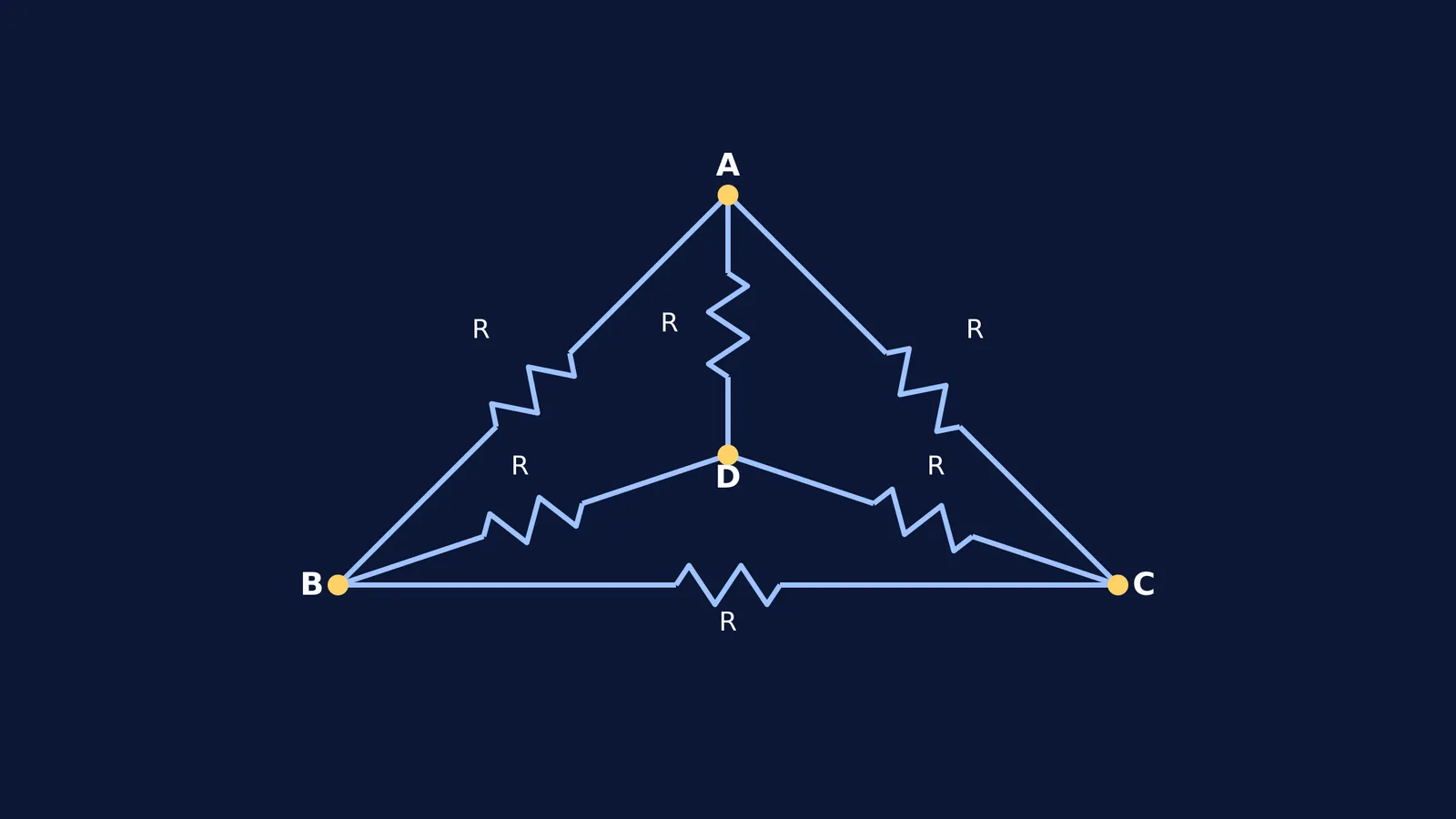
When you first encounter a tetrahedron made entirely of resistors, it looks like a 3D nightmare. With six identical resistors (each of resistance R) forming the edges, finding the equivalent resistance between any two corners seems to require a tangle of Kirchhoff's loop equations.
But physics problems involving Platonic solids are rarely about brute-force algebra. Instead, they test your ability to spot symmetry. By finding the nodes that share the same electrical potential, you can simplify the 3D shape into a basic parallel circuit.
According to the geometric properties of regular polyhedra, if six equal resistors are soldered together to form a tetrahedron, the resistance measured between any two vertices is exactly half that of one resistor (Wikipedia). Here is how to prove it without writing a single loop equation.
Why does symmetry beat brute force?
If you connect a battery across two vertices—let's call them A and B—current flows into A, splits through the network, and exits at B. To use Kirchhoff's laws, you would need to assign currents to all six edges, set up multiple loop equations, and solve a system of linear equations. This process is highly prone to calculation errors.
Instead, you can apply a reliable shortcut based on symmetry. In a perfectly symmetrical circuit, any nodes that sit in identical positions relative to the input and output will have the exact same voltage. If two nodes have the same voltage, no current will flow through any resistor connecting them. This is the exact same principle that balances a Wheatstone bridge.
If you flatten a tetrahedron into a 2D diagram, it looks exactly like a triangle with a central node connected to the three outer vertices. When you inject current into one outer vertex and extract it from another, the circuit forms a Wheatstone bridge layout with one extra resistor connected directly across the input and output.
How do you find the zero-current edge?
Let's carefully choose nodes A and B as our input and output. The remaining two nodes in the network are C and D.
Because a regular tetrahedron is completely symmetrical in 3D space, every edge is identical and every face is an equilateral triangle. The path from A through C to B consists of two resistors in series. Similarly, the path from A through D to B also consists of two identical resistors. There is absolutely nothing to distinguish node C from node D from the perspective of the current flowing from A to B.
Consequently, C and D must be at the exact same electrical potential. Because there is no voltage difference between them, the resistor connecting C to D carries zero current. It is electrically inert.
How does the 3D circuit simplify into parallel branches?
If a resistor carries no current, it has no effect on the rest of the circuit. You can simply remove edge CD from your diagram.
Once that edge is gone, the complex 3D puzzle collapses into three straightforward, parallel branches connecting A directly to B:
The direct edge: The single resistor running straight from A to B (resistance R).
The C branch: The current that travels from A to C, then from C to B. Since the CD path is gone, these two resistors are now strictly in series, creating a total branch resistance of R + R = 2R.
The D branch: The current that travels from A to D, then from D to B. These are also strictly in series, creating a total branch resistance of R + R = 2R.
What is the final equivalent resistance?
You are left with three parallel paths: one of resistance R, and two of resistance 2R. You can find their total equivalent resistance (Req) using the standard parallel formula:
1 / Req = 1/R + 1/(2R) + 1/(2R)
1 / Req = 1/R + 2/(2R)
1 / Req = 1/R + 1/R = 2/R
Flipping the fraction gives the final answer:
Req = R / 2
The equivalent resistance between any two corners of the tetrahedron is simply half the resistance of a single edge.
If you're finding it tricky to spot these symmetry planes in complex circuits, you can work through similar examples in the Fermi Problem Library. Instead of just giving you the answer, Fermi's AI tutor works alongside you to explain the reasoning step-by-step, helping you build an intuition for which nodes will share the same potential. You can also explore foundational topics like the Wheatstone bridge in the Fermi Concept Library to strengthen your understanding before tackling 3D structures.


