On this page
Cross-multiplication solves a pair of linear equations written as a1x + b1y + c1 = 0 and a2x + b2y + c2 = 0. You put the coefficients in a grid, multiply along crossing arrows, then divide. It is quick, but the easiest slips to make are sign slips.
Is cross-multiplication in the CBSE Class 10 syllabus?
The CBSE Class 10 Mathematics curriculum for 2026-27 lists solving a pair of linear equations algebraically "by substitution, by elimination". It does not mention cross-multiplication. The summary of the NCERT Class 10 chapter (reprint 2026-27) also names only the substitution and elimination methods.
So if you are a CBSE student and a question names a method, use that method. Cross-multiplication is still a fast check on your answer. If you study under another board, check its current syllabus.
What is the cross-multiplication formula?
For a1x + b1y + c1 = 0 and a2x + b2y + c2 = 0, the rule is x/(b1c2 − b2c1) = y/(c1a2 − c2a1) = 1/(a1b2 − a2b1).
This is Cramer's rule for two equations, which Gabriel Cramer published for any number of unknowns in 1750. It only works when a1b2 − a2b1 is not zero. NCERT's ratio test says the same thing: you get a unique solution only when a1/a2 ≠ b1/b2 (NCERT, Table 3.1).
How does the arrow pattern work?
Move every term to the left so each equation ends in "= 0", keeping each constant's new sign.
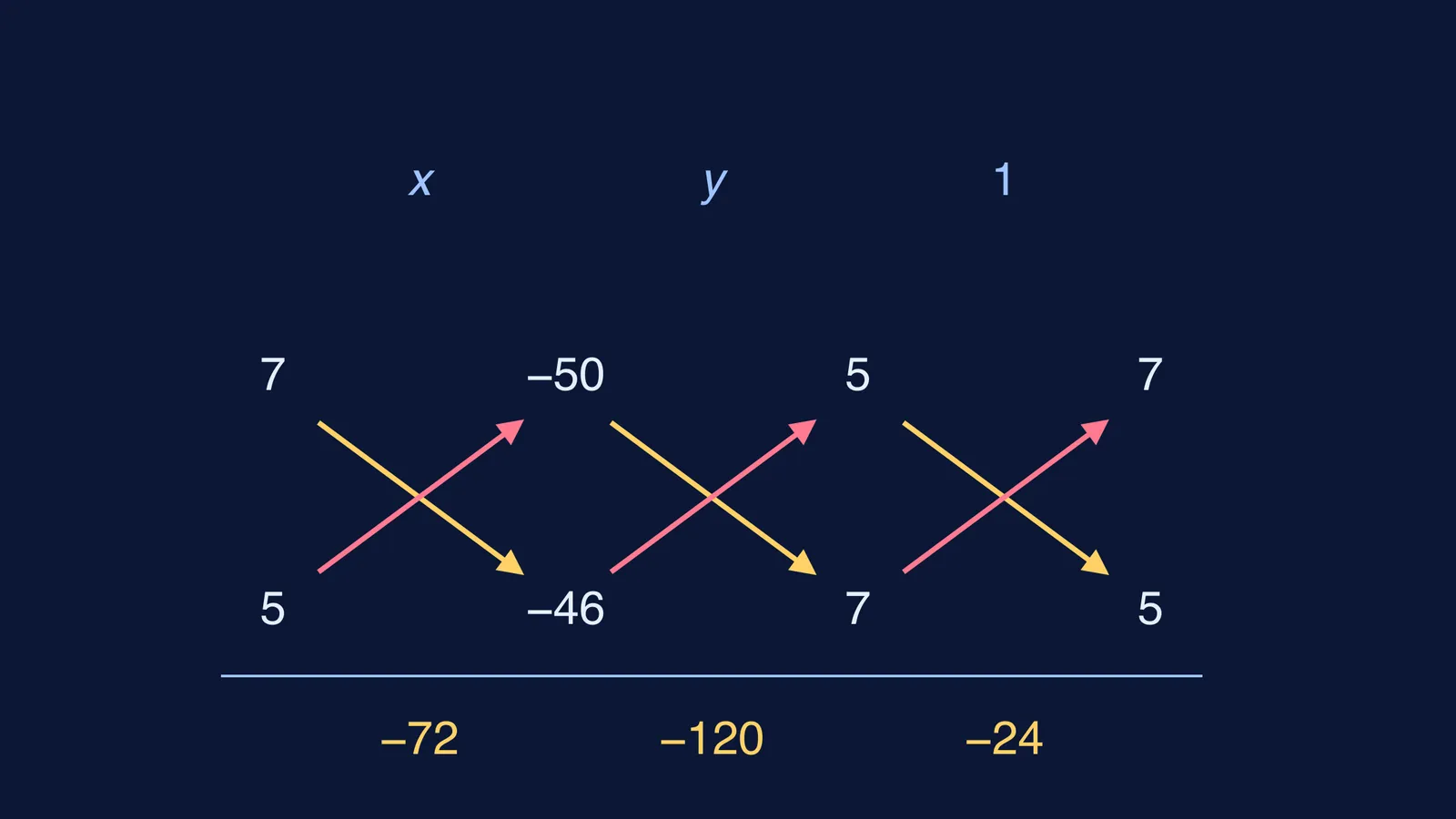
Write the coefficients in two rows in the order b, c, a, b: b1, c1, a1, b1 on top and b2, c2, a2, b2 below.
Above the three gaps between columns, write x, y and 1.
In each gap, take the down-arrow product (top-left to bottom-right) minus the up-arrow product (bottom-left to top-right).
Then x = first number ÷ third and y = second ÷ third.
You write the b column twice so that the gaps come out in the order x, y, 1.
Worked example: NCERT's pencils and pens question
This is Exercise 3.1, Question 1(ii), in the NCERT chapter: 5 pencils and 7 pens together cost ₹50, whereas 7 pencils and 5 pens together cost ₹46. Find the cost of one pencil and one pen. NCERT asks for a graphical solution; here we use the same pair to practise cross-multiplication.
Let one pencil cost ₹x and one pen cost ₹y.
5x + 7y = 50 becomes 5x + 7y − 50 = 0, so a1 = 5, b1 = 7, c1 = −50.
7x + 5y = 46 becomes 7x + 5y − 46 = 0, so a2 = 7, b2 = 5, c2 = −46.
The grid has 7, −50, 5, 7 in the top row and 5, −46, 7, 5 in the bottom row.
Under x: (7)(−46) − (5)(−50) = −322 + 250 = −72
Under y: (−50)(7) − (−46)(5) = −350 + 230 = −120
Under 1: (5)(5) − (7)(7) = 25 − 49 = −24
So x/(−72) = y/(−120) = 1/(−24). That gives x = −72 ÷ −24 = 3 and y = −120 ÷ −24 = 5. A pencil costs ₹3 and a pen costs ₹5.
Which sign mistakes cost marks?
Leaving the constant on the right. Reading c1 = 50 and c2 = 46 from 5x + 7y = 50 gives x = −3 and y = −5. A negative price means: rearrange.
Losing a minus inside a product. In the x gap, −(5)(−50) is +250. Writing −250 gives −572 ÷ −24, about 23.83, not a whole number of rupees.
Subtracting the wrong way round in one gap. In the y gap, (−46)(5) − (−50)(7) = 120 gives y = −5.
Dividing upside down. −24 ÷ −72 gives x = 1/3 instead of 3.
Skipping the denominator test. If a1b2 − a2b1 = 0, there is no unique solution. For NCERT's 9x + 3y + 12 = 0 and 18x + 6y + 24 = 0, 9 × 6 − 18 × 3 = 0, so the lines coincide.
If the same slip keeps coming back, the Fermi Problem Library has worked problems with a step-by-step solver that explains the reasoning rather than printing an answer, so you can find the line where the sign went wrong. If the ratio conditions themselves feel shaky, the Fermi Concept Library gives each mathematics concept its own lesson.
What should you practise this week?
Day 1: rewrite five NCERT pairs in "= 0" form and write down a, b and c with their signs.
Day 2: solve the same pairs by elimination.
Day 3: solve them again by cross-multiplication and compare.
Day 4: turn two word problems into equations, such as this supplement of an angle problem, then solve and check.
Each equation is a straight line, and the answer is where the two lines meet; see how to write a line's equation in point-slope and two-point form. Parents choosing a Class 10 paper can use our checklist for basic or standard maths.