

On this page
The human nervous system is a vast communication network, and the peripheral nerves are the cables that carry signals to and from the rest of the body. Whether you are preparing for a biology exam or simply curious about human anatomy, knowing the exact numbers and roles of these nerves is a foundational step.
What is the peripheral nervous system?
Anatomists divide the human nervous system into two main parts. The central nervous system (CNS) consists of the brain and the spinal cord, acting as the body's main control centre. You can learn more about how the brain is structured in our guide to parts of the human brain: forebrain, midbrain and hindbrain roles.
The peripheral nervous system (PNS) is the network of nerves that branch out from the CNS to connect it to the limbs, skin, and internal organs. The PNS is responsible for transmitting sensory information from the environment back to the central nervous system, and then carrying motor commands to the muscles and glands. It is further divided into the somatic nervous system, which controls voluntary movements, and the autonomic nervous system, which manages involuntary functions like heart rate and digestion.
How many cranial and spinal nerves in humans?
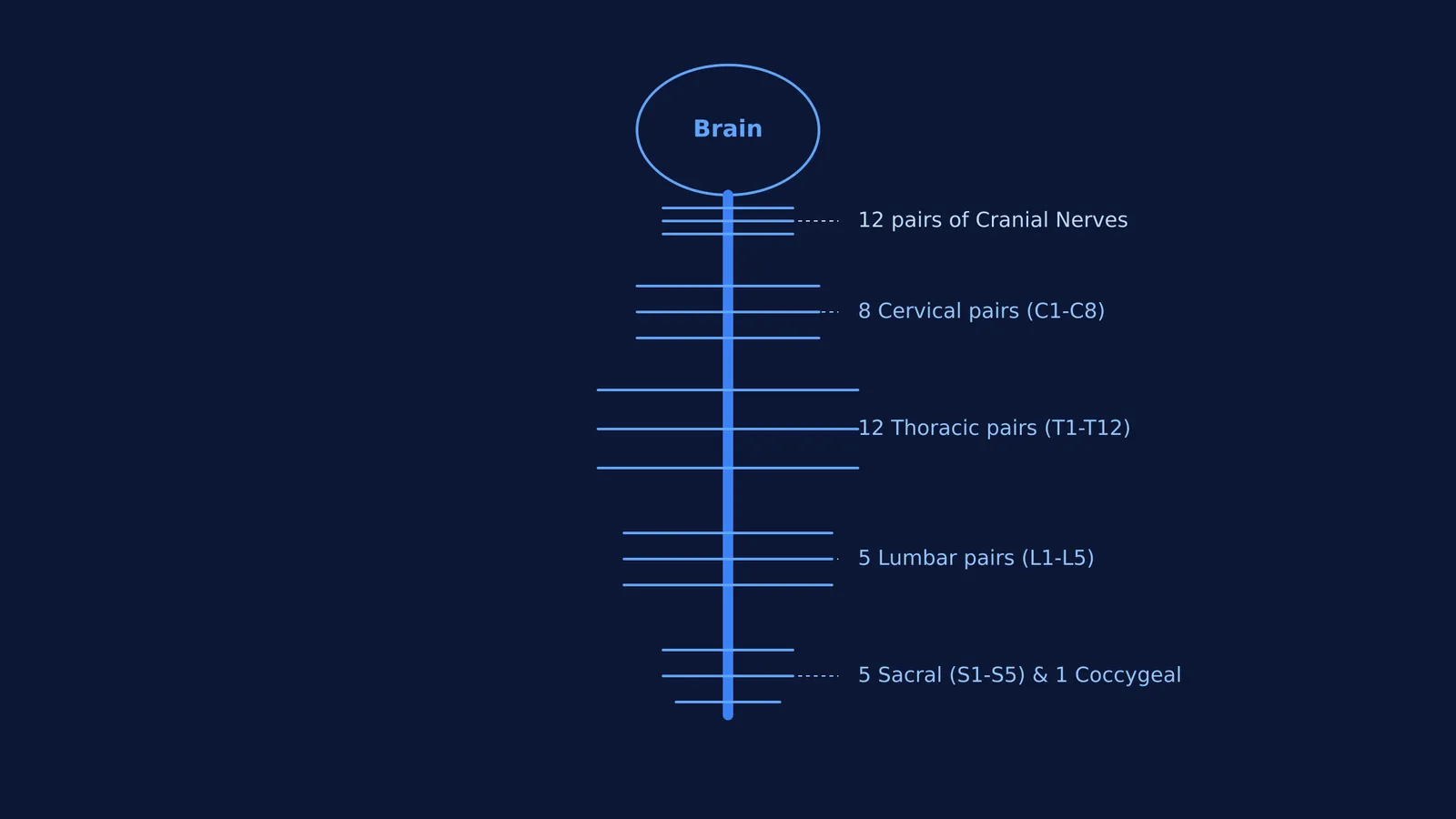
Humans have a total of 43 pairs of peripheral nerves, which are formally classified into two groups based on where they originate (Chung & Chung, 2020):
12 pairs of cranial nerves: These emerge directly from the brain and brainstem. They primarily innervate the head and neck, controlling functions such as sight, smell, facial expressions, and chewing. A notable exception is the vagus nerve, which extends down into the chest and abdomen to control the heart and digestive tract.
31 pairs of spinal nerves: These emerge from the spinal cord through the spaces between the vertebrae. They form the somatic nervous system pathways to the rest of the body.
The 31 pairs of spinal nerves are grouped by the region of the spine they exit from:
8 cervical pairs (C1 to C8): These nerves control signals to the neck, shoulders, arms, and hands.
12 thoracic pairs (T1 to T12): These supply the chest muscles and abdominal wall.
5 lumbar pairs (L1 to L5): These provide motor and sensory functions to the lower abdomen and the front of the legs.
5 sacral pairs (S1 to S5): These innervate the pelvic organs, buttocks, and the back of the legs.
1 coccygeal pair (Co1): This final pair supplies the skin over the tailbone.
Each spinal nerve is a "mixed" nerve, meaning it carries both sensory fibres (bringing information in) and motor fibres (sending commands out).
How can you remember the cranial nerves?
Medical students and biology pupils have relied on mnemonics for generations to memorise the 12 cranial nerves in order (Chung & Chung, 2020). The nerves are numbered using Roman numerals (I to XII) and each has a specific role:
Olfactory (I): Smell.
Optic (II): Vision.
Oculomotor (III): Eye movement and pupil constriction.
Trochlear (IV): Eye movement.
Trigeminal (V): Facial sensation and chewing.
Abducens (VI): Eye movement.
Facial (VII): Facial expression and taste.
Vestibulocochlear (VIII): Hearing and balance.
Glossopharyngeal (IX): Taste and swallowing.
Vagus (X): Heart rate, digestion, and organ sensation.
Accessory (XI): Neck and shoulder movement.
Hypoglossal (XII): Tongue movement.
If you need to remember whether each nerve carries sensory fibres, motor fibres, or both, another classic phrase is used. Using S for Sensory, M for Motor, and B for Both: "Some Say Marry Money, But My Brother Says Big Brains Matter More."
How do nerve pathways handle reflex actions?
The peripheral nervous system is not just a passive set of wires; it plays an active role in keeping you safe. When you touch a hot stove, the sensory nerves send a signal that bypasses the brain and routes directly through the spinal cord to trigger an immediate muscle response. This rapid pathway is called a reflex arc.
Because the signal only has to travel to the spinal cord and back out to the motor nerves, your hand pulls away before your brain even consciously registers the pain. For a detailed breakdown of how these rapid responses occur, read our step-by-step guide to the nerve impulse, synapse and reflex arc.
Understanding how these signals integrate with the rest of your body is a key part of the curriculum, especially in topics like control and coordination in Class 10: reflexes, brain and hormones. The study of these 43 nerve pairs (Chung & Chung, 2020) bridges the gap between basic anatomy and the complex behaviours that keep humans alive.
When you are tracing reflex arcs or memorising these 43 nerve pairs, active recall works much better than simply re-reading your textbook. The Fermi Problem Library has worked problems with a step-by-step solver that explains the reasoning, helping you test your knowledge of the nervous system. You can also explore the Fermi Concept Library, where every concept has its own lesson and its place in the map, including human anatomy.


