On this page
If a question hands you cos(A + B) times cos(A − B), you need not expand both brackets. The product always collapses to a difference of two squares, and so does the matching sine product.
cos(A + B) cos(A − B) = cos²A − sin²B
sin(A + B) sin(A − B) = sin²A − sin²B
They turn values such as sin²75° − sin²15° into one multiplication.
What is the formula for cos(A + B) cos(A − B)?
The NCERT Class 11 maths textbook, Chapter 3, Section 3.4, proves the four compound-angle formulas these identities rest on (NCERT, Trigonometric Functions):
cos(A + B) = cos A cos B − sin A sin B
cos(A − B) = cos A cos B + sin A sin B
sin(A + B) = sin A cos B + cos A sin B
sin(A − B) = sin A cos B − cos A sin B
To see why the sine formula is true, our post on the rectangle that proves the sin(A + B) formula draws it in one picture.
Multiply the two cosine formulas and you get cos²A − sin²B. Multiply the two sine formulas and you get sin²A − sin²B. Each answer also has a twin form, because sin² and cos² of the same angle add to 1:
cos²A − sin²B = cos²B − sin²A
sin²A − sin²B = cos²B − cos²A
How do you prove both identities in two lines?
Each bracket pair is (p − q)(p + q), so the product is p² − q². Then swap one square using sin² + cos² = 1.
cos(A + B) cos(A − B) = cos²A cos²B − sin²A sin²B.
Replace cos²B with 1 − sin²B and sin²A with 1 − cos²A: cos²A − cos²A sin²B − sin²B + cos²A sin²B = cos²A − sin²B.
sin(A + B) sin(A − B) = sin²A cos²B − cos²A sin²B.
Replace cos²B with 1 − sin²B and cos²A with 1 − sin²A: sin²A − sin²A sin²B − sin²B + sin²A sin²B = sin²A − sin²B.
The cross terms always cancel. That is the whole trick.
How do you use these identities to evaluate values?
Read the identity right to left: a difference of squares becomes a product of the sum and difference angles, which are often standard angles.
sin²75° − sin²15° = sin(90°) sin(60°) = √3/2.
cos²45° − sin²15° = cos(60°) cos(30°) = (1/2)(√3/2) = √3/4.
sin²52½° − sin²22½° = sin 75° sin 30°. NCERT's Exercise 3.3 asks you to find sin 75°, which is (√6 + √2)/4, so the answer is (√6 + √2)/8.
cos(60° + x) cos(60° − x) = cos²60° − sin²x = 1/4 − sin²x.
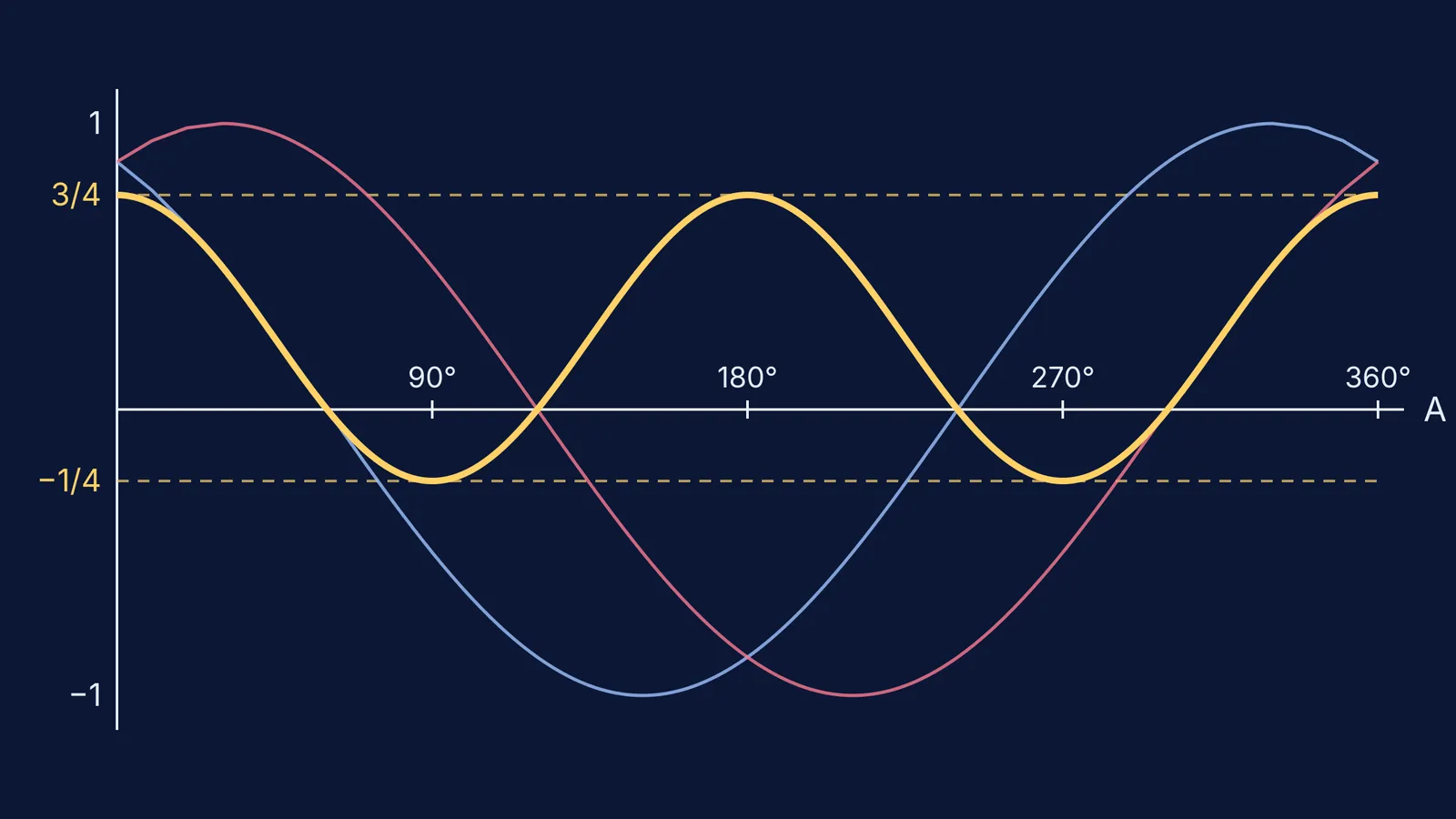
sin(60° + A) sin(60° − A) = 3/4 − sin²A. Multiply by sin A and you get (3 sin A − 4 sin³A)/4 = (sin 3A)/4, the result in our post on proving the sin A sin(60° − A) sin(60° + A) identity.
NCERT Exercise 3.3, questions 12 and 13 (NCERT) ask you to prove sin²6x − sin²4x = sin 2x sin 10x and cos²2x − cos²6x = sin 4x sin 8x. The first is the sine identity with A = 6x and B = 4x. For the second, rewrite cos²2x − cos²6x as sin²6x − sin²2x, then use A = 6x and B = 2x.
Sum-to-product formulas also work here; see our guide on when to use sum to product formulas.
For more questions like these, the Fermi Problem Library has worked problems with a step-by-step solver that explains the reasoning rather than printing an answer.
When should you reach for this identity?
A product of the same two angles, added and subtracted, inside cos·cos or sin·sin: use it forwards.
A difference such as sin²P − sin²Q or cos²P − sin²Q: read it backwards with A = P and B = Q.
P + Q and P − Q land on 30°, 45°, 60° or 90°: the value comes out in one line.
cos²P − cos²Q: convert it to sin²Q − sin²P first.
What mistakes cost marks with this identity?
Writing cos²A − cos²B. Test with A = 60° and B = 30°: cos 90° cos 30° = 0, and cos²60° − sin²30° = 0, but cos²60° − cos²30° = −1/2.
Swapping A and B in the cosine version. cos²B − sin²A is fine, as shown above. cos²B − sin²B is not; that is cos 2B.
Losing the order in the sine version. sin(A + B) sin(A − B) = sin²A − sin²B, not sin²B − sin²A. The square of B, the angle that appears with both signs, is subtracted.
If the compound-angle formulas themselves still feel shaky, the Fermi Concept Library gives each concept in mathematics its own lesson, so you can rebuild the base before you practise these shortcuts.