

On this page
Heat a 1,5-diene and something tidy happens: one σ bond breaks, a new one forms three atoms away, and both π bonds slide over by one position. No ions, no reagents, no intermediate. If you can number six atoms, you can predict the product, and the Claisen rearrangement follows the same map.
What is the Cope rearrangement of 1,5-dienes?
The Cope rearrangement is a [3,3]-sigmatropic rearrangement of a 1,5-diene in which σ and π bonds reorganise in a single concerted step (Cope rearrangement, Wikipedia). It is named after Arthur C. Cope, who reported it with Elizabeth M. Hardy in the Journal of the American Chemical Society in 1940 (Cope and Hardy, 1940).
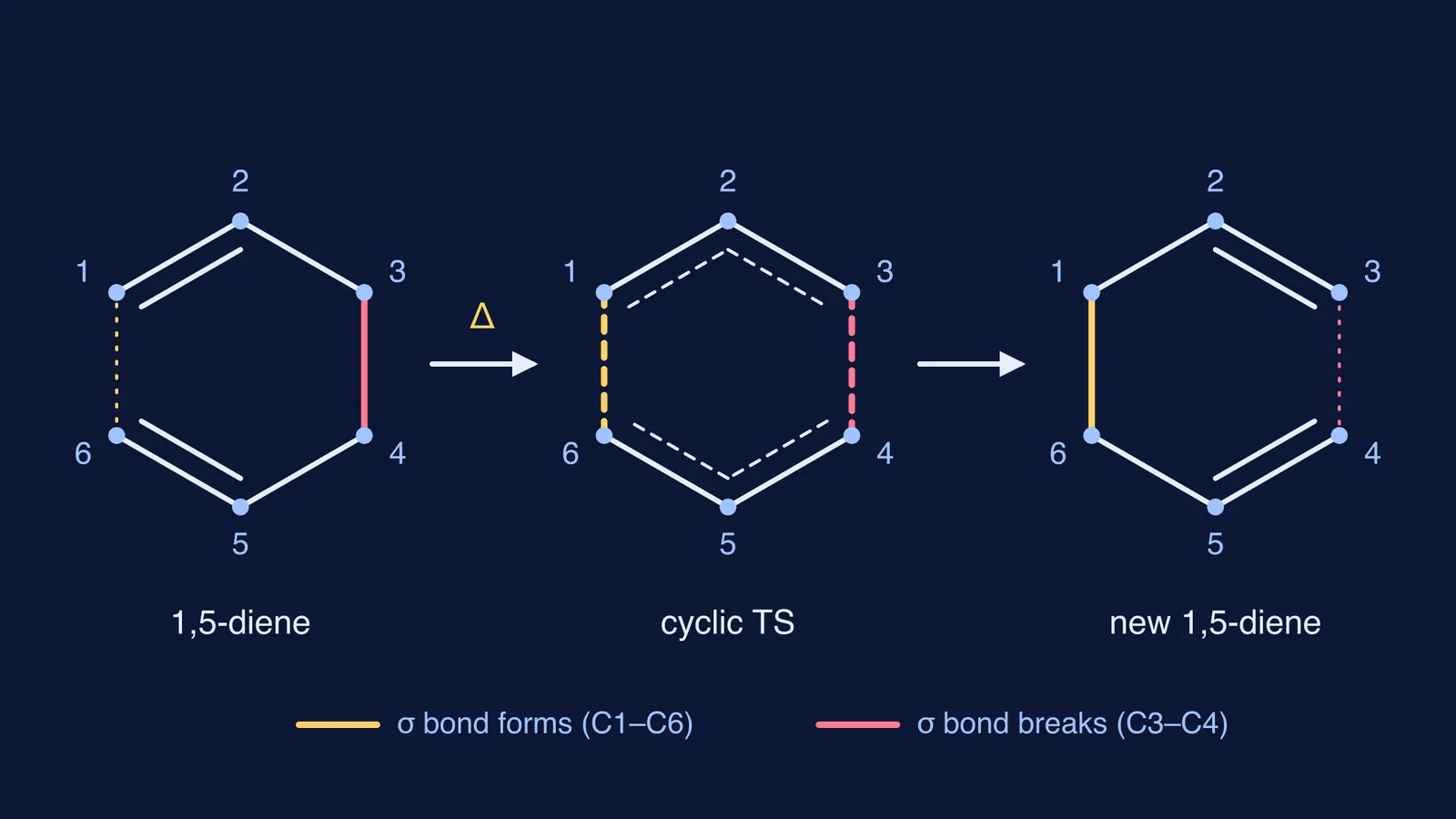
The label [3,3] tells you where the bonds move. Number the chain C1 to C6, with double bonds at C1=C2 and C5=C6. The C3–C4 σ bond breaks, and the new bond joins the atoms three places out on each side, C1 and C6. Hence [3,3].
How does the six-membered transition state shift the bonds?
For C1 and C6 to meet, the chain curls into a ring of six atoms. In that cyclic transition state, three electron pairs move at the same time:
The C3–C4 σ bond breaks.
The C1=C2 π bond moves to become C2=C3.
The C5=C6 π bond moves to become C4=C5, and a new σ bond forms between C1 and C6.
The result is another 1,5-diene, wired differently. For hexa-1,5-diene itself the product is identical to the starting material, which chemists call a degenerate rearrangement (Wikipedia).
The ring is not flat. Experiments by W. von E. Doering and W. R. Roth showed that open-chain 1,5-dienes prefer a chair-like transition state over a boat (Doering and Roth, Tetrahedron, 196280025-8); Wikipedia). Constrained molecules such as cis-1,2-divinylcyclopropane can still react through the boat.
Worked example: what does 3-methylhexa-1,5-diene give?
Heating 3-methylhexa-1,5-diene to 300 °C gives hepta-1,5-diene (Wikipedia). Here is how to get there yourself.
Write it out: CH2=CH–CH(CH3)–CH2–CH=CH2.
Number the diene: C1 and C2 are the CH2=CH on the left, C3 carries the methyl, C4 is the CH2, and C5 and C6 are the CH=CH2 on the right.
Break C3–C4 and join C1 to C6.
Move the π bonds to C2=C3 and C4=C5.
Read off the new chain: CH3–CH=CH–CH2–CH2–CH=CH2, which is hepta-1,5-diene.
Now check the direction. The methyl now sits on a double-bond carbon, so one alkene has become internal and more substituted, and more substituted alkenes are generally more stable. Our explainer on alkene stability from heats of hydrogenation shows how to compare them.
How is the Cope rearrangement like the Claisen rearrangement?
Put an oxygen at position 3 and you have the Claisen rearrangement. Ludwig Claisen described the rearrangement of allyl phenyl ethers into C-allyl phenols in 1912 (Claisen, Berichte, 1912), the first recorded [3,3]-sigmatropic rearrangement (Claisen rearrangement, Wikipedia).
What the two share and where they differ:
Same map: six atoms, one cyclic transition state, one σ bond broken and one formed, no intermediate, driven by heat.
Different start: the Claisen begins with an allyl vinyl ether, so the chain is C=C–O–C–C=C instead of six carbons.
Different product: the Claisen gives a γ,δ-unsaturated carbonyl compound, while the Cope gives another 1,5-diene.
Different push: forming the C=O bond gives an enthalpy change of about −25 kcal/mol, which pulls the Claisen towards product (Wikipedia). Cope rearrangements without ring strain or electronic help are often close to thermally neutral (Wikipedia).
In the aromatic Claisen, the first product loses its ring aromaticity and then tautomerises to 2-allylphenol; our walkthrough of the Claisen rearrangement of allyl phenyl ether takes it step by step.
The oxy-Cope sits between the two. Put an OH on C3 and the Cope product is an enol, which tautomerises to a carbonyl. Turn that OH into a potassium alkoxide and the reaction runs 10¹⁰ to 10¹⁷ times faster, fast enough to work at room temperature (Evans and Golob, 1975; Wikipedia).
How do you spot a [3,3] shift in an exam question?
Run this checklist before you reach for ionic mechanisms:
The condition is usually just heat, with no acid or reagent.
You can find six atoms in a row with π bonds at both ends: X=C–C–C–C=X.
Number from the middle σ bond outward, then break 3–4 and join 1–6.
Move each π bond one place towards the middle.
If position 3 is oxygen, expect a carbonyl (Claisen). If C3 carries OH, expect an enol that becomes a carbonyl (oxy-Cope).
Count bonds: the product has the same number of σ and π bonds as the start.
Stuck on why a product is right? Our guide to checking curly arrows in organic mechanisms helps you test each step. The Fermi Problem Library has worked problems with a step-by-step solver that explains the reasoning rather than printing an answer, so you can see where your numbering went wrong. If sigmatropic shifts still feel shaky, the Fermi Concept Library gives every chemistry concept its own lesson.
Try it now: number hexa-1,5-diene, draw the chair, and check that the product is the same molecule.


