

On this page
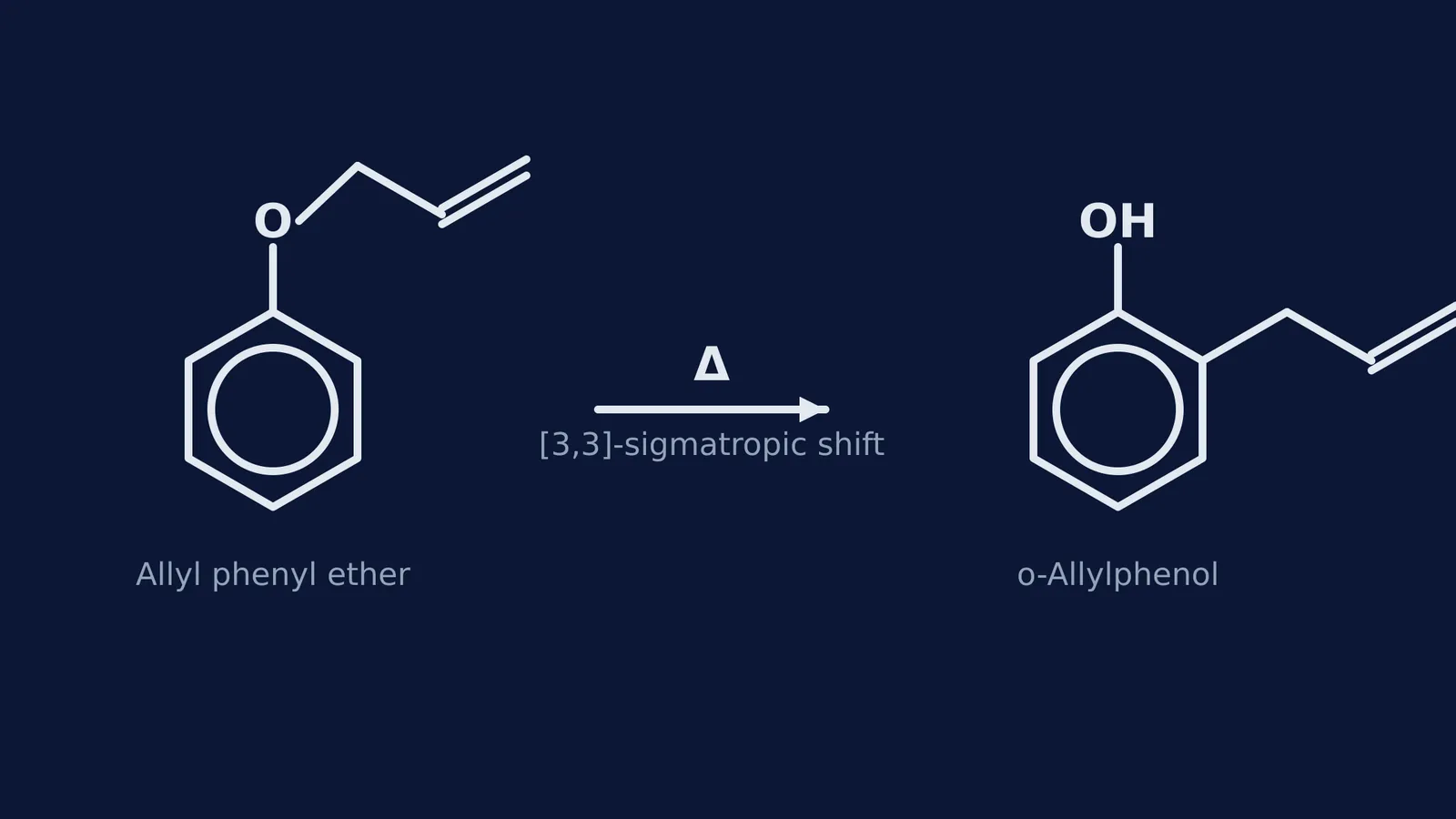
When you heat allyl phenyl ether (often to high temperatures Wikipedia), something unusual happens. The allyl group detaches from the oxygen atom and reattaches itself to the carbon ring, specifically at the *ortho* position. This reaction, known as the Claisen rearrangement, is a classic example of a [3,3]-sigmatropic shift.
It is one of the few organic reactions that requires no catalyst—just heat—and proceeds entirely within a single molecule. Because it forms a new carbon-carbon bond, it is incredibly useful in organic synthesis for building complex molecules. Here is how the mechanism works, why it forms *o*-allylphenol, and how to predict the product when the usual spots are blocked.
What is the mechanism of the Claisen rearrangement?
The Claisen rearrangement is a concerted reaction. This means the breaking of the old bonds and the making of the new ones happen at exactly the same time, without any intermediate stopping points or charged ions forming along the way.
A 2016 study in the *New Journal of Chemistry* confirmed that this reaction follows a precise sequence of C–O bond breaking and C–C bond formation through a highly structured transition state (10.1039/c6nj02074g). The researchers mapped the exact points where electron density shifts as the reaction progresses.
The mechanism involves two main steps:
The [3,3]-Sigmatropic Shift: As the molecule is heated, six electrons (two from the C–O single bond, two from the allyl double bond, and two from the benzene ring) move in a continuous circle. The molecule briefly forms a six-membered, chair-like transition state. The C–O bond breaks, and a new C–C bond forms simultaneously at the *ortho* carbon of the benzene ring.
Tautomerisation: The shift initially produces a non-aromatic intermediate called a cyclohexadienone. Because aromatic rings are highly stable, this intermediate is temporary. It rapidly undergoes a proton shift (tautomerisation), where the hydrogen atom on the *ortho* carbon moves to the oxygen. This restores the stable benzene ring and gives the final product: *o*-allylphenol.
If you are confused by the electron arrows, the Fermi Concept Library has a lesson for every concept in chemistry, each with its place in the map. You can use it to build a mental map of where each atom ends up before trying to memorise the whole mechanism.
What happens if the ortho positions are blocked?
A common exam question asks what happens when both *ortho* positions on the benzene ring already have substituent groups (like methyl groups) attached to them.
Since the allyl group cannot permanently attach to an occupied *ortho* carbon without destroying the ring's aromaticity, it undergoes a second rearrangement to find a free space.
**First shift to *ortho*:** The allyl group moves to the *ortho* position as usual, forming the temporary cyclohexadienone intermediate.
**Second shift to *para*:** Because it cannot tautomerise at the blocked *ortho* position, a second [3,3]-sigmatropic shift occurs. This second shift is specifically called a Cope rearrangement. The allyl group moves from the *ortho* position to the *para* position on the opposite side of the ring.
Tautomerisation: The molecule tautomerises at the *para* position, restoring aromaticity and forming *p*-allylphenol as the final stable product.
How do you predict the product of a Claisen rearrangement?
When you see an allyl aryl ether and a heat symbol (often shown as Δ) in a reaction scheme, you do not need to redraw the entire transition state every time. Use this checklist to draw the correct product quickly:
**Check the *ortho* positions:** Are either of the *ortho* carbons (the positions immediately next to the oxygen) free of substituents?
If yes (at least one is free): Move the allyl group to the free *ortho* position. Remember to invert the allyl group—the carbon that was furthest from the oxygen is now the one attached directly to the ring. Finally, convert the ether oxygen into an –OH group to complete the phenol.
If no (both are blocked): Move the allyl group to the *para* position (opposite the oxygen). Because it moved twice, the allyl group undergoes two inversions, meaning it ends up attached in its original orientation. Add the –OH group.
Practising these electron shifts takes time, but it becomes intuitive once you understand the pattern. If you want to check your reasoning, you can read how to practice writing organic mechanisms with AI or review the addition vs substitution reactions in Class 10 carbon chemistry to build your foundation before moving to complex rearrangements.
Understanding the Claisen rearrangement gives you a powerful tool for synthesis and helps you spot [3,3]-sigmatropic shifts in other contexts. These pericyclic reactions are elegant because they rely entirely on the internal flow of electrons triggered by heat, avoiding the need for complex reaction conditions.


