

On this page
This Class 10 word problem tests two habits: turning a sentence into an equation, and checking which roots actually answer the question. Here is the full method, plus a quick test for when the negative pair belongs in your answer.
How do you write "the product of two consecutive integers is 306" as an equation?
Consecutive integers differ by 1, so name the smaller one x. The next integer is x + 1. "Product" means multiply, so:
x(x + 1) = 306
x² + x = 306
x² + x − 306 = 0
That last line is in standard form, ax² + bx + c = 0 with a = 1, b = 1 and c = −306. In the NCERT Class 10 Mathematics textbook, Chapter 4, this exact situation is Exercise 4.1, Question 2(ii): "The product of two consecutive positive integers is 306. We need to find the integers." Note the word positive: it decides the final answer.
How do you solve x² + x − 306 = 0?
The quickest route is splitting the middle term. You need two numbers that multiply to −306 and add to +1. 306 is close to 17.5², which is 306.25, so try numbers near 17 and 18. Since 17 × 18 = 306, the pair is +18 and −17.
x² + 18x − 17x − 306 = 0
x(x + 18) − 17(x + 18) = 0
(x + 18)(x − 17) = 0
x = −18 or x = 17
If the signs in step 1 feel shaky, our walkthrough on splitting the middle term, signs included covers that step in detail.
The quadratic formula makes a good check. The discriminant is b² − 4ac = 1 − 4(1)(−306) = 1 + 1224 = 1225. That is 35², a perfect square, which is why the equation factorised so neatly. Then x = (−1 ± 35) / 2, giving x = 17 or x = −18, the same answer as before. NCERT's chapter states that a quadratic equation can have at most two roots, and that b² − 4ac > 0 means two distinct real roots (NCERT Chapter 4). So you have found every solution.
Should you keep the negative pair −18 and −17?
Both pairs satisfy the equation: (−18) × (−17) = +306, because a negative times a negative is positive. Whether both go in your final answer depends on the wording, not the algebra. Run this test:
The question says "positive integers" or "natural numbers": keep only 17 and 18. Write one line rejecting x = −18 because it is not positive, so the reader sees why you dropped it.
The question says just "integers": keep both pairs, 17 and 18, and −18 and −17. Dropping the negative pair here leaves your answer incomplete.
The numbers stand for something physical (ages, lengths, page numbers, people): reject the negative root and say why.
NCERT models that last habit itself. In its prayer-hall example, the roots are 12 and −12.5, and the book rejects −12.5 because "x is the breadth of the hall, it cannot be negative" (NCERT Chapter 4, Example 6). The rule is the same every time: the equation gives you candidates, and the question decides which ones count.
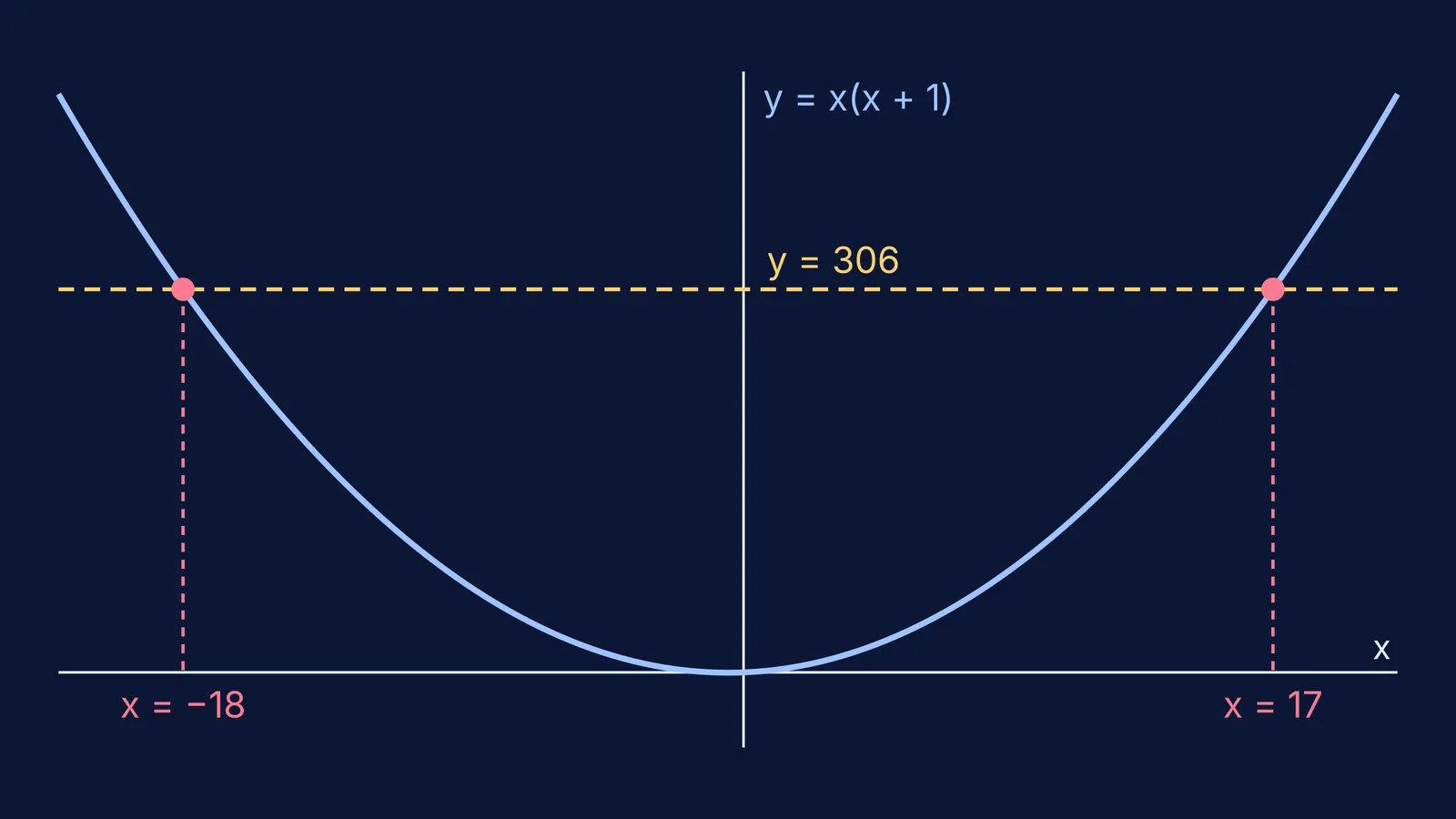
What does the graph of x(x + 1) = 306 look like?
Picture the parabola y = x(x + 1) and the horizontal line y = 306. They cross at exactly two points, x = −18 and x = 17. The parabola is symmetric about x = −0.5, the midpoint between its zeros at 0 and −1, so the two crossings sit at equal distances on either side of it: −0.5 − 17.5 and −0.5 + 17.5. Our guide to sketching a parabola from a quadratic equation shows how to draw this yourself.
How do you solve any consecutive-integer question?
Name the smaller number x. The others are x + 1, x + 2 (or x + 2, x + 4 for consecutive odd or even numbers).
Translate the sentence word by word into one equation, then move everything to one side.
Factorise, or use the formula if no factor pair turns up quickly.
Turn each root into its full set of numbers and substitute back to check.
Reread the question for "positive", "natural" or a real-world meaning, then keep or reject the negative set, with a one-line reason.
Try it on NCERT's companion question from the same chapter: find two consecutive positive integers whose squares add up to 365 (Exercise 4.2, Question 4 in the same NCERT chapter).
For more practice, the Fermi Problem Library has worked problems with a step-by-step solver that explains the reasoning rather than printing an answer. If the gap is earlier, in roots, factors or the discriminant itself, each has its own lesson in the Fermi Concept Library.


