

On this page
A classic Class 11 and JEE warm-up gives you log 2 = 0.3010 and log 3 = 0.4771 and asks for the log of something else. You need no table or calculator: see the number as a product of primes, and three rules do the rest.
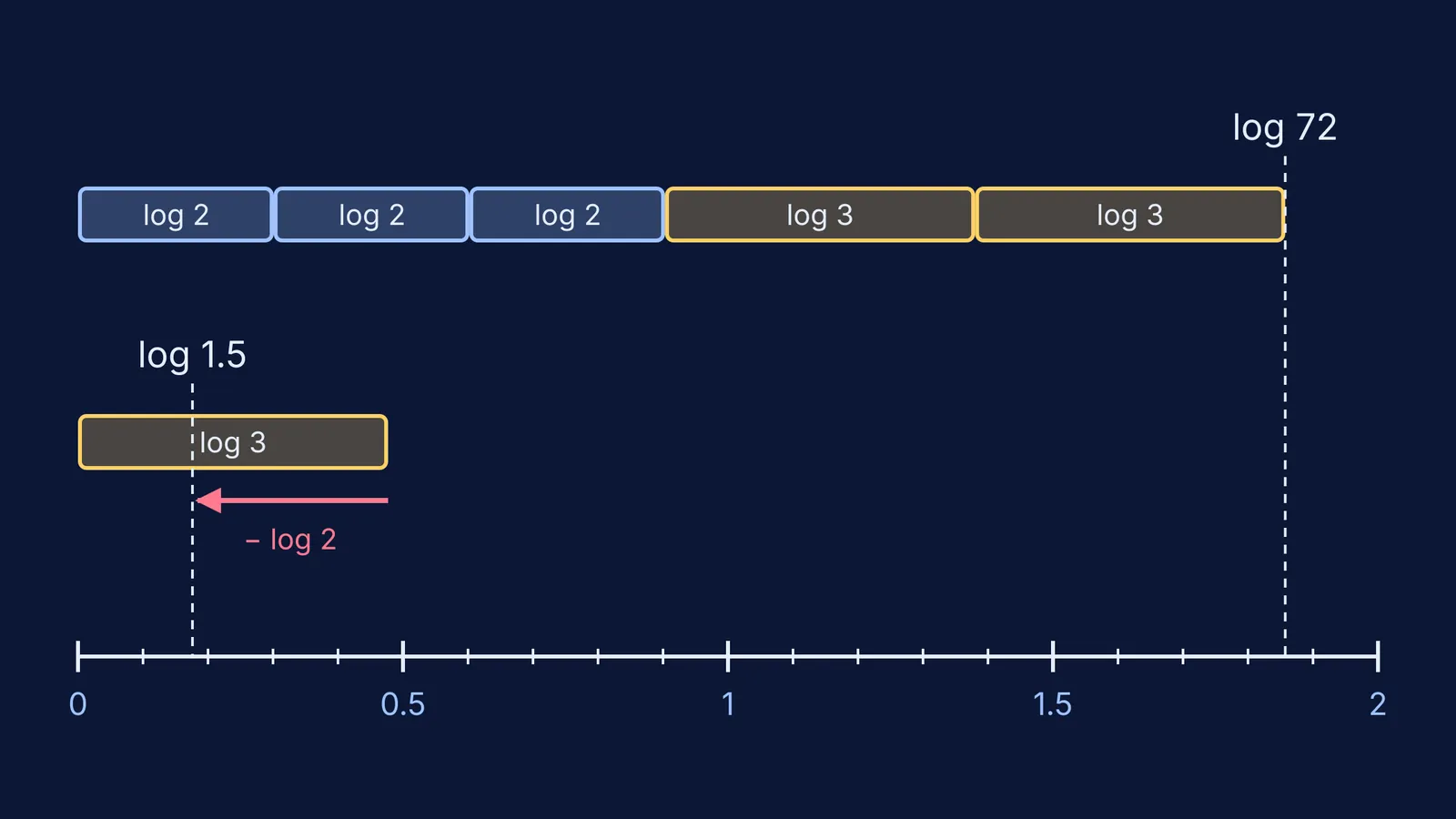
How do you find log 72 using log 2 and log 3?
Here "log" means the common logarithm, which is the logarithm to base 10 (Wikipedia: Common logarithm). The values you are given are rounded: log 2 = 0.30102999... (OEIS A007524) and log 3 = 0.47712125... (OEIS A114490).
The three rules you need are the product rule, log(MN) = log M + log N; the quotient rule, log(M/N) = log M − log N; and the power rule, log(Mⁿ) = n log M (OpenStax College Algebra with Corequisite Support 2e, section 6.5).
Now the worked example:
Factor into primes: 72 = 8 × 9 = 2³ × 3².
Use the product rule: log 72 = log 2³ + log 3².
Use the power rule: log 72 = 3 log 2 + 2 log 3.
Substitute: 3(0.3010) + 2(0.4771) = 0.9030 + 0.9542 = 1.8572.
Sanity check: 72 lies between 10 and 100, so its log must lie between 1 and 2. It does. The whole-number part of a common log is called the characteristic, and it is set by where the decimal point sits (Wikipedia: Common logarithm).
How do you find log 1.5 and log 0.006?
Decimals use the same trick: rewrite them as fractions over 2, 3 or a power of 10, and remember that log 10 = 1.
For log 1.5:
Write 1.5 = 3/2.
Use the quotient rule: log 1.5 = log 3 − log 2.
Substitute: 0.4771 − 0.3010 = 0.1761.
Sanity check: 1.5 lies between 1 and 10, so the answer lies between 0 and 1.
For log 0.006:
Write 0.006 = 6/1000 = 2 × 3 × 10⁻³.
Expand: log 0.006 = log 2 + log 3 − 3.
Substitute: 0.3010 + 0.4771 − 3 = 0.7781 − 3 = −2.2219.
Old log tables write a negative log with a bar over the characteristic so the decimal part stays positive; log 0.012, for example, is written 2̄.07918 (Wikipedia: Common logarithm). In that form, log 0.006 = 3̄.7781, which means −3 + 0.7781.
Which numbers can you reach with only log 2 and log 3?
More than you might expect, because log 10 = 1 gives you log 5 free: log 5 = 1 − log 2 = 0.6990. So any number built only from the primes 2, 3 and 5 is within reach. A factor of 7 or 11 is not, which is why such questions also give log 7 or log 11.
Try these before reading the answers:
log 24 = log(2³ × 3) = 0.9030 + 0.4771 = 1.3801
log 4.5 = log(9/2) = 0.9542 − 0.3010 = 0.6532
log 0.125 = log(1/8) = −3 log 2 = −0.9030
log 25 = log(100/4) = 2 − 0.6020 = 1.3980
log 0.36 = log(2² × 3² × 10⁻²) = 0.6020 + 0.9542 − 2 = −0.4438
log 1.2 = log(2² × 3 / 10) = 0.6020 + 0.4771 − 1 = 0.0791
You can check the last one: the decimal part of log 120 is 0.07918 (Wikipedia: Common logarithm), and 1.2 and 120 differ only by a power of 10, so they share that decimal part.
The same idea counts digits. 2⁵⁰ has log 50 × 0.3010 = 15.05, so its characteristic is 15 and the number has 16 digits; our post on how to find the number of digits in 2 power 100 works through more cases. Speed-ups like this pair well with the habits in our post on calculation shortcuts for JEE when there is no calculator.
What mistakes cost marks on these questions?
Adding inside the log. log(2 + 3) is not log 2 + log 3; the product rule only works for multiplication. Our guide to logarithm rules and how to check them covers this and similar slips.
Losing the power of 10. In log 0.006 the −3 comes from 10⁻³. Count the places the decimal point moves before you start.
Rounding too early. Four-place values give log 72 = 1.8572; more precise values give 1.85733. Either is fine when the question supplies 0.3010 and 0.4771; just do not round halfway through.
Skipping the sanity check. A number between 0.001 and 0.01 has a log between −3 and −2.
How should you practise this?
For a week, pick three numbers a day made of 2s, 3s and 5s, at least one a decimal. Factor, expand, substitute, sanity-check. Say the factorisation aloud: "0.006 is 2 times 3 times 10 to the minus 3." Once that comes without thinking, the arithmetic is easy.
If your answer keeps differing from the book, the Fermi Problem Library has worked problems with a step-by-step solver that explains the reasoning rather than printing an answer, so you can see which line went wrong.


