

On this page
Complement questions look easy: list what is missing from A. Marks are usually lost one step earlier, when you forget to ask what the universal set is. Below: the definition, the laws, and one set A with four different complements.
What is the complement of a set?
The NCERT Class 11 Mathematics chapter on Sets (section 1.10) defines it this way: if U is the universal set and A is a subset of U, the complement of A is the set of all elements of U which are not elements of A.
In symbols, A′ = {x : x ∈ U and x ∉ A}, which the same NCERT chapter notes is just A′ = U − A.
The universal set is the basic set that is relevant to a particular context, usually written U. In NCERT's examples, for the set of all integers U can be the rational numbers or the real numbers R, and in human population studies U is all the people in the world. Wolfram MathWorld defines the complement the same way, relative to a containing set, and writes it as E′ or as E with a bar over it.
A quick check from NCERT's Example 20: with U = {1, 2, ..., 10} and A = {1, 3, 5, 7, 9}, A′ = {2, 4, 6, 8, 10}. On a Venn diagram, A′ is everything inside the rectangle for U but outside the circle for A.
What are the properties of the complement of a set?
The NCERT Sets chapter lists four groups of properties of complement sets:
Complement laws: A ∪ A′ = U and A ∩ A′ = φ.
De Morgan's laws: (A ∪ B)′ = A′ ∩ B′ and (A ∩ B)′ = A′ ∪ B′.
Law of double complementation: (A′)′ = A.
Laws of empty set and universal set: φ′ = U and U′ = φ.
In words: A and A′ together fill U and never overlap, and complementing twice returns A. For counting, finite sets give n(A′) = n(U) − n(A).
If De Morgan's laws feel slippery, our post on checking De Morgan's laws with Venn diagrams works through them region by region.
How does changing the universal set change the complement?
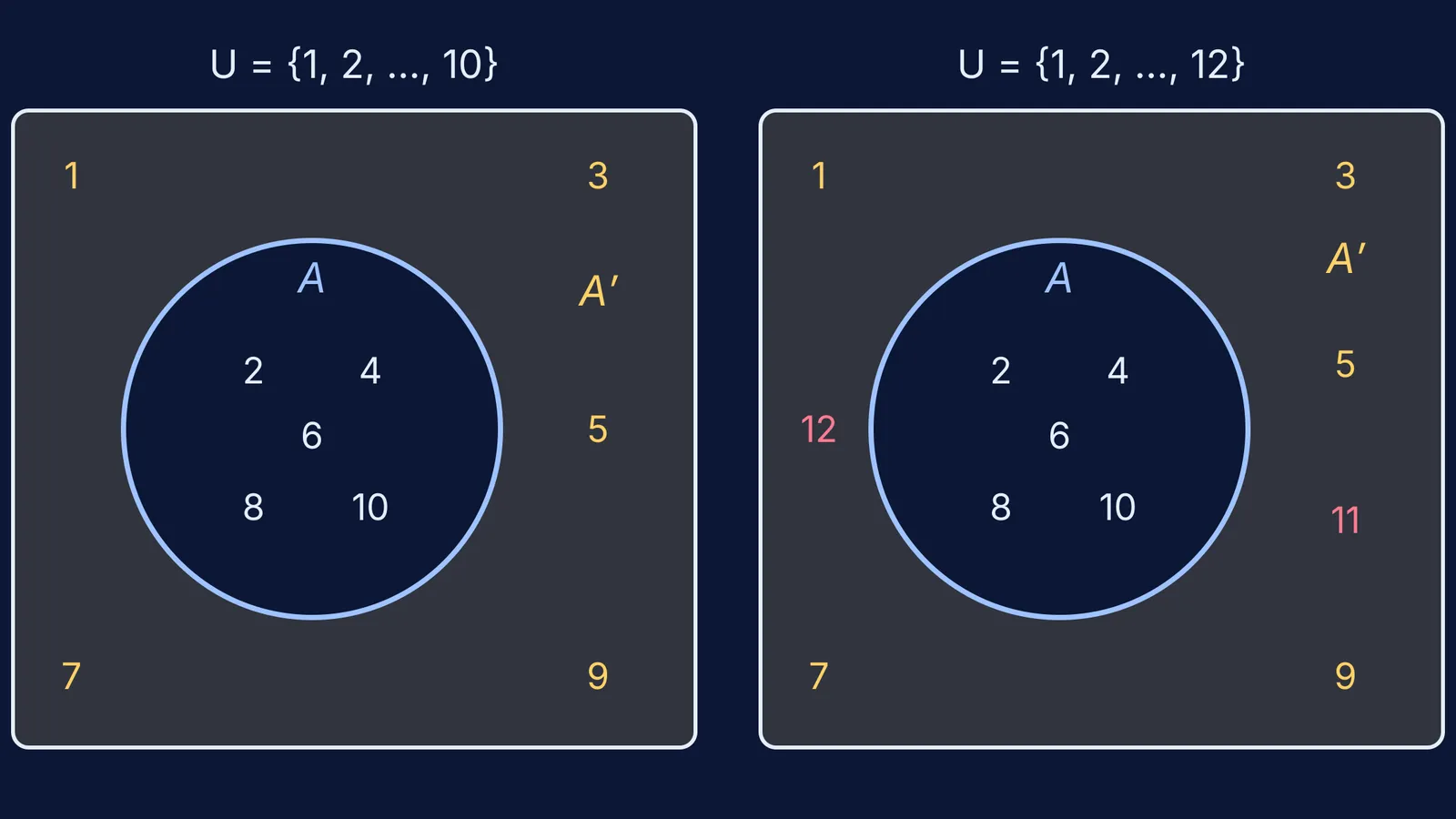
A′ depends on two sets, not one. Let A = {2, 4, 6, 8, 10}.
If U = {1, 2, ..., 10}, then A′ = {1, 3, 5, 7, 9}.
If U = {1, 2, ..., 12}, then A′ = {1, 3, 5, 7, 9, 11, 12}.
If U = {2, 4, 6, ..., 20}, the even numbers up to 20, then A′ = {12, 14, 16, 18, 20}.
If U = N, the natural numbers, then A′ is every odd natural number together with every even number from 12 onwards.
In each line A ∪ A′ gives back exactly that U and A ∩ A′ = φ; in the first two, n(A′) = 10 − 5 = 5 and 12 − 5 = 7.
The same thing happens with inequalities. Question 3 of Exercise 1.5 in the NCERT chapter asks for the complement of {x : x ≥ 7} with the natural numbers as U, and the answer is {1, 2, 3, 4, 5, 6}. Change U to the real numbers R and the complement becomes the interval (−∞, 7), which also contains 6.5, 0 and −3. For a refresher on what belongs to N, W, Z and R, see our guide to natural, whole and integer number sets.
Where do students go wrong with complements?
Use this checklist when you practise:
Name U first, even when it seems obvious.
Check that A is a subset of U; NCERT defines the complement only for subsets of U.
Build A′ only from elements of U.
Verify with the laws and count. A ∪ A′ should equal U, A ∩ A′ should be empty, and for finite sets n(A) + n(A′) should equal n(U).
Watch the brackets. (A ∪ B)′ is A′ ∩ B′, not A′ ∪ B′.
Wolfram MathWorld derives P(E′) = 1 − P(E) in the same way. That idea does a lot of work in exam problems, as our post on the complement trick for at least once in n trials shows.
To see how sets connect to intervals and probability, the Fermi Concept Library gives every concept in mathematics its own lesson and its place in the map. When a textbook question keeps going wrong, the Fermi Problem Library has worked problems with a step-by-step solver that explains the reasoning rather than printing an answer.
Try it now: take A = {a, e, i, o, u} and find A′ with U as the English alphabet. Then explain why U = {a, b, c, d, e} cannot be used here.


