

On this page
Augustus De Morgan, a 19th-century mathematician, published his foundational book *Formal Logic* in 1847. In it, he laid out rules of complementation that connect unions, intersections and negations. Today, we know them as De Morgan's laws, and they are a cornerstone of set theory and probability.
The two laws state:
(A ∪ B)′ = A′ ∩ B′
(A ∩ B)′ = A′ ∪ B′
Despite their structural symmetry, human intuition treats them differently. A 2010 study in the *Revista Argentina de Ciencias del Comportamiento* found that students intuitively recognise De Morgan's law for unions more easily than the corresponding law for intersections. To bridge this gap and train your brain out of its natural biases, you can visualise the regions with a Venn diagram or trace the logic step-by-step through an element-chasing argument.
If you find yourself guessing which rule to apply when simplifying an expression, you are not alone. The Fermi Concept Library can help you map out set theory visually, helping you understand the reasoning behind each formula.
What are De Morgan's laws in sets?
In plain terms, De Morgan's laws describe how the "not" operation (the complement, denoted by a prime symbol) interacts with "or" (union, ∪) and "and" (intersection, ∩). They tell us how to distribute a complement across a bracket.
The first law, (A ∪ B)′ = A′ ∩ B′, means that everything lying outside the combination of A and B is exactly the area where "outside A" overlaps with "outside B". The complement of a union is the intersection of the individual complements.
The second law, (A ∩ B)′ = A′ ∪ B′, means that everything outside the shared overlap of A and B is simply everything outside A combined with everything outside B. The complement of an intersection is the union of the individual complements.
How to verify (A ∪ B)′ = A′ ∩ B′ with a Venn diagram?
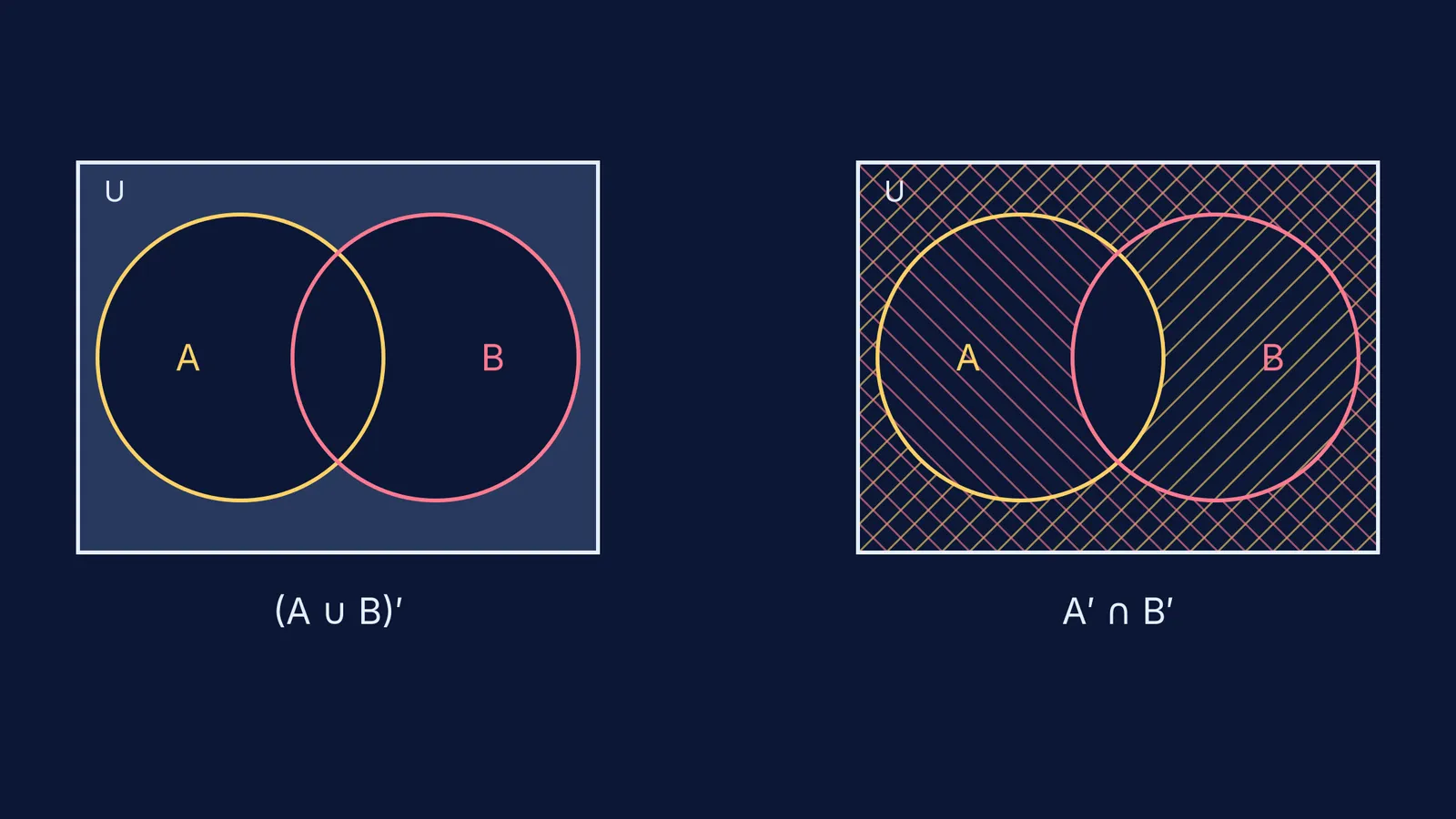
A Venn diagram turns abstract algebra into a visual map, which is just as useful here as it is for three-set Venn problems. To verify the first law, we draw two identical universe boxes and shade the left side for the left-hand expression and the right side for the right-hand expression.
Draw the left side, (A ∪ B)′: Draw two overlapping circles, A and B. Their union, A ∪ B, is the entire figure-eight shape inside both circles. To find its complement, (A ∪ B)′, shade everything in the universe box that lies completely outside this figure-eight.
Draw the right side, A′ ∩ B′: Start with a fresh universe box. Shade A′ by drawing diagonal lines across everything outside circle A. Then, shade B′ by drawing diagonal lines in a different direction across everything outside circle B.
Find the intersection: The intersection A′ ∩ B′ is the region where the two sets of shading overlap (the cross-hatched area).
You will see that the cross-hatched area on the right perfectly matches the solid shaded area on the left.
How to verify (A ∩ B)′ = A′ ∪ B′ with a Venn diagram?
We apply the same structured method to the second law.
Draw the left side, (A ∩ B)′: The intersection A ∩ B is the small lens-shaped overlap in the middle of the circles. Its complement, (A ∩ B)′, is everything in the universe box *except* that small central overlap. Shade it all.
Draw the right side, A′ ∪ B′: Shade A′ (everything outside A). Then, shade B′ (everything outside B).
Find the union: Because we are looking for a union this time, we include any area that has *at least one* type of shading. You will notice that the only region left completely blank is the central overlap.
Both sides yield the exact same shaded region, confirming the second law.
How do you prove De Morgan's laws with an element-chasing argument?
Venn diagrams effectively verify the laws for two or three sets, but a formal mathematical proof requires an element-chasing argument. These logic chains are foundational to counting the number of subsets and the power set.
To prove that two sets are equal (X = Y), you must show that every element of X is in Y, and every element of Y is in X. Here is the formal proof for (A ∪ B)′ = A′ ∩ B′:
Let x be an arbitrary element in (A ∪ B)′.
By the definition of a complement, x ∉ (A ∪ B).
If x is not in the union of A and B, it means x cannot be in A, and x cannot be in B.
So, x ∉ A and x ∉ B.
This is exactly the definition of complements: x ∈ A′ and x ∈ B′.
Therefore, x is in their intersection: x ∈ A′ ∩ B′.
Because we can read these exact logical steps in reverse, the argument works in both directions. Every element on the left is strictly on the right, and vice versa.
If you are stuck on setting up proofs like this, the Fermi Problem Library provides a step-by-step solver that explains the reasoning line-by-line, rather than just printing the final theorem.
Why do students make mistakes with these laws?
The most common trap is distributing the prime symbol without flipping the sign—writing (A ∪ B)′ = A′ ∪ B′, which is mathematically false.
The cognitive pattern identified in the 2010 study suggests that our brains naturally resist transforming "and" into "or" when applying negations. To counter this, make a habit of reading the expression out loud. "Not (A or B)" logically means "Not A, AND not B". Translating symbols into plain English engages a different part of your reasoning and catches the sign-flipping mistake before you write it down on your exam paper.


