

On this page
You simplify an expression by adding or subtracting the coefficients of like terms and leaving every unlike term exactly as it is. The arithmetic is easy. The hard part is spotting which terms really are alike, and that is where 3x² and 3x catch many students.
What are like terms in algebra?
Terms with the same algebraic factors are like terms, and terms with different algebraic factors are unlike terms, as the NCERT Class 7 Exemplar unit on algebraic expressions puts it. In practice that means the same variables raised to the same powers. The coefficient, the number in front, does not matter.
The same NCERT unit gives the rule for combining them: the sum or difference of two like terms is a like term whose coefficient is the sum or difference of the two coefficients. So 5x + 2x = 7x, and 4ab − 9ab = −5ab.
The order of the letters does not matter either. 2ax and 3xa are like terms, because a × x and x × a mean the same thing, a point made in a 2022 study of Grade 8 algebra errors.
If terms, factors and coefficients still feel shaky, our explainer on terms, factors and coefficients in algebraic expressions covers that first step.
Why are 3x² and 3x not like terms?
They share a coefficient and a letter. But 3x² means 3 × x × x, while 3x means 3 × x. Their algebraic factors are different, so by the NCERT definition they are unlike.
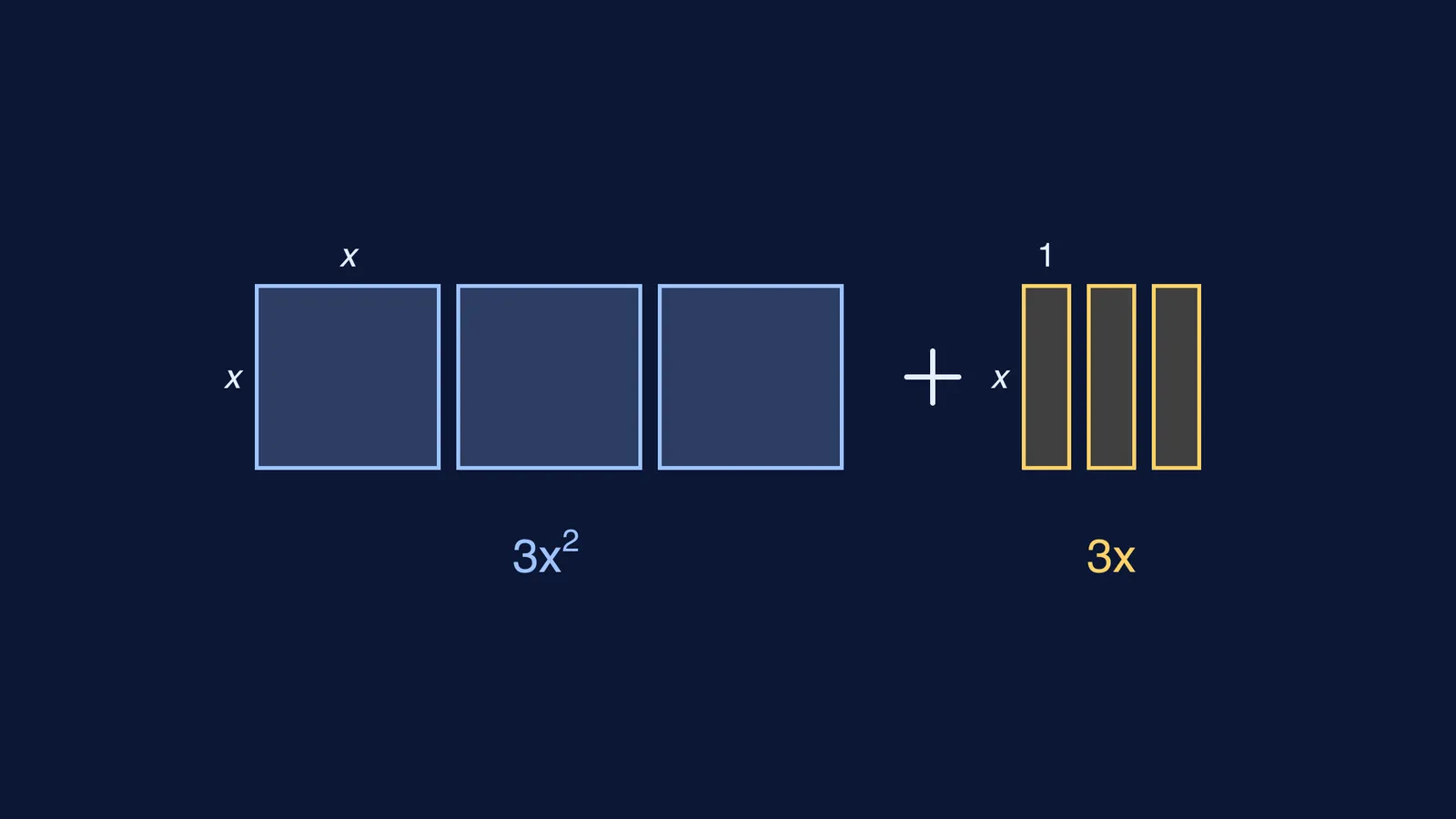
A picture makes it obvious. With algebra tiles, x² is a square x long and x wide, while x is a strip x long and 1 wide. Three squares and three strips are different shapes; pushing them together never turns them into six of either.
Numbers prove it too. Put x = 2:
3x² + 3x = 12 + 6 = 18
6x² = 24
6x = 12
6x³ = 48
None of the “combined” answers gives 18, so 3x² + 3x is already in its simplest form. Avoid testing with x = 1 or x = 0: every power of 1 is 1, so wrong answers can look right.
How do you simplify expressions by combining like terms?
Underline each term together with the sign in front of it. The sign belongs to the term.
Group like terms, using a different mark for each family (x², x, constants).
Add or subtract only the coefficients within each family. The letters and powers stay unchanged.
Write the answer from the highest power down, then check it with a number such as x = 2.
Worked example
Simplify 4x² + 3x − 5 + 2x² − 7x + 8 − x².
x² family: 4x² + 2x² − x² = (4 + 2 − 1)x² = 5x²
x family: 3x − 7x = (3 − 7)x = −4x
constants: −5 + 8 = 3
Answer: 5x² − 4x + 3.
Check with x = 2. The original gives 16 + 6 − 5 + 8 − 14 + 8 − 4 = 15. The answer gives 20 − 8 + 3 = 15. They match.
With two letters: 3ab + 2ba − 5a = 5ab − 5a. The ab and ba terms combine; −5a stays.
When you add or subtract whole expressions in brackets, the same idea applies once you have handled the signs; see our guide to adding and subtracting algebraic expressions.
What mistakes do students make most often?
In the study by Eunice Kolitsoe Moru and Motlatsi Mathunya, the researchers gave simplification tasks to 95 Grade 8 learners at a high school in Lesotho and found that overgeneralising rules from earlier knowledge was the most frequent cause of errors. Their review of earlier studies lists familiar slips:
3x + 5 written as 8x, treating the + as an instruction to produce one answer (the “conjoin” error)
2a + 5a written as 7a², multiplying the letters instead of adding like terms
3x + 3x written as 6x²
The first carries over the arithmetic habit that 5 + 4 yields one number. In algebra, a two-term answer is often finished.
Signs are the other trap. Keep the minus with its term when you regroup: in −5 + 8, the 5 is negative. If negatives trip you up, practise with our post on evaluating expressions with negative values.
Where can you practise combining like terms?
Do ten mixed expressions, check each with x = 2, and note which family (powers, signs or two-letter terms) causes your mistakes. If you get stuck on a step, the Fermi Problem Library has worked problems with a step-by-step solver that explains the reasoning rather than printing an answer. To revisit terms and powers from scratch, the Fermi Concept Library gives each mathematics concept its own lesson.


