

On this page
Your salt is white, it doesn't colour the flame, and the dry heating test left only a white residue. The cobalt nitrate test is the next quick check. One drop and a strong flame can point you towards aluminium, zinc or magnesium before you start the wet tests.
What is the cobalt nitrate test?
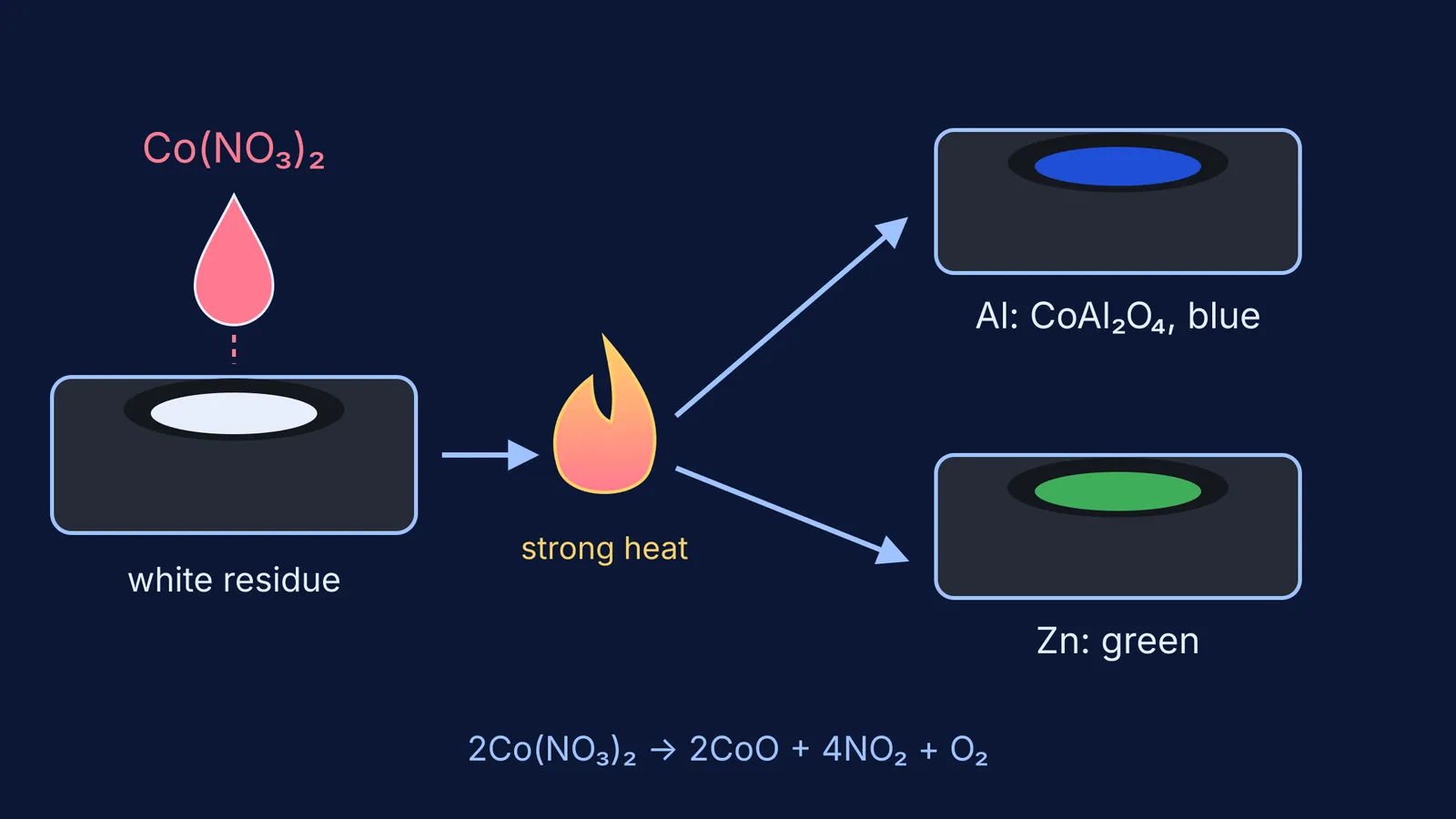
It is a dry test for colourless salts that leave a white, infusible residue after heating. Frederick Getman's textbook The Elements of Blowpipe Analysis gives the method: once the residue has been heated on charcoal, it "is moistened with a drop of cobalt nitrate" and heated again, and its colour changes.
The same book explains the colour. The heat decomposes the cobalt nitrate, the nitric acid is driven off, and the cobalt oxide left behind combines with the oxide of the residue to form "a colored mass" (Getman, Project Gutenberg). Your school manual may do this on a charcoal block or as an ash, so follow its exact steps. The chemistry is the same.
Why does aluminium turn blue and zinc green?
Written as equations, the change goes in two steps:
2Co(NO₃)₂ → 2CoO + 4NO₂ + O₂ (the cobalt nitrate decomposes in the flame)
CoO + Al₂O₃ → CoAl₂O₄ (blue) or CoO + ZnO → a green cobalt-zinc oxide
The blue compound is the artists' pigment cobalt blue. Cobalt blue is mainly cobalt(II) aluminate, CoAl₂O₄, made by heating cobalt(II) oxide with alumina at high temperature, and Louis Jacques Thénard independently discovered it as an alumina-based pigment in 1802 (Wikipedia: Cobalt blue). That is why the lab result is called Thenard's blue.
The green compound is named after Sven Rinman, a Swedish chemist who discovered it in 1780 (Wikipedia: Cobalt green). It is zinc oxide with some of the zinc replaced by cobalt, written Zn₁₋ₓCoₓO. You will also see it written as CoZnO₂. In your answer, the name Rinmann's green and the colour matter more than the exact formula.
The pigments are still made in chemistry classes. A 2018 article in the Journal of Chemical Education describes a student lab that makes Thenard's blue (CoAl₂O₄), Rinman's green (CoZnO₂) and Berzelius' red (CoMgO₂) by igniting filter paper soaked in a cobalt solution and then in an aluminium, zinc or magnesium solution (Martín-Ramos et al., 2018).
How do you read the colour of the residue?
An anonymous 19th-century manual, A System of Instruction in the Practical Use of the Blowpipe, lists the results: "Alumina gives a pure blue color, the oxide of zinc a bright green, magnesia a light red, and the oxide of tin a bluish-green color." Use it as a decision list:
Blue: aluminium (Thenard's blue)
Bright green: zinc (Rinmann's green)
Pale pink or flesh colour, clearer once cool: magnesium
Bluish-green, seen clearly only after cooling: tin, so don't call every green zinc
No clear colour: the test tells you nothing, so move on to the group analysis
Is the cobalt nitrate test enough to confirm aluminium or zinc?
No. Treat it as a hint and confirm it with a wet test. Here is a worked example of how the evidence fits together:
A white salt is heated dry. The residue is yellow while hot and white when cold. A Seethalakshmi Ramaswami College qualitative analysis manual reads this as zinc. Our post on the dry heating test in salt analysis covers the other results.
Cobalt nitrate turns the residue green, which also points to zinc.
In Group IV, H₂S gives a dirty white precipitate, and potassium ferrocyanide gives a bluish-white precipitate that confirms zinc (same manual). For the reasons behind this, see why zinc sulphide is the white Group IV precipitate.
If the residue had turned blue, you would look in Group III for a gelatinous white precipitate that dissolves in excess NaOH, which is how the manual identifies aluminium. Our post on the blue lake test for aluminium covers another confirmation.
If you keep mixing up which test goes with which group, practise on worked salt-analysis problems in the Fermi Problem Library. Its step-by-step solver explains the reasoning rather than printing an answer.
What mistakes spoil the result?
Adding cobalt nitrate too early. Getman warns that "care should be taken to thoroughly ignite before adding the cobalt nitrate solution."
Using a coloured salt. The test is meant for a white residue, and coloured oxides can hide the colour.
Judging the colour while the residue is hot. Let it cool, then look in daylight.
Writing "aluminium confirmed" after the dry test. Write "aluminium may be present" and confirm it in Group III.
If a step in the explanation still feels shaky, the Fermi Concept Library has a lesson on each concept in chemistry, so you can go back to the idea before your next practical.


