

On this page
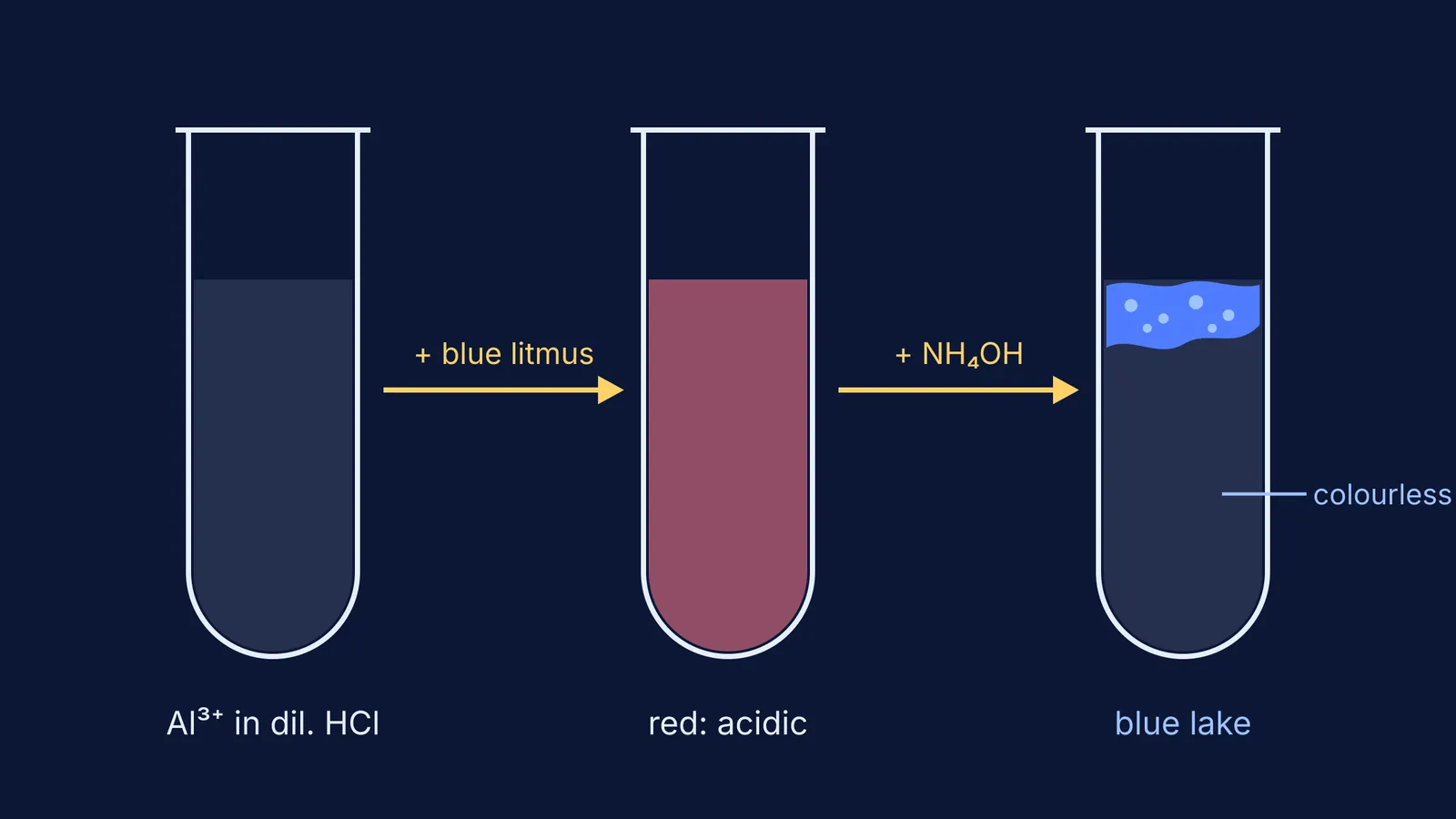
The lake test is the confirmatory test for the aluminium ion (Al³⁺) in group III of salt analysis. According to the NCERT Class 12 chemistry laboratory manual, aluminium hydroxide adsorbs the blue colour from the solution and forms an insoluble adsorption complex called a "lake", so you see a blue mass floating in a colourless solution. Here are the steps, the chemistry behind them, and the lines to write in your record.
Where does the lake test fit in group III analysis?
In the NCERT lab manual's group table, group III holds Al³⁺ and Fe³⁺, and the group reagent is NH₄OH in the presence of NH₄Cl. You take the original solution, add 2-3 drops of concentrated HNO₃ to oxidise Fe²⁺ to Fe³⁺, heat for a few minutes, cool, then add a little solid NH₄Cl and excess NH₄OH until the tube smells of ammonia.
The colour of the precipitate is your first clue. A gelatinous white precipitate points to Al³⁺; a brown one points to Fe³⁺. The lake test confirms the white one.
How do you perform the blue lake test step by step?
These steps follow Table 7.14 of the NCERT manual:
Dissolve the white precipitate in dilute HCl and divide the solution into two parts.
To the first part, add sodium hydroxide solution and warm. A white gelatinous precipitate forms and dissolves in excess NaOH.
To the second part, add blue litmus solution. It turns red, because the solution is acidic.
Add ammonium hydroxide drop by drop along the side of the test tube.
Look for a blue mass floating in a colourless solution. That is the lake, and it confirms Al³⁺.
The manual writes the first part as AlCl₃ + 3NaOH → Al(OH)₃ + 3NaCl, then Al(OH)₃ + NaOH → NaAlO₂ + 2H₂O. The precipitate dissolves in excess alkali because it forms sodium meta-aluminate.
Why does Al(OH)₃ turn blue and float?
Two things happen as the NH₄OH goes in. The solution becomes alkaline, so the litmus goes back from red to blue. At the same time, aluminium hydroxide precipitates and adsorbs the blue dye, taking the colour out of the liquid. The NCERT manual calls this insoluble adsorption complex a "lake".
Adsorption means the dye sticks to the surface of the solid. That is why the liquid around the blue mass is colourless: the colour has moved onto the precipitate.
The same idea shows up in another aluminium test. LibreTexts' notes on aluminium ions describe the dye aluminon being adsorbed by gelatinous Al(OH)₃ to form a red "lake" and a colourless solution. So a lake is a dye held on a solid, and its colour depends on the dye.
How do you avoid mixing up the blues in salt analysis?
Salt analysis has more than one blue result, and it is easy to confuse them. All three appear in the NCERT manual:
Blue lake (Al³⁺, wet test): a blue mass floating in a colourless solution after litmus and NH₄OH.
Prussian blue (Fe³⁺, wet test): a blue precipitate or colouration when the dissolved brown precipitate meets potassium ferrocyanide.
Cobalt nitrate test (dry test): a white residue from the charcoal cavity test, heated with cobalt nitrate, gives blue CoO·Al₂O₃ when aluminium is present.
A quick check: if the group III precipitate was brown and ferrocyanide turns it blue, you have Fe³⁺. If the precipitate was white and only a floating mass is blue while the liquid stays colourless, you have Al³⁺.
What should you write in your practical record?
A worked entry for the lake test:
Experiment: Dissolved the white group III precipitate in dilute HCl. To one part, added blue litmus, then NH₄OH drop by drop.
Observation: Litmus turned red, then a blue mass floated in a colourless solution.
Inference: Al³⁺ confirmed.
Practise these viva answers out loud:
Why is it called a lake test? Al(OH)₃ adsorbs the blue dye and forms an insoluble coloured mass, called a lake.
Why does litmus turn red first? The solution is acidic after dissolving the precipitate in dilute HCl.
Why is the liquid colourless at the end? The dye is adsorbed on the precipitate, so it is no longer in solution.
For clean equations in the record, see our guide to writing chemical equations in board exams for full marks. The same observation-to-inference habit helps with the confirmatory test for chromium ion and with telling chloride, bromide and iodide apart with silver nitrate.
If adsorption itself is the weak spot, the Fermi Concept Library covers every concept in chemistry, each with its own lesson. For salt-analysis questions you get stuck on, the Fermi Problem Library has worked problems with a step-by-step solver that explains the reasoning rather than printing an answer.


