

On this page
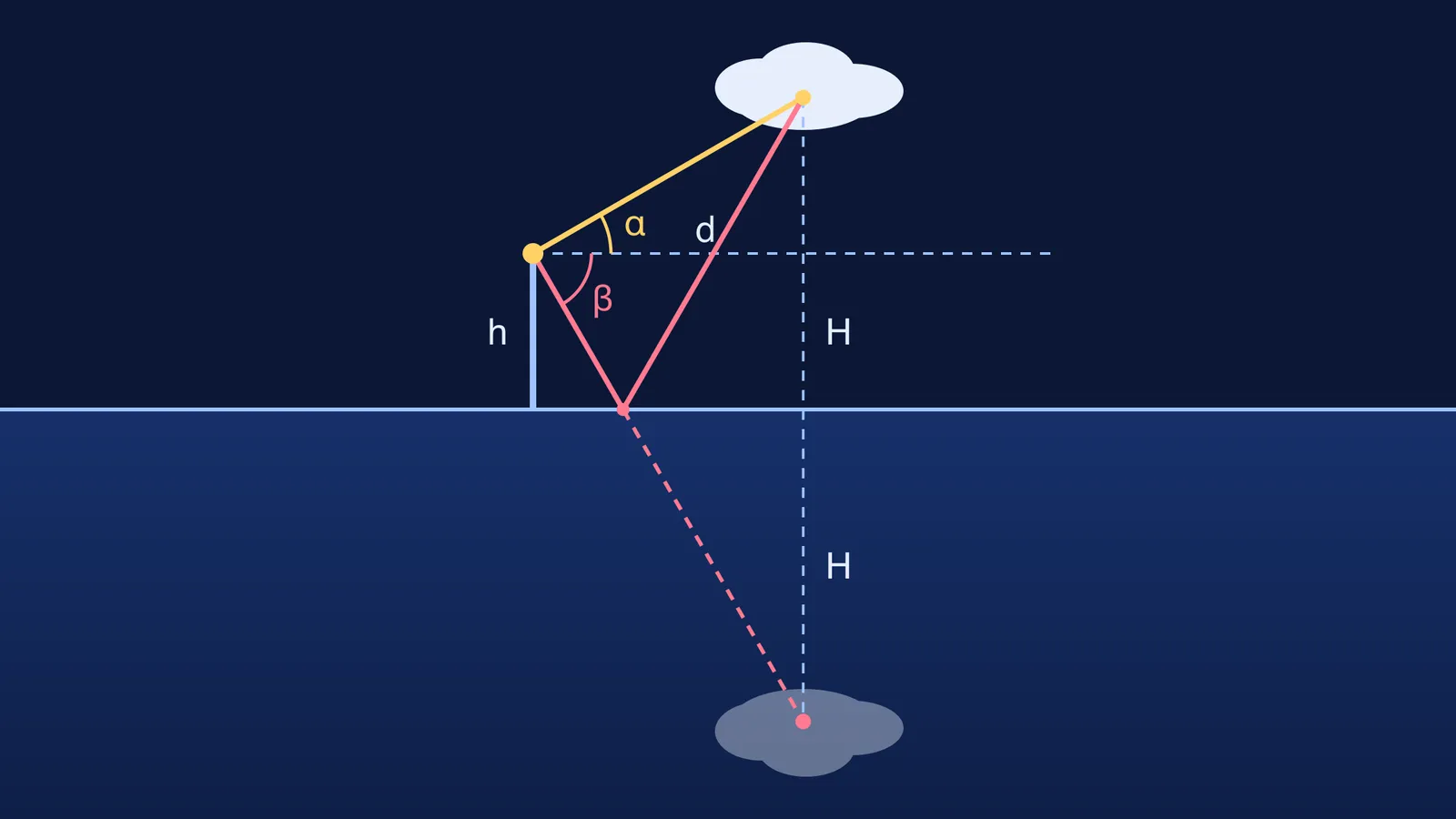
You stand on a jetty h metres above a still lake. You look up at a cloud at an angle α, then down at its reflection in the water at an angle β. From those you can find the cloud's height. The whole problem turns on one fact from optics.
What does the reflection of a cloud in a lake tell you?
A calm water surface behaves like a plane mirror. NCERT's Class 10 science textbook states that "the image formed is as far behind the mirror as the object is in front of it" (NCERT Class 10 Science, Chapter 9). So if the cloud is H metres above the water, its reflection appears H metres below the water, directly under the cloud. Not at the surface, and not H below you.
In NCERT Class 10 Maths, Chapter 9, the angle of elevation is the angle the line of sight makes with the horizontal when the object is above that horizontal level. The angle of depression is the same angle when the object is below it. Both are measured from the horizontal through your eye, not from the water. Our explainer on telling angles of elevation and depression apart covers the difference.
How do you set up the two tan equations?
Draw a vertical line through the cloud and its image, and a horizontal line through your eye. Call the horizontal distance from you to that vertical line d.
Your eye is h above the water, so the cloud is H − h above your eye.
The image is H below the water, so it is H + h below your eye.
That gives two right triangles with the same base d:
Elevation of the cloud: tan α = (H − h)/d
Depression of the reflection: tan β = (H + h)/d
Divide the second equation by the first and d cancels: tan β / tan α = (H + h)/(H − h). Solving for H gives H = h(tan β + tan α)/(tan β − tan α). Either equation then gives the horizontal distance, d = 2h/(tan β − tan α).
Worked example: 60 m above the lake, 30° and 60°
This version is from the CBSE Class 10 sample paper for the 2019 boards, as reproduced on Teachoo/category/CBSE-Class-10-Sample-Paper-for-2019-Boards/); the paper calls the reflection the cloud's "shadow" in the lake. You are 60 m above the lake, the cloud's angle of elevation is 30° and the reflection's angle of depression is 60°.
Known: h = 60, tan 30° = 1/√3, tan 60° = √3.
Elevation triangle: (H − 60)/d = 1/√3, so d = √3(H − 60).
Depression triangle: (H + 60)/d = √3, so d = (H + 60)/√3.
Set the two expressions for d equal: √3(H − 60) = (H + 60)/√3, so 3(H − 60) = H + 60.
Solve: 2H = 240, so H = 120 m.
Check: d = √3 × 60 ≈ 103.9 m. Then (120 − 60)/103.9 ≈ 0.577 = tan 30°, and (120 + 60)/103.9 ≈ 1.732 = tan 60°.
A follow-up part often asks how far the cloud is from you. That is the hypotenuse of the elevation triangle: d / cos 30° = 103.9 / 0.866 ≈ 120 m.
The diagram at the top is drawn to these numbers. The ray leaves the cloud, hits the water a third of the way out from you and bounces up to your eye; your eye traces it straight back to the image.
Which mistakes cost marks on this question?
Writing tan β = H/d or (H − h)/d for the reflection. The image is H + h below your eye.
Writing tan α = H/d for the cloud. You are already h up, so only H − h is above you.
Measuring angles from the water line instead of the horizontal through your eye.
Ending up with β smaller than α. With the same base d and H + h > H − h, β is always the bigger angle. If your working says otherwise, two labels are swapped.
Where does this idea show up again?
The same two-triangle idea, with the unknown height entering each triangle differently, solves two angles of elevation from a moving observer. For a picture-first tour of the chapter, read heights and distances visualised.
If you get stuck deciding which side goes on top in each tan, the Fermi Problem Library has worked problems with a step-by-step solver that explains the reasoning rather than printing an answer. To revise plane-mirror images before you return to trigonometry, the Fermi Concept Library gives each concept its own lesson.
Next time you meet this question, sketch both triangles before you write a single tan.


