

On this page
A 2024 study published in *Cogent Education* applied Newman’s Error Analysis to find out where high school students go wrong in trigonometry. The researchers found that a greater part of student errors relate to transformation, processing skills, and comprehension. The transformation stage—the leap from understanding the words to setting up the correct mathematical diagram or equation—is particularly difficult for word problems.
If you often get stuck turning the word problem into a diagram, the Fermi Problem Library has a step-by-step solver that explains the reasoning rather than printing an answer. Fermi's AI tutor works out what you already know and builds a plan for the session, drawing the figure and checking your understanding as it goes.
Why are moving observer problems so hard?
The classic "moving observer" problem asks you to find the height of a tower when someone walks towards it and the angle of elevation increases.
Students often try to solve the entire problem in one go. However, the correct approach is to split the drawing into two separate right-angled triangles. Just as in horizontal projectile from a cliff problems where time links the vertical and horizontal axes, here the unknown height h is the shared link between the two triangles.
How do you draw the two triangles?
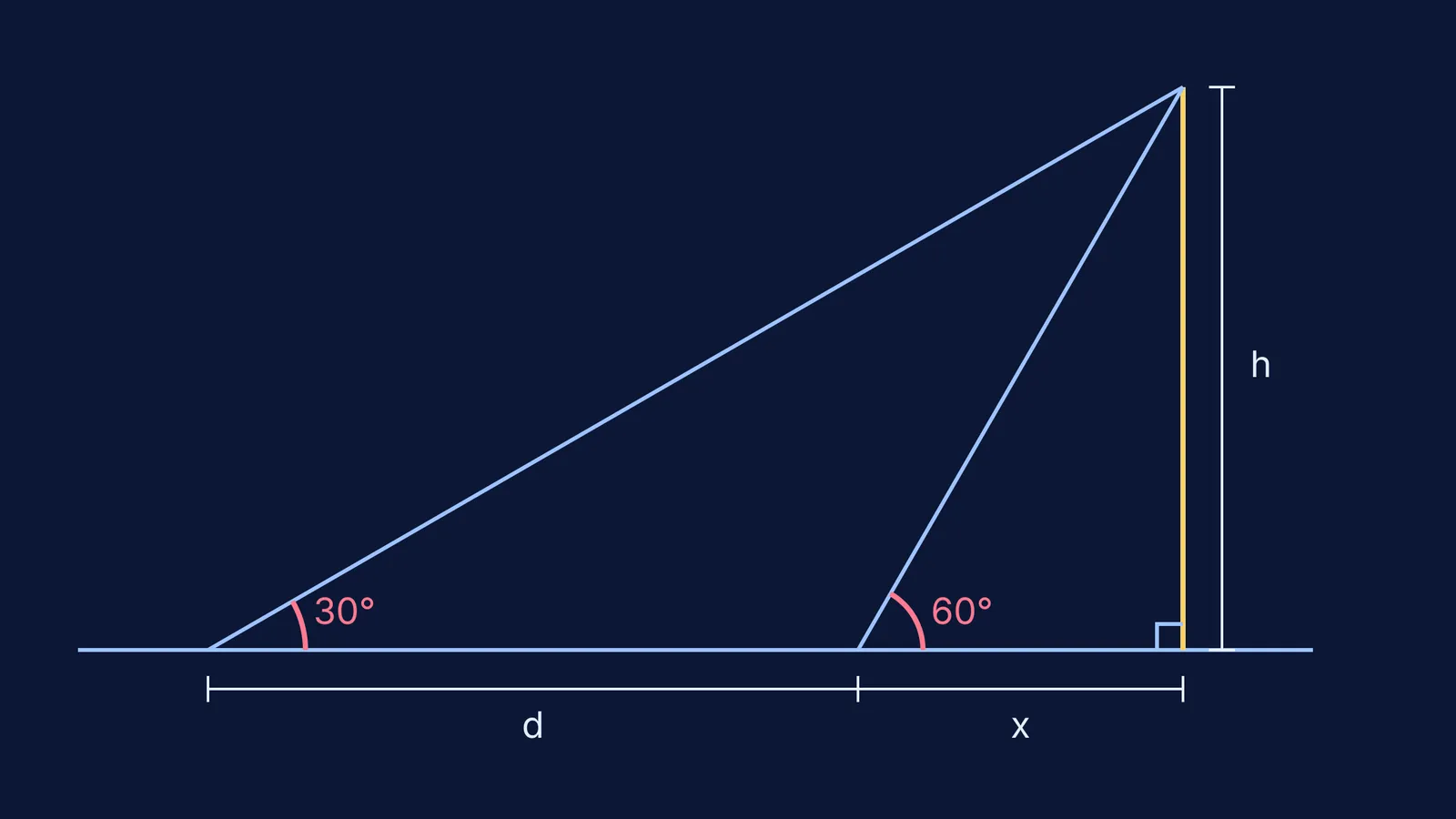
Draw a horizontal line for the ground and a vertical line for the tower of height h.
Mark the first position of the observer far away. The angle to the top is 30°.
Mark the second position closer to the tower. The angle to the top is 60°.
Label the distance walked between the two points as d.
Label the remaining distance from the second point to the base of the tower as x.
This gives you two overlapping triangles. The small triangle has an angle of 60° and a base of x. The large triangle has an angle of 30° and a base of x + d. Both have the same height h.
Angle of elevation changes from 30 to 60: how to find the height?
Let's run through the exact algebra for the most common version of this question. We want to eliminate the unknown remaining distance x so we can find h using only the distance walked d.
First, write the equation for the smaller triangle (60°): tan 60° = h / x. Since tan 60° = √3, we get √3 = h / x, which means x = h / √3.
Next, write the equation for the larger triangle (30°): tan 30° = h / (x + d). Since tan 30° = 1 / √3, we get 1 / √3 = h / (x + d). Cross-multiply to get x + d = h√3.
Now, substitute x = h / √3 into the second equation to get (h / √3) + d = h√3, which rearranges to d = h√3 − (h / √3).
To subtract these, put them over a common denominator: d = (3h − h) / √3, which simplifies to d = 2h / √3.
Finally, rearrange to solve for the height h: h = d√3 / 2.
Does this work for other angles?
The exact formula h = d√3 / 2 only works when the angles are 30° and 60°, because of their specific tangent values. However, the two-triangle setup is universal. If the angles were 45° and 60°, you would still set up x for the small base and x + d for the large base, and solve the two tangent equations to eliminate x.
For another example of how an unknown starting point changes the equation, you can see how we calculate the distance in the nth second using similar algebraic substitution.


