

On this page
When solving height and distance problems in trigonometry, the hardest part is rarely the algebra. It is drawing the triangle. Research using Newman’s Error Analysis shows that a major hurdle for students is the "transformation" stage—when you understand the words in the problem but fail to translate them into a correct geometric diagram.
The most frequent culprit is the confusion between the angle of elevation and the angle of depression. While they sound like opposites, geometrically they are closely related.
What is the difference between angle of elevation and angle of depression?
The difference lies entirely in where you are standing and where you are looking. According to the official NCERT curriculum, both angles must be measured against a horizontal "line of sight" extending from the observer's eye.
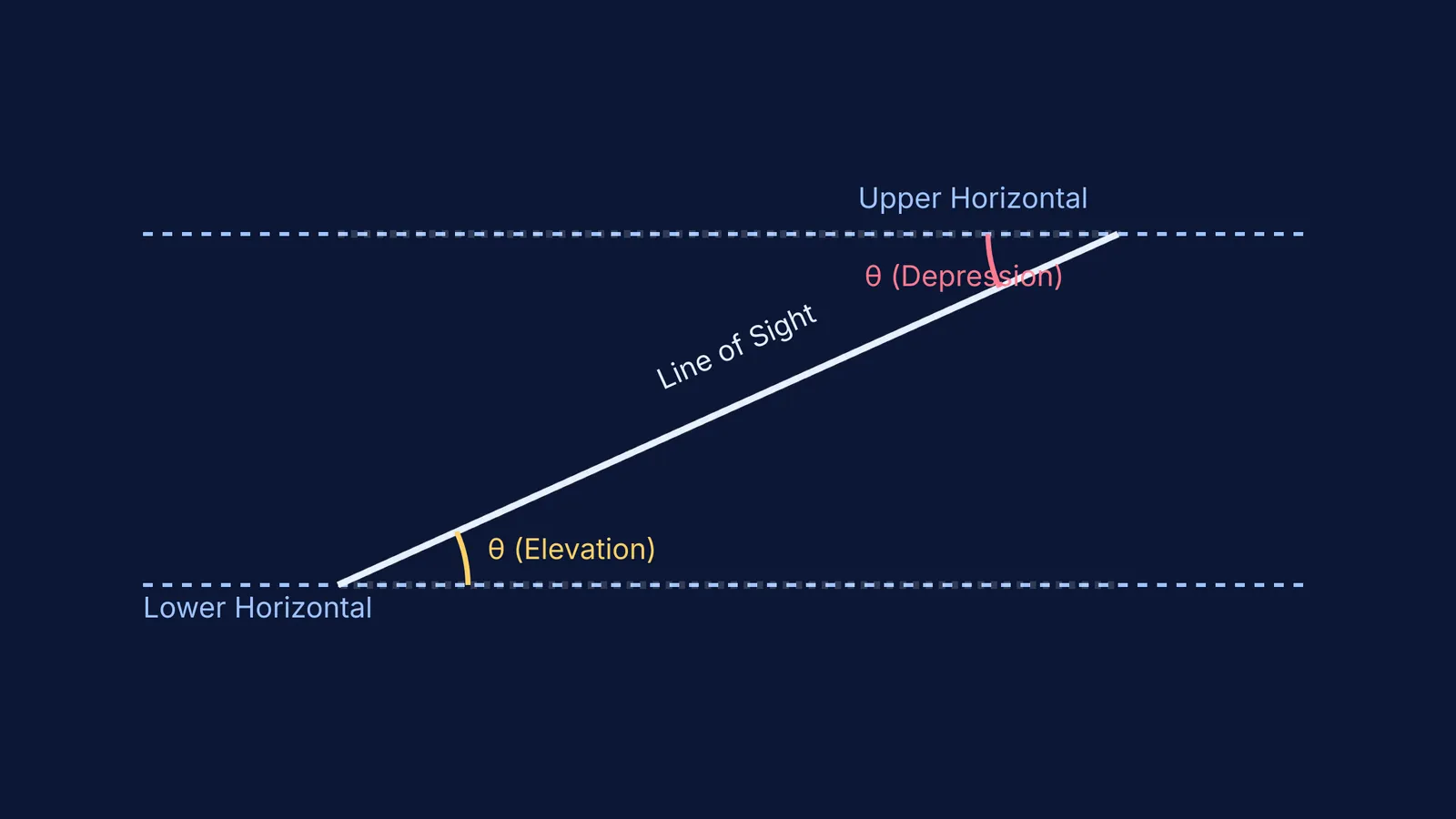
Angle of elevation: This is formed when the object is above the horizontal level. You raise your head to look up at it. The angle sits between the horizontal line and your upward gaze.
Angle of depression: This is formed when the object is below the horizontal level. You lower your head to look down at it. The angle sits between the horizontal line in the sky and your downward gaze.
If you are standing on the ground looking up at a kite, you use the angle of elevation. If you are standing on a balcony looking down at a car, you use the angle of depression.
What is the most common mistake in angle of depression problems?
The reason the angle of depression causes so much trouble is that its horizontal reference line hangs in empty space.
When a word problem says, "the angle of depression from the top of a 50-metre tower to a boat is 30°," the instinctive reaction is to draw a vertical line for the tower, a diagonal line to the boat, and place the 30° angle inside the top of the triangle, right against the vertical tower.
This is incorrect. Angles of elevation and depression are never measured from the vertical. Placing the angle against the tower gives you the complement (60°), which will lead you to use the wrong trigonometric ratio. The 30° angle must sit outside the main triangle, between the downward line of sight and an imaginary horizontal line drawn straight out from the top of the tower.
Why are the angle of elevation and angle of depression equal?
If a person on the ground looks up at a person on a tower, and the person on the tower looks down at the person on the ground, their line of sight is the exact same diagonal line.
Because both observers measure their angles from a horizontal line, and all horizontal lines are parallel to each other, this diagonal acts as a transversal. From basic geometry, we know that alternate interior angles are equal. Therefore, the angle of elevation looking up is exactly equal to the angle of depression looking down.
If you struggle to picture this, the Fermi Concept Library has a lesson on parallel lines and alternate angles to help you review before you set up your equations.
How do you draw a diagram for height and distance problems?
To avoid transformation errors in your next exam, follow this sequence when translating a word problem into a diagram:
Draw the ground and the vertical objects: Sketch the horizontal ground line, then add towers, cliffs or buildings as vertical lines meeting the ground at 90°.
Mark the observer's eye level: If the problem gives the observer a height (for example, a 1.5-metre tall student), draw a horizontal line at that height. If not, place the observer as a point on the ground or at the top of the building.
Draw the horizontal reference: For an angle of depression, draw a dashed horizontal line straight out from the top observer.
Draw the line of sight: Connect the observer to the object with a diagonal line.
Mark the angle: Place the angle between the horizontal line and the diagonal line of sight.
Use the Z-pattern: If you have an angle of depression, trace the "Z" shape formed by the top horizontal, the diagonal, and the bottom horizontal. Move the angle down to the ground inside the triangle. This lets you use standard right-angled trigonometry without working outside the triangle.
If you want to review the basic ratios before tackling word problems, see our guide on the Introduction to trigonometry in Class 10 or practice with Trigonometric identities and equations.


