

On this page
Combinatorics questions involving "at least" or "at most" conditions are staples of the Class 11 mathematics syllabus and competitive exams. They test whether you understand the fundamental counting principle—specifically, when to multiply combinations and when to add them.
The most common mistake is confusing these two operations. If you are stuck on setting up cases for a word problem, the Fermi Problem Library has worked examples with a step-by-step solver that explains the reasoning rather than just printing the final answer.
How do you select 2 boys and 3 girls from a class?
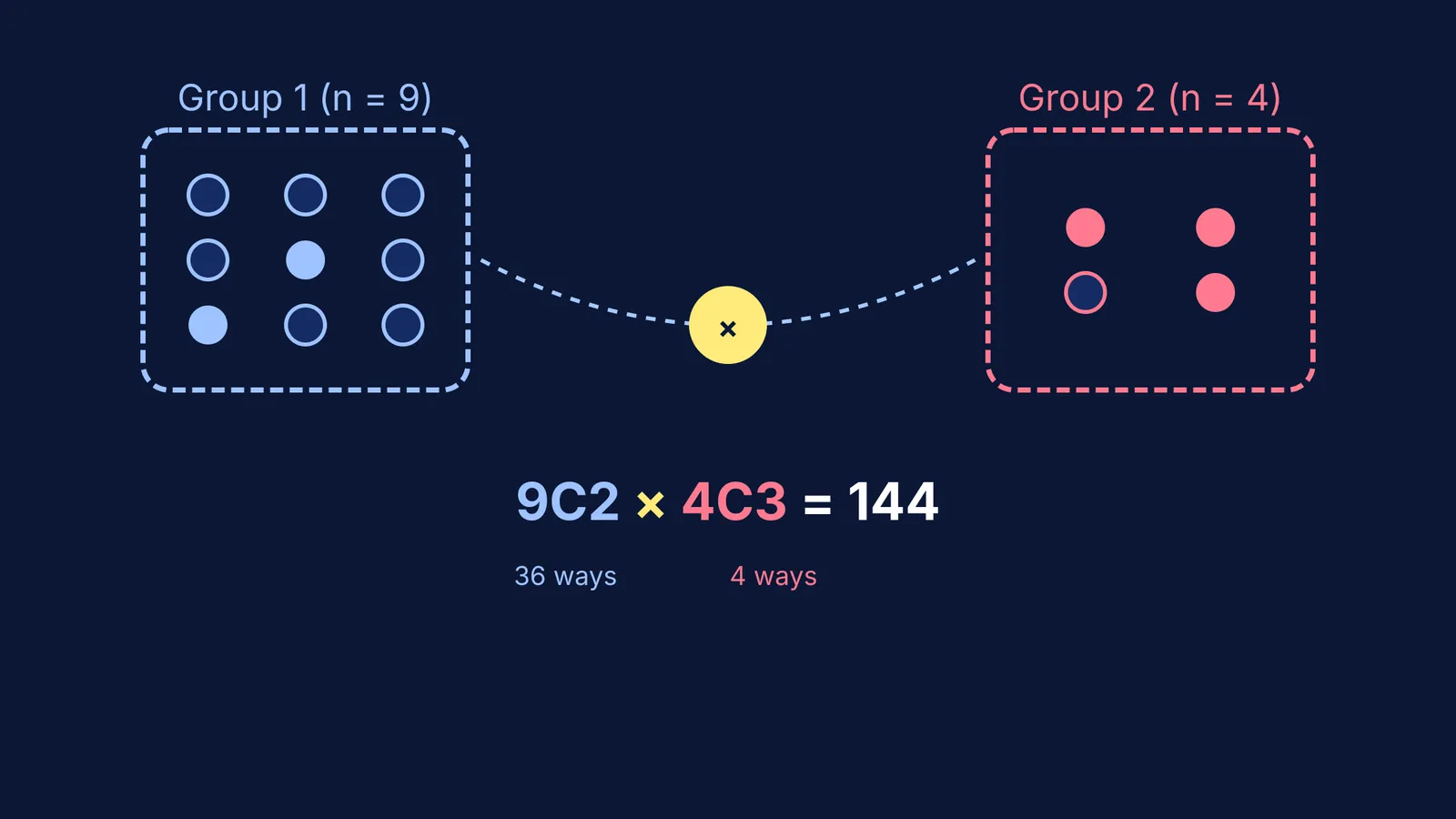
Let us take a standard example from the curriculum. A class has 9 boys and 4 girls. You need to form a committee of 5 students consisting of exactly 2 boys and 3 girls.
First, you are choosing individuals from separate, distinct groups. The order in which you pick the students does not matter, so you use the combinations formula:
nCr = n! / [r!(n - r)!]
You handle each group on its own:
Choosing the boys: You need 2 boys from a group of 9. This gives 9C2 = 36 ways.
Choosing the girls: You need 3 girls from a group of 4. This gives 4C3 = 4 ways.
Because these two selections must happen together to complete your committee, you multiply their results. The total number of ways to form the committee is 36 × 4 = 144.
Why we multiply combinations for different groups
This multiplication step is an application of the fundamental principle of counting. When one operation (choosing the boys) can be performed in 36 ways, and for every one of those ways, a second operation (choosing the girls) can be performed in 4 ways, the two operations together can be performed in 36 × 4 ways.
You multiply when the problem implies "AND". You are choosing boys AND girls to make a single team. For a deeper look at the logic, read When to add and when to multiply in counting problems.
How to solve "at least" and "at most" conditions?
Problems become more complex when they introduce constraints like "at least" or "at most". Suppose the same class of 9 boys and 4 girls needs a committee of 7 students, but the condition is now that the committee must have at least 3 girls.
"At least 3" means the committee can have 3 girls, or it can have 4 girls. It cannot have 5 girls because there are only 4 girls in the class. You must break the problem down into mutually exclusive cases.
Case 1: 3 girls and 4 boys
Select 3 girls from 4: 4C3 = 4 ways.
Select 4 boys from 9: 9C4 = 126 ways.
Multiply within the case: 4 × 126 = 504 ways.
Case 2: 4 girls and 3 boys
Select 4 girls from 4: 4C4 = 1 way.
Select 3 boys from 9: 9C3 = 84 ways.
Multiply within the case: 1 × 84 = 84 ways.
Because Case 1 and Case 2 cannot happen at the same time (the committee either has 3 girls OR 4 girls), you add the results of the cases together.
Total ways = 504 + 84 = 588.
You add when the problem implies "OR". You can see more visual examples in Permutations vs combinations visualised: picking 3 of 5 books.
What happens with "at most" conditions?
The process for "at most" conditions is exactly the same, but you count downwards to zero. If you need to form a committee of 5 students from 9 boys and 4 girls with at most 2 girls, your cases would look like this:
Case 1: 2 girls and 3 boys (4C2 × 9C3)
Case 2: 1 girl and 4 boys (4C1 × 9C4)
Case 3: 0 girls and 5 boys (4C0 × 9C5)
A common mistake here is forgetting Case 3. "At most 2 girls" allows for the possibility of having no girls at all on the committee. You must calculate all three cases and add them together to find the total number of ways. To see this in action for other scenarios, check out How to choose a committee with a chairperson.
Why do students struggle with combinations?
It is easy to get lost in the factorials and forget what you are actually counting. A 2013 theoretical model of combinatorial thinking published in The Journal of Mathematical Behavior noted that students often focus too heavily on formulas without grounding them in the actual objects being counted.
The researcher, Elise Lockwood, found that successful students connect the mathematical operations to the "sets of outcomes"—the actual groups of students you could list out. If you jump straight to the nCr formula without taking a moment to visualise the groups you are forming, you are much more likely to multiply when you should add, or miss a case entirely.
If you are unsure whether your cases cover every possibility, Fermi's AI tutor can check your logic. Instead of just giving the answer, it works out what you already know, builds a plan for the session, and checks your understanding of the counting process before you apply the formula.
Always start by defining your cases in plain English. Once you know exactly what "at least" means for your specific groups, the combinations formula will do the heavy lifting for you.


