

On this page
In an Ohm's law practical, the observation table starts before any reading: range and least count of the ammeter, then of the voltmeter. The NCERT Class 12 physics lab manual makes it step 4: "Note the range and least count of the given voltmeter and milliammeter." Those numbers decide how big your error will be.
What do range and least count mean on an ammeter?
The range is the largest value the meter can show on the scale you are using, for example 0–500 mA.
In ammeters and voltmeters, the least count is the value of the smallest division on the scale, as the IGNOU physics lab manual on current and voltage measurements defines it.
To find it, divide the range by the number of divisions. IGNOU's example: if 10 divisions on the ammeter scale equal 1 A, the least count is 0.1 A.
Why does the wrong meter range give a large error?
The NCERT manual estimates the error in resistance as ΔR/R = ΔV/V + ΔI/I, where ΔV and ΔI are the least counts of the voltmeter and milliammeter (NCERT Class 12 lab manual).
The least count is fixed, so each fraction shrinks only when the reading sits high on the scale.
An analogue meter's accuracy class works the same way: it is a percentage of full-scale deflection, so a class 2 meter on a 100 V scale can be off by up to 2 V (class of accuracy). That is 2% of a 100 V reading but 20% of a 10 V reading.
Too large a range can make a reading useless. IGNOU's manual describes a 0–1 A ammeter with a 0.1 A least count used on a diode carrying a few mA: the deflection may be too small to read at all (IGNOU manual). Too small a range sends the needle off the scale, and the same manual warns that heavy current can damage meters.
How do you choose the correct ammeter and voltmeter range in a practical?
IGNOU's manual bases the choice on the source voltage and the total resistance. Its example: a 0–5 V source and a 1,000 Ω resistor give at most 5 mA, so it picks a 0–10 V voltmeter and a 0–10 mA ammeter (IGNOU manual).
Find the largest voltage the cells or eliminator can give.
Estimate the largest current, I = V ÷ R, with the smallest resistance the circuit can have.
Pick the next range above each number.
Count the divisions, work out the least count, and write both in your table.
Check each pointer sits on zero and current enters at the + terminal.
Start with the rheostat set for minimum current.
If the needle barely moves, ask your teacher for a lower range.
The NCERT Class 10 lab manual tells teachers the same thing: with meters of other ranges, choose resistors "so that an appreciable deflection may appear".
Worked example: which meters for a 10 Ω wire?
The NCERT Class 12 experiment uses a wire of about 10 Ω, a 0 to 3 V source, a 0–5 V voltmeter and a 0–500 mA milliammeter. The largest current is 3 V ÷ 10 Ω = 300 mA, and the rheostat only lowers it. So both meters sit just above the largest readings: 500 mA above 300 mA, 5 V above 3 V.
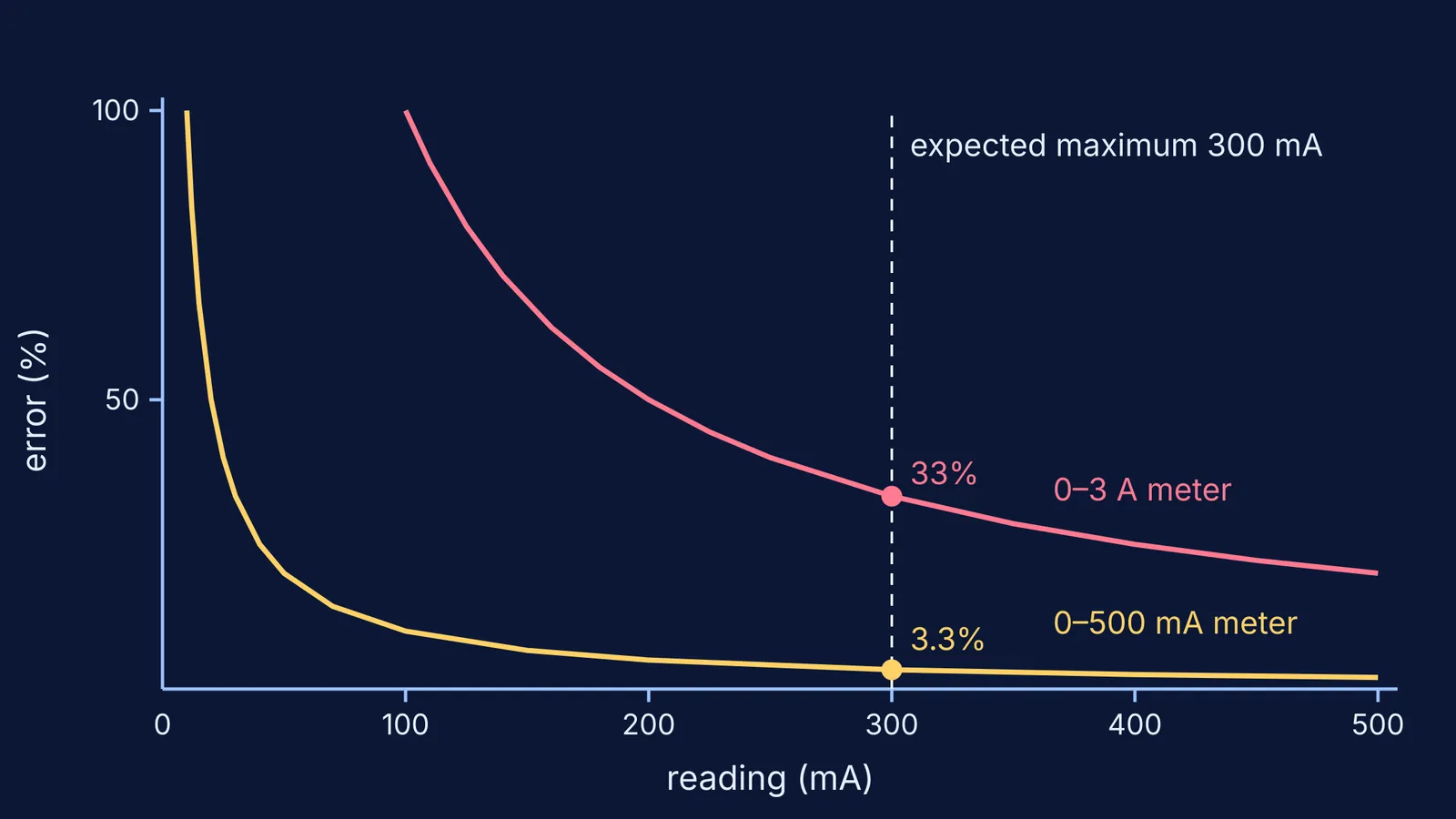
Suppose the milliammeter has 50 divisions, a least count of 10 mA. Suppose you used a 0–3 A ammeter instead, like the Class 10 kit's, with 30 divisions and a least count of 0.1 A.
At 300 mA: 10 ÷ 300 is about 3.3% on the milliammeter, but 0.1 ÷ 0.3 is about 33% on the 0–3 A meter.
At 100 mA: 10% on the milliammeter, 100% on the 0–3 A meter.
Now use NCERT's formula. A voltmeter reading of 2.50 V with a 0.1 V least count gives ΔV/V = 4%. A current of 250 mA on the milliammeter adds 4%, so ΔR/R = 8%. On the 0–3 A meter that current falls between the 0.2 and 0.3 marks: ΔI/I = 40% and ΔR/R = 44%.
If error numericals like this trip you up, the Fermi Problem Library has worked problems with a step-by-step solver that explains the reasoning rather than printing an answer.
What should go in your practical record?
Range and least count of each meter, with units.
Any zero error and how it was corrected.
Readings written to the least count, not beyond it.
One line on why you chose each range, ready for the viva.
The same habit applies to length in reading the least count of a metre scale. For the graph, see finding resistance from an Ohm's law graph slope, and for the wider picture, why practical marks drop in board exams.
Next time the meters land on your bench, do the one-line sum V ÷ R before you touch the key.


