

On this page
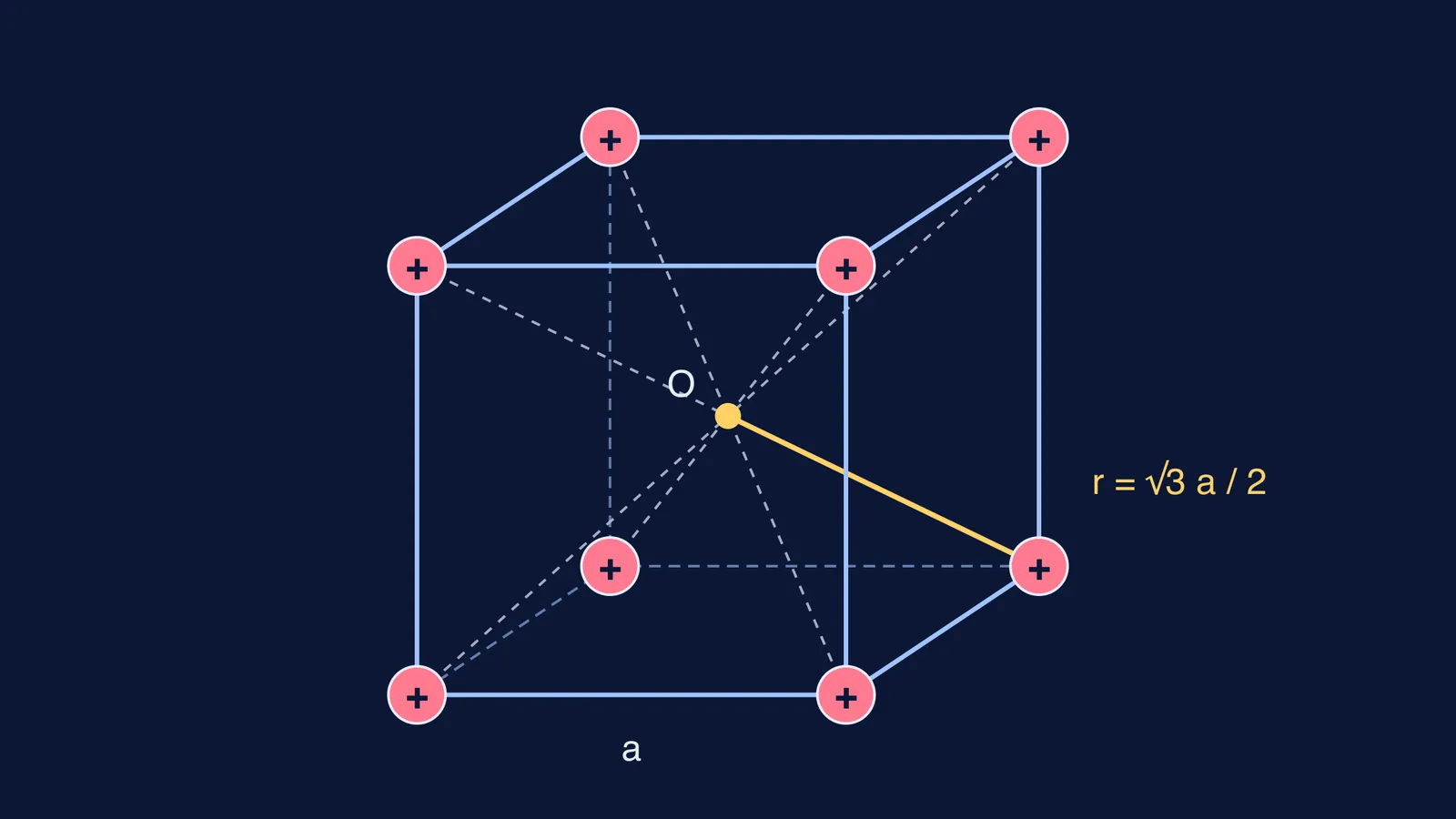
This is a standard electrostatics question in Class 12 and JEE Main practice: eight charges, each q, sit on the corners of a cube of side a. Find the potential and the field at the centre. The whole problem rests on one distance and one idea.
What is the potential at the centre of a cube with charges at the corners?
Start with the distance, where most wrong answers begin.
The diagonal of one face is √(a² + a²) = a√2.
The body diagonal joins two opposite corners through the centre. It is the hypotenuse of a right triangle with legs a√2 and a, so it is √(2a² + a²) = a√3.
The centre is the midpoint of every body diagonal, so each corner is r = √3a/2 from the centre.
Our post on the angle between two diagonals of a cube works through the same geometry with vectors.
The potential of a point charge is V = kq/r, where k = 8.99 × 10⁹ N·m²/C² (OpenStax University Physics, Volume 2, section 7.3). The same OpenStax section says the net potential at a point is the sum of the individual potentials, because potential is a scalar and has no direction. So you add eight equal numbers:
V = 8 × kq/(√3a/2) = 16kq/(√3a)
Written with ε₀ in place of k = 1/(4πε₀), this becomes V = 4q/(√3πε₀a). Answer keys use both forms. This V is measured from the usual zero at infinity. If you are unsure why that choice is allowed, read why the zero of potential energy can go anywhere.
Why is the electric field at the centre zero when the potential is not?
The electric field is a vector, and the total field from several charges is the vector sum of their separate fields (OpenStax University Physics, Volume 2, section 5.4).
Pair each corner with the corner opposite it, at the other end of the same body diagonal. The two charges are equal and the same distance from the centre, so their fields are equal in size. The two fields lie along the same line but point in opposite directions, so each pair gives zero. Four pairs give a total field of zero.
OpenStax makes the same point in Example 7.12, on a dipole: evaluating potential is significantly simpler than finding the field, because potential is a scalar (OpenStax, section 7.3).
Worked example: what is V for 2 µC charges on a 10 cm cube?
Take q = 2 µC = 2 × 10⁻⁶ C and a = 10 cm = 0.1 m, with k = 8.99 × 10⁹ N·m²/C² from the OpenStax point-charge formula.
Distance: r = √3 × 0.1/2 ≈ 0.0866 m.
One charge: kq/r = (8.99 × 10⁹ × 2 × 10⁻⁶)/0.0866 ≈ 2.08 × 10⁵ V.
Eight charges: V ≈ 8 × 2.08 × 10⁵ ≈ 1.66 × 10⁶ V.
Field: E = 0, by the pairing argument above.
If a question then asks for the work needed to bring a small charge q₀ from infinity to the centre, it is simply W = q₀V.
How do exams change the cube problem?
Setters keep the cube and change the charges.
One corner empty, seven charges q: V = 7kq/r. For the field, think of the full cube (E = 0) minus the missing charge. The answer is a field of size kq/r² = 4kq/(3a²), pointing towards the empty corner.
Top face +q, bottom face −q: the eight potentials cancel, so V = 0. The fields do not cancel. Every charge pushes or pulls the field towards the negative face, giving E = 32kq/(3√3a²), straight from the positive face to the negative one.
Alternating +q and −q, so every edge joins opposite signs: V = 0, and E = 0 as well. Opposite corners now carry opposite charges, so each pair's fields add, but the four pair fields point in a symmetric tetrahedral pattern and sum to zero.
For the Gauss's law version, see flux through each face when a charge is at the centre of a cube.
A 30-second check before you mark your answer
Did you use √3a/2, not a/2 or a√2/2?
Did you add potentials as signed numbers, with no directions?
Did you pair opposite corners for the field before calculating anything?
Does V = 0 with E ≠ 0, or the reverse, make sense for this arrangement?
If you want more practice on these symmetry problems, the Fermi Problem Library has worked problems with a step-by-step solver that explains the reasoning rather than printing an answer. If the idea of potential as a scalar still feels shaky, the Fermi Concept Library gives each concept in physics its own lesson and shows where it fits in the map.


