On this page
Put an electric and a magnetic field along the same line, fire a charge across them, and the path is a spring that stretches as it goes: the loops stay the same size, but each is longer than the last. JEE Main and JEE Advanced problems use it to test whether you can split a motion into independent parts.
Why does a charge move in a helix in parallel E and B fields?
Split the velocity into parts across the fields (v⊥) and along them (v∥).
Across the fields. The magnetic force is always perpendicular to the velocity, so it does no work and the speed stays constant, as OpenStax University Physics/University_Physics_II_-_Thermodynamics_Electricity_and_Magnetism_(OpenStax)/11%3A_Magnetic_Forces_and_Fields/11.04%3A_Motion_of_a_Charged_Particle_in_a_Magnetic_Field) explains. The same section gives the radius r = mv/qB and the period T = 2πm/qB. E has no component across the fields, so the cross-section motion is uniform circular motion.
Along the fields. The magnetic force on a charge moving parallel to B is zero, according to HyperPhysics. Only qE acts along the line, so the charge has a constant acceleration a = qE/m.
Together: a fixed circle sliding ever faster along the axis, which is a helix whose pitch grows.
What is the pitch after n turns?
For constant v∥, OpenStax defines the pitch as p = v∥T. Here v∥ changes, so use uniform-acceleration kinematics. Every turn still takes exactly T, because T does not depend on speed (our post on why the cyclotron frequency does not depend on speed shows this in a simulation).
With initial speed u along the field, z = ut + ½at². The nth pitch is the distance covered between t = (n − 1)T and t = nT:
p(n) = uT + ½aT²(2n − 1)
If the charge starts with no velocity along the field (u = 0), substitute a = qE/m and T = 2πm/qB:
p(n) = (2n − 1) × 2π²mE/(qB²)
So:
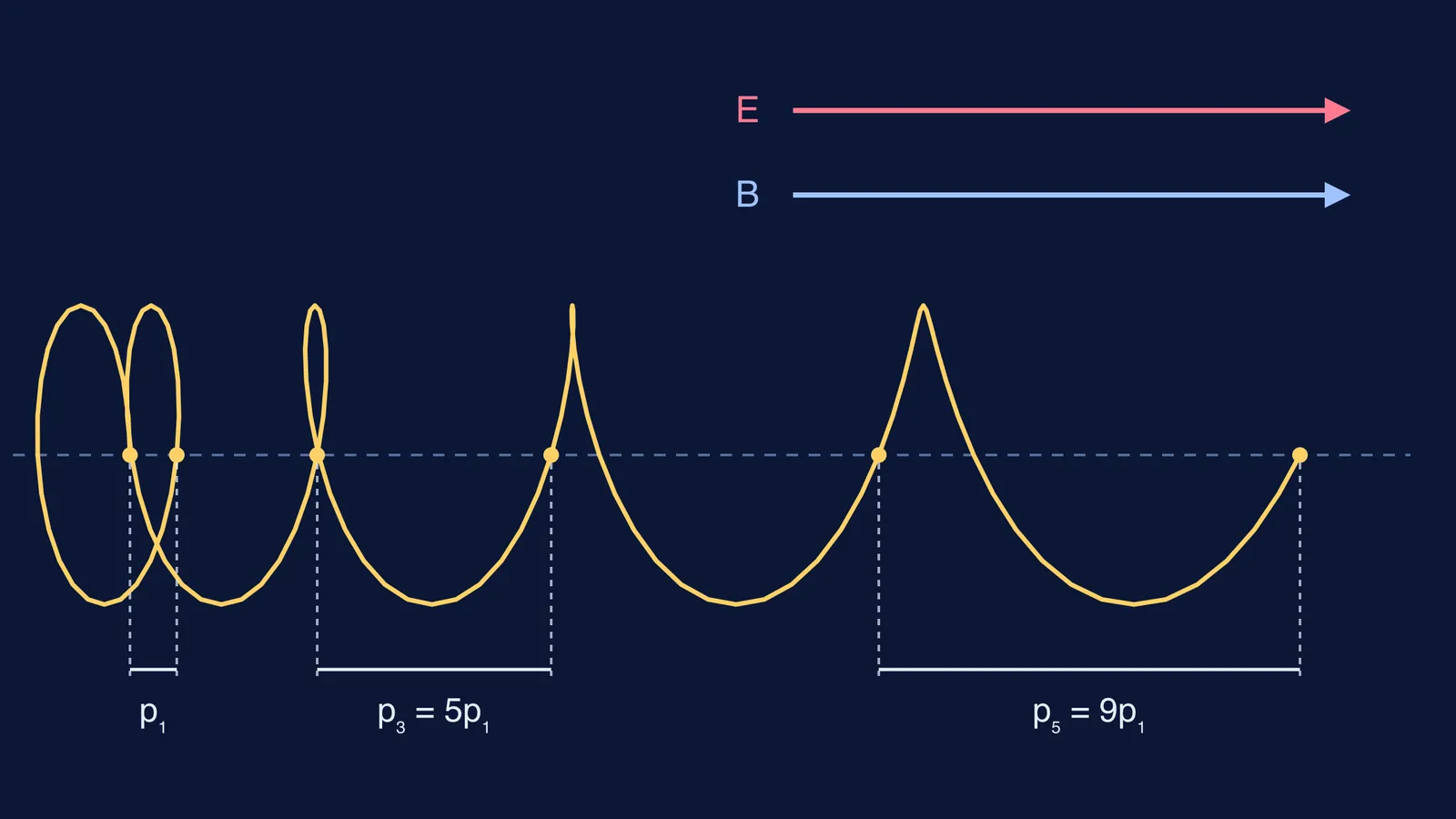
Pitches go 1 : 3 : 5 : 7, like distances fallen in equal time intervals from rest.
Each pitch exceeds the one before by aT² = 4π²mE/(qB²).
After n turns the charge has moved n² times the first pitch.
If u points against qE, the charge slows along the field, stops, then moves back with growing pitch.
Worked example: a proton in parallel fields
The proton mass is 1.672 621 925 95 × 10⁻²⁷ kg (NIST CODATA 2022), and the elementary charge is exactly 1.602 176 634 × 10⁻¹⁹ C (NIST). Take B = 0.5 T and E = 1.0 × 10⁴ V/m, both along +z, and a proton entering at 1.0 × 10⁵ m/s along x.
Period: T = 2πm/(eB) = 1.31 × 10⁻⁷ s.
Radius: r = mv/(eB) = 2.09 mm, the same on every turn.
Acceleration along z: a = eE/m = 9.58 × 10¹¹ m/s².
First pitch: p(1) = ½aT² = 8.24 mm.
Fifth pitch: p(5) = 9 × p(1) = 74.2 mm.
Distance along the field after five turns: 25 × p(1) = 206 mm.
After five turns the speed along z is a × 5T, about 6.3 × 10⁵ m/s, far below light speed, so non-relativistic formulas hold.
If the helix feels shaky, try the helical path of a charge in a magnetic field alone, where the pitch is constant, or the Fermi Concept Library, which gives each concept its own lesson.
How is this different from the cycloid in crossed fields?
Turn E through 90° so it is perpendicular to B, and release the same proton from rest. The guiding centre drifts at E/B along E × B, a speed that is the same for any charge and mass (Wikipedia: Guiding center). The path is a cycloid whose maximum displacement along E is twice the rolling radius (E/B)/(qB/m), that is 2mE/(qB²) (QuickField crossed-field example).
With the numbers above, the drift speed is 2.0 × 10⁴ m/s, the proton never gets more than 0.835 mm from its start along E, and it advances 2.62 mm per period.
Parallel fields: E keeps doing work, so energy grows without limit; radius fixed, pitch growing.
Crossed fields: the proton gains energy moving along E, loses it coming back, and stops at each cusp.
Cross-check: p(1) = 2π²mE/(qB²) is exactly π² times the cycloid's maximum height, and 8.24 mm ÷ 0.835 mm ≈ 9.87. Our post on why a charge in crossed E and B fields traces a cycloid derives that path in full.
How do you tell which path a question wants?
Check the angle between E and B, then the starting velocity:
E along B, charge launched across: helix, fixed radius, growing pitch.
B only, velocity at an angle: helix, constant pitch.
E across B, released from rest: cycloid drifting along E × B.
E across B, moving at exactly E/B perpendicular to both: straight line, since qE and qvB cancel.
If you pick the right picture but slip in the algebra, the Fermi Problem Library has worked problems with a step-by-step solver that explains the reasoning rather than printing an answer.
Next step: redo the example with an electron, predicting its direction along the field first.