On this page
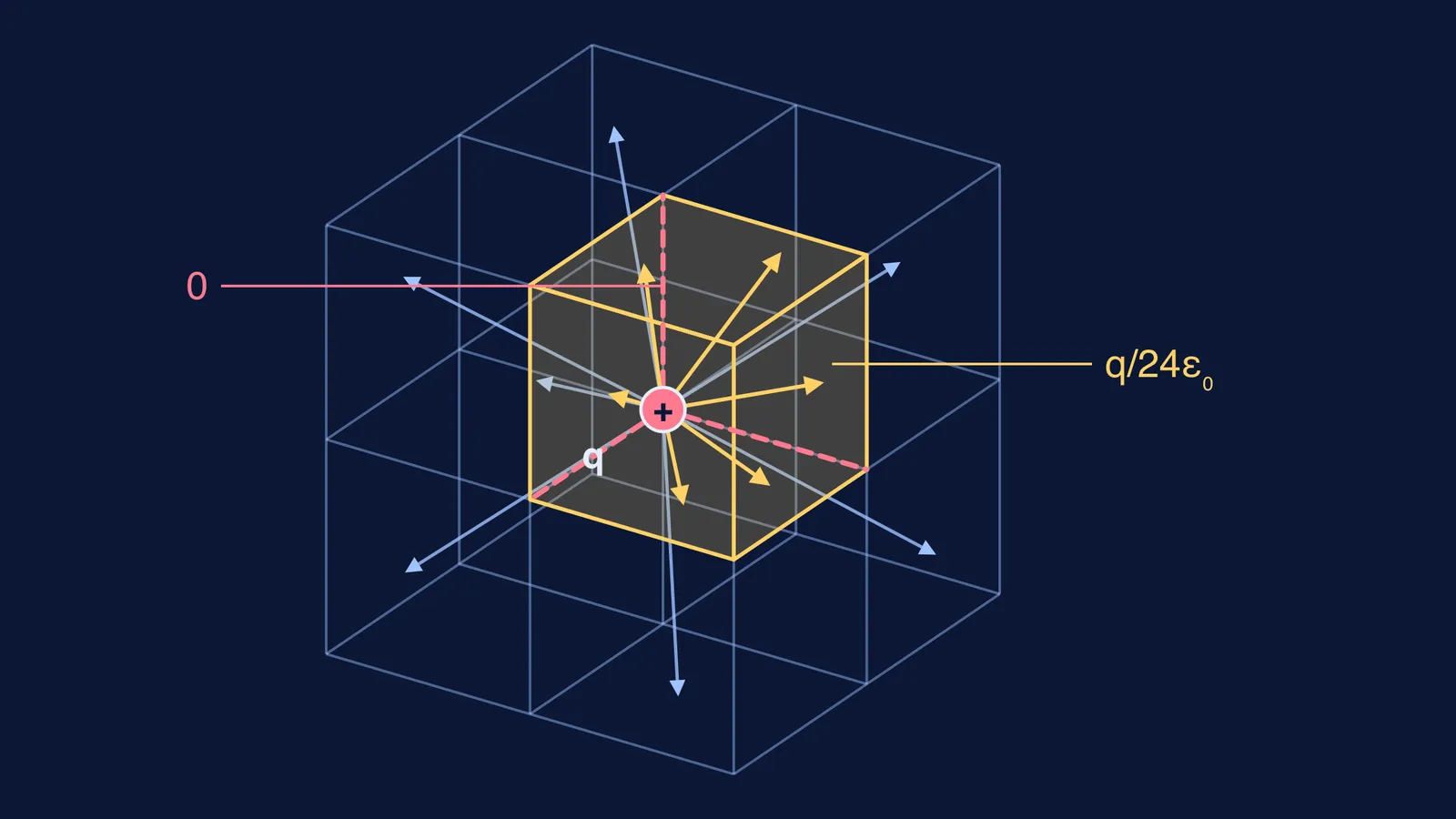
Put a point charge q on one corner of a cube and ask for the flux through it. It looks like a hard integral, but one picture turns it into two divisions. Below we use that picture, explain why three faces get nothing, and check the answer face by face on a calculator.
What is the flux through a cube when the charge is at a corner?
Gauss's law, as OpenStax University Physics, Volume 2 states it, says the flux through any closed surface equals the net charge enclosed divided by ε₀. A charge on the corner is not inside the cube, so the trick is to build a closed surface that does surround it.
Stack eight identical cubes so they share that one corner. Together they make a bigger cube with the charge at its exact centre. The big cube encloses q, so the total flux out of it is q/ε₀.
The charge sees all eight small cubes the same way, so each gets an equal share:
Flux through one small cube: q/ε₀ ÷ 8 = q/8ε₀.
Each small cube has three faces that touch the charge and three far faces that do not.
The touching faces carry zero flux (next section), so the three far faces share q/8ε₀ equally.
Flux through each far face: q/8ε₀ ÷ 3 = q/24ε₀.
Why do the three faces touching the charge get zero flux?
Flux through a surface counts only the part of the field that crosses it. The OpenStax chapter on electric flux defines it as the dot product of the field with the area vector, and notes that when a surface lies along the field lines, none pass through and the flux is zero.
A point charge's field points straight away from the charge. The face in the plane x = 0 contains the charge, so the line from the charge to any point on it stays in that plane. The field runs along the face, and its normal (x) component is zero everywhere. The same holds for the y = 0 and z = 0 faces.
So do not split q/8ε₀ six ways: q/48ε₀ per face is a common wrong answer.
Does a face-by-face calculation agree?
You can test the symmetry answer by adding up E · dA on one far face, using the flux definition from the OpenStax flux page. Put the charge at the origin and take a cube of side a = 1. On the far face x = 1, the normal component of the field at (1, y, z) is
E_x = (q/4πε₀) × 1/(1 + y² + z²)^(3/2)
So the flux through that face is (q/4πε₀) × I, where I is the integral of 1/(1 + y² + z²)^(3/2) over the unit square. The symmetry argument predicts q/24ε₀, which needs I = 4π/24 = π/6 ≈ 0.5236.
Split the face into four squares of side 0.5 and use the value at each centre:
Centre (0.25, 0.25): 1 + y² + z² = 1.125, so the integrand is about 0.838.
Centre (0.25, 0.75): 1.625, so about 0.483.
Centre (0.75, 0.25): the same as above, about 0.483.
Centre (0.75, 0.75): 2.125, so about 0.323.
The sum is 2.126. Multiply by the area of each square, 0.25, and you get I ≈ 0.532. That is within 2% of π/6 with only four points.
A 4 × 4 grid (centres at 0.125, 0.375, 0.625 and 0.875) gives I ≈ 0.5256, within 0.4% of π/6. The estimate closes in on 0.5236 as the grid gets finer, as it should if the symmetry answer is right. On the touching faces every term is zero, because E_x = 0 on the plane x = 0.
If you want more worked problems where symmetry replaces an integral, the Fermi Problem Library has a step-by-step solver that explains the reasoning rather than printing an answer.
How do exam questions change this setup?
Count how many identical cubes share the charge's position:
Charge at the centre of the cube: one cube, flux q/ε₀ (see our post on flux through each face with the charge at the centre).
Charge at the centre of a face: two cubes share it, flux q/2ε₀.
Charge at the midpoint of an edge: four cubes share it, flux q/4ε₀.
Charge at a corner: eight cubes share it, flux q/8ε₀, and q/24ε₀ per far face.
A short checklist before you write the answer:
Does the question ask for the whole cube or one face?
Which faces contain the charge? Those get zero.
Are the remaining faces equal by symmetry? If not, the simple division does not work.
Each far face also covers 4π/24 steradians as seen from the corner; our explainer on solid angles and steradians shows why flux and solid angle go together.
If flux itself still feels shaky, the Fermi Concept Library gives each concept in physics its own lesson.