

On this page
If you look at the Moon and the Sun from Earth, they appear to be almost exactly the same size. The Sun is vastly larger than the Moon, but it is also much further away. In physics and astronomy, we describe this "apparent size" using a solid angle.
While a flat, two-dimensional angle measures how far two lines spread apart, a solid angle measures how much of your field of view a three-dimensional object occupies. Understanding this idea is crucial for solving flux problems in electromagnetism or calculating luminous intensity in optics.
What is a solid angle and a steradian?
A solid angle (often denoted by the Greek letter Ω) projects a three-dimensional view onto the surface of a sphere. In the International System of Units (SI), the unit of solid angle is the **steradian (sr)**.
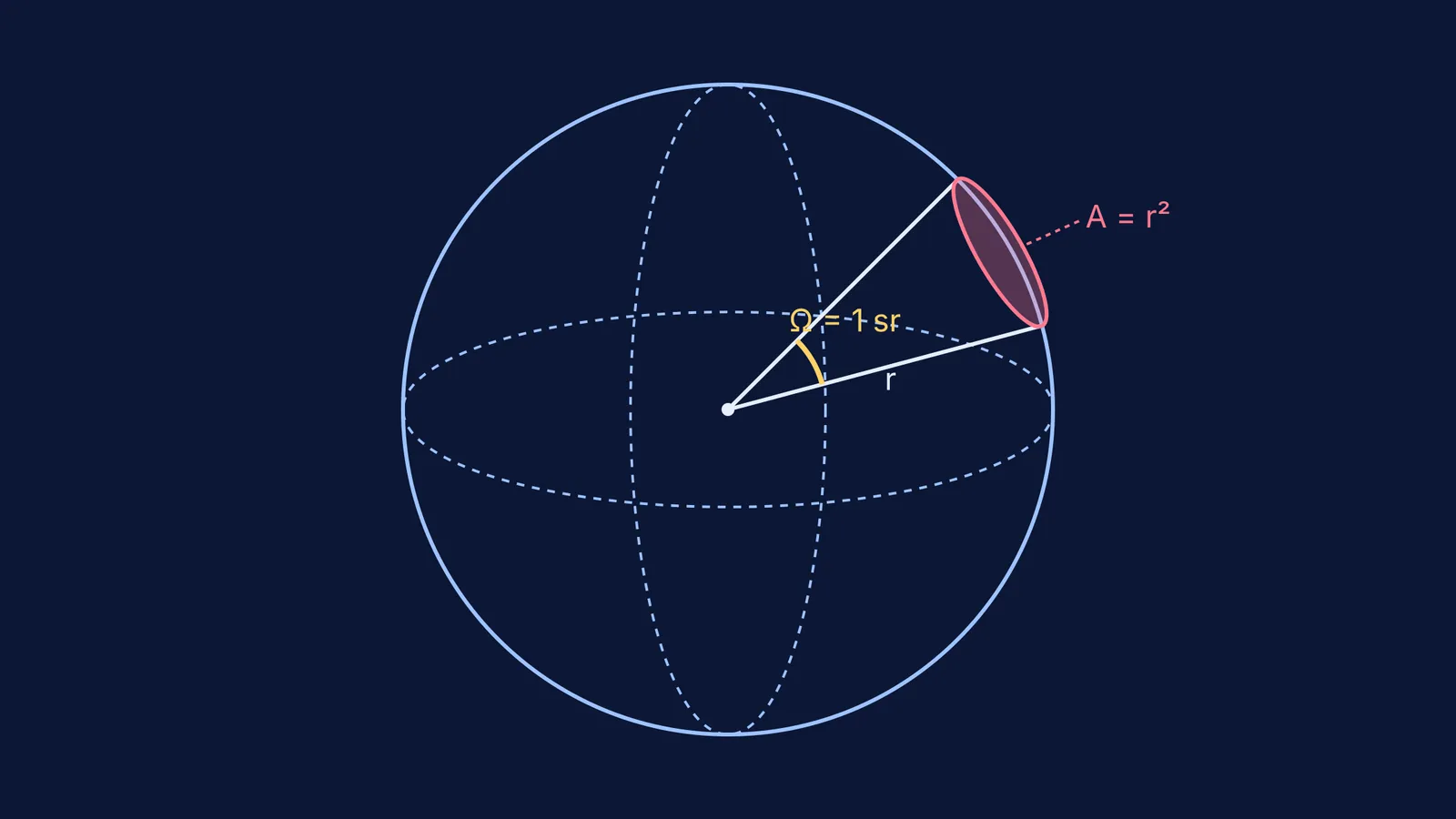
One steradian is defined geometrically. Imagine you are at the centre of a sphere of radius r. A steradian is the solid angle that subtends a surface area on the sphere exactly equal to r².
The formula for the solid angle is: Ω = A/r²
Here, A is the spherical surface area covered by the object, and r is the distance from the observer. Because you are dividing an area (square metres) by a distance squared (square metres), the steradian is a dimensionless quantity.
To put this into perspective, if you hold a curved square patch that measures 1 metre by 1 metre, and you stand exactly 1 metre away from its centre, that patch subtends a solid angle of exactly 1 steradian. As you move further away, the r² term in the denominator grows much faster than the paper's fixed area, so the solid angle it subtends sharply decreases.
Why is a full sphere 4π steradians?
If you spin around and look in every possible direction, your total field of view is a full sphere. We know from geometry that the total surface area of a sphere is 4πr².
If we plug this total area into our solid angle formula, we get: Ω = 4πr² / r² = 4π steradians
This means a complete sphere contains exactly 4π steradians (roughly 12.57 sr). Half of your field of view—a hemisphere, such as the dome of the night sky—covers exactly 2π steradians.
If you struggle to visualise these geometric boundaries, the Fermi Concept Library contains interactive 3D models to help you see exactly how areas on a sphere map to solid angles.
How does solid angle relate to flux in Gauss's law?
In electrostatics, Gauss's law states that the electric flux through a closed surface depends only on the charge enclosed. The solid angle is the geometric trick that makes this work.
For a point charge q, the electric field drops off as 1/r². Meanwhile, the surface area subtended by a given solid angle grows proportionally to r². When you calculate the flux, the 1/r² field strength and the r² area expansion perfectly cancel out.
As a result, the electric flux passing through any patch of a surface depends purely on the solid angle it subtends from the charge's perspective. Since any closed surface completely surrounds the charge, it sweeps out a full sphere of 4π steradians. This gives the fixed total flux of q/ε₀, regardless of the surface's actual shape. This principle is essential when you calculate Gauss's law for a sphere with non-uniform charge density.
Where else are steradians used in physics?
Solid angles are the backbone of any topic where power, light, or particles radiate outward from a point source.
Luminous Intensity: In optics, the SI base unit of luminous intensity is the candela (cd). One candela is defined as emitting one lumen of luminous flux per steradian. If you take a light bulb and focus its beam into a smaller solid angle (a tighter cone), its intensity increases even though the total light stays the same.
Astrophysics and Radiation: When calculating the energy density and intensity of an EM wave radiated from a star, astronomers divide the total power by 4πr². This relies on treating the outward flow across the 4π steradians of space.
If you are stuck trying to set up the integrals for these flux and intensity problems, Fermi's AI tutor can help. Instead of simply printing the final answer, the tutor will work out what you already know and draw the geometry on a board, holding a line of reasoning with you until you can build the area element yourself.


