

On this page
If the vertices of a triangle ABC have position vectors a, b and c, the centroid G has position vector g = (a + b + c)/3. That one line turns up in Class 12 vector algebra, in JEE Main vectors and 3D geometry, and in physics whenever three equal masses sit at the corners of a triangle.
What is the position vector of the centroid of a triangle?
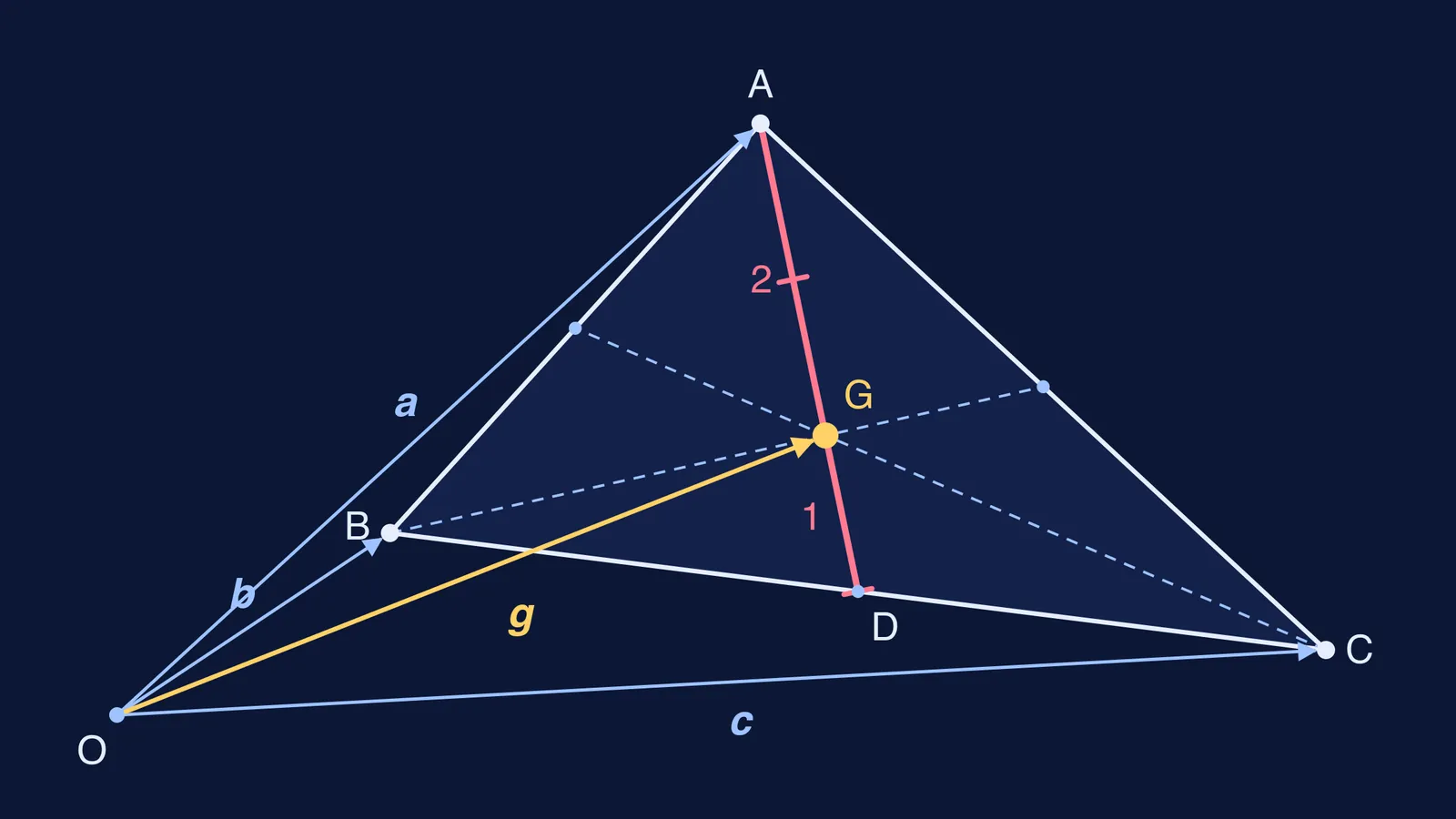
The centroid of a triangle is the point where its three medians meet, a median being the line from a vertex to the midpoint of the opposite side (Wikipedia: Centroid). The same source states that the centroid divides each median in the ratio 2 : 1, and that its coordinates are the means of the coordinates of the three vertices.
In vector language: choose any origin O, and let OA = a, OB = b and OC = c. Then OG = (a + b + c)/3. This holds in 2D and 3D alike.
How do you prove the centroid is (a + b + c)/3?
You need one tool, the section formula. In the NCERT Class 12 Mathematics Part II chapter on vector algebra (section 10.5.3), the point R that divides PQ internally in the ratio m : n has position vector (m·q + n·p)/(m + n), where p and q are the position vectors of P and Q (NCERT, Vector Algebra). The same chapter notes the special case m = n: the midpoint of PQ has position vector (p + q)/2.
Now run the proof along the median from A:
Let D be the midpoint of BC. By the midpoint rule, d = (b + c)/2.
G lies on the median AD with AG : GD = 2 : 1, so G divides AD internally in the ratio 2 : 1, counted from A.
Apply the section formula with P = A, Q = D, m = 2 and n = 1: g = (2d + a)/3.
Substitute d: g = (2 × (b + c)/2 + a)/3 = (a + b + c)/3.
The answer is symmetric in a, b and c. The medians from B and C give the same expression, which is why all three medians pass through one point.
Worked example: how do you find the centroid from three position vectors?
Take points A, B and C with these position vectors:
a = 2i − j + 3k
b = 4i + 5j − 2k
c = −3i + 2j + 5k
Add them: a + b + c = 3i + 6j + 6k. Divide by 3: g = i + 2j + 2k. So the centroid is the point (1, 2, 2).
Now check it through a median. The midpoint of BC is d = (b + c)/2 = 0.5i + 3.5j + 1.5k, so 2d = i + 7j + 3k. Then 2d + a = 3i + 6j + 6k, and dividing by 3 gives i + 2j + 2k again. Two routes, one point.
How do you find a missing vertex from the centroid?
Given the centroid and two vertices, rearrange g = (a + b + c)/3 into c = 3g − a − b. With g = i + 2j + 2k and a, b as above: 3g = 3i + 6j + 6k; subtract a to get i + 7j + 3k; subtract b to get −3i + 2j + 5k. That is c.
Why do GA, GB and GC add up to zero?
The vectors from G to the vertices are a − g, b − g and c − g. Their sum is (a + b + c) − 3g, which is the zero vector. So GA + GB + GC = 0; a question giving this condition is telling you G is the centroid.
What mistakes cost marks on centroid questions?
Run this checklist before you move on:
The 2 sits on the midpoint d, not on the vertex a.
You divided the sum by 3, not by 2; dividing by 2 gives a midpoint.
Every component was divided, including the k component.
For a missing vertex, you multiplied g by 3 before subtracting.
You checked the answer once through a median.
If the section formula itself feels shaky, the Fermi Concept Library has a lesson for every concept in mathematics, each with its place in the map, so you can step back one idea and return. For practice, the Fermi Problem Library has worked problems with a step-by-step solver that explains the reasoning rather than printing an answer.
To go further, see how the same ratio idea works in coordinates in our guide to the section formula in Class 10, find a median's length with the Apollonius theorem, or work backwards in finding a triangle's vertices from its midpoints.


