

On this page
Coordinate geometry often presents problems that can be solved in two ways: a long, algebra-heavy route, or a rapid, geometry-based shortcut. One classic problem is finding the coordinates of a triangle's vertices when you only know the midpoints of its three sides.
In the CBSE Class 10 mathematics syllabus, coordinate geometry carries a weightage of 6 marks, focusing heavily on the distance and section formulas. However, when faced with the midpoint problem, students often set up three pairs of simultaneous equations to find the unknowns. This method is slow and leaves plenty of room for arithmetic errors.
Why do students struggle with coordinate geometry?
The difficulty is rarely just about doing the algebra; it is about visualising the plane. A 2015 study of 1,000 student scripts by researcher Kakoma Luneta in the journal *Pythagoras* found that most Grade 12 students operate at lower "Van Hiele levels" of spatial reasoning than expected (doi.org/10.4102/pythagoras.v36i1.261). Because they struggle to connect numerical coordinates to visual shapes, they default to algebraic memorisation.
If you find yourself repeatedly setting up long walls of equations for geometry problems, Fermi's AI tutor can help you spot these geometric shortcuts. The tutor works out what you know and builds a plan for the session, guiding you toward the visual intuition before writing the formula.
How to find vertices of triangle when midpoints of sides are given?
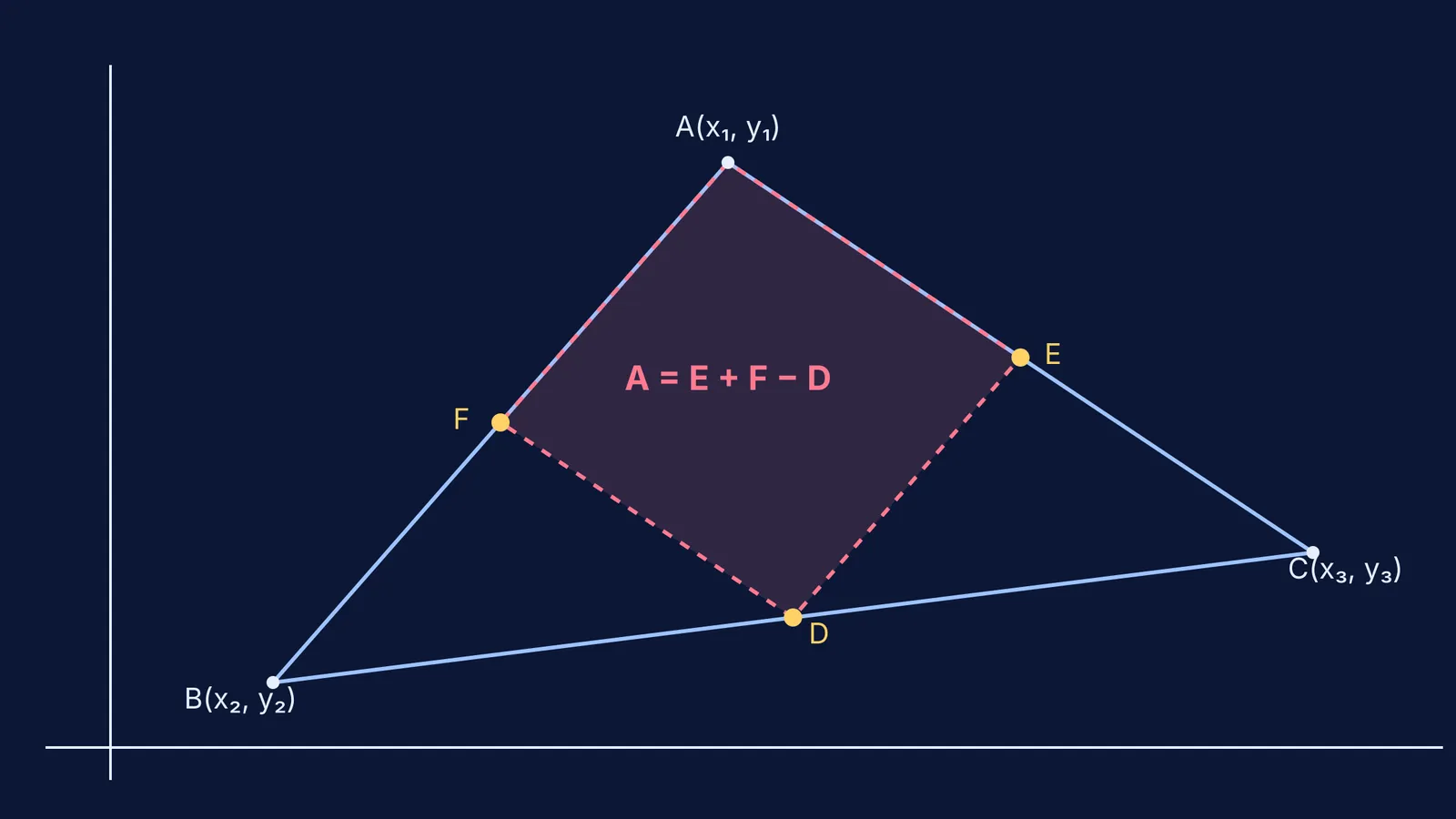
Let the unknown vertices of the triangle be A, B, and C. Let D be the midpoint of side BC, E be the midpoint of CA, and F be the midpoint of AB.
The mid-point theorem tells us that the line segment connecting the midpoints of two sides of a triangle is parallel to the third side and half its length. Because of this, the quadrilateral AFDE forms a perfect parallelogram.
In a parallelogram, the vector diagonals tell us that the position of a vertex is the sum of its adjacent midpoints minus the opposite midpoint. Therefore, to find vertex A, you simply add the coordinates of E and F, and subtract D.
Vertex A (opposite D) = E + F − D
Vertex B (opposite E) = D + F − E
Vertex C (opposite F) = D + E − F
Just as finding the centre of a circle through three given points can be done via geometric properties of chords, using this parallelogram property removes the need to solve simultaneous equations entirely.
To practice these shortcuts on past exam questions, you can use the Fermi Problem Library, which features a step-by-step solver that explains the geometric reasoning rather than just printing the final coordinates.
A worked example
Let the midpoints of the sides of a triangle be D(1, 2), E(3, 4), and F(5, −1). Find the coordinates of its vertices A, B, and C.
Step 1: Find Vertex A Vertex A is opposite midpoint D. Its adjacent midpoints are E and F. x_A = x_E + x_F − x_D = 3 + 5 − 1 = 7 y_A = y_E + y_F − y_D = 4 + (−1) − 2 = 1 Vertex A is (7, 1).
Step 2: Find Vertex B Vertex B is opposite midpoint E. Its adjacent midpoints are D and F. x_B = x_D + x_F − x_E = 1 + 5 − 3 = 3 y_B = y_D + y_F − y_E = 2 + (−1) − 4 = −3 Vertex B is (3, −3).
Step 3: Find Vertex C Vertex C is opposite midpoint F. Its adjacent midpoints are D and E. x_C = x_D + x_E − x_F = 1 + 3 − 5 = −1 y_C = y_D + y_E − y_F = 2 + 4 − (−1) = 7 Vertex C is (−1, 7).
Checking your answer with the centroid
How do you know you have not made a simple addition mistake? You can verify your vertices by checking the centroid. The centroid of your calculated triangle (ABC) must be exactly the same as the centroid of the midpoint triangle (DEF).
Let's check the x-coordinate of the centroid of the midpoints (DEF): (1 + 3 + 5) / 3 = 9 / 3 = 3
Now, let's check the x-coordinate of the centroid of the vertices (ABC): (7 + 3 − 1) / 3 = 9 / 3 = 3
The match confirms the coordinates are correct. Discovering and verifying relationships like this is just as satisfying as proving conditional identities when A + B + C = π in trigonometry.


