

On this page
Say you build a battery from six 1.5 V cells and one goes in backwards. It is tempting to write 7.5 V. The real answer is 6 V, and the internal resistance does not shrink at all. Here is why, with a worked example you can copy into your notes.
Why does a reversed cell subtract 2E, not E?
Start from the rule. In a series combination, emfs add algebraically, so a cell connected the wrong way enters the sum with a negative sign. The NCERT Class 12 Physics textbook derives this in section 3.11 of the Current Electricity chapter: if the two negative electrodes are joined, the equivalent emf becomes ε1 − ε2 (Eq. 3.47). OpenStax College Physics 2e says the same in everyday terms: when a cell is put into an appliance backward, "the total emf is less, since it is the algebraic sum of the individual emfs."
Now count. With n identical cells all the right way round, the total is nE. Flip one cell and two things happen to the sum. You lose the +E it used to give, and you gain a −E in its place. That is a change of 2E, not E.
Does the reversed cell's internal resistance subtract too?
No. NCERT states that "the equivalent internal resistance of a series combination of n cells is just the sum of their internal resistances" (NCERT Class 12 Physics, section 3.11). Reversing a cell changes only the sign of its emf in that derivation; r1 + r2 stays r1 + r2. OpenStax gives the same rule for series batteries: their internal resistances add.
The same current flows through every cell in a series chain, and resistance opposes it whichever way the cell faces. Emf has a direction; resistance does not.
Worked example: six cells, one in backwards
Six identical cells, each with emf E = 1.5 V and internal resistance r = 0.5 Ω, are connected in series to a 7 Ω resistor. By mistake, the fourth cell is reversed. Find the current, the voltage across the resistor and the voltage across the reversed cell.
Effective emf: (6 − 2) × 1.5 = 6.0 V.
Total internal resistance: 6 × 0.5 = 3.0 Ω, unchanged by the mistake.
Current, using I = ε/(R + r) from NCERT Eq. 3.40: I = 6.0 / (7 + 3) = 0.6 A.
Voltage across the resistor: IR = 0.6 × 7 = 4.2 V.
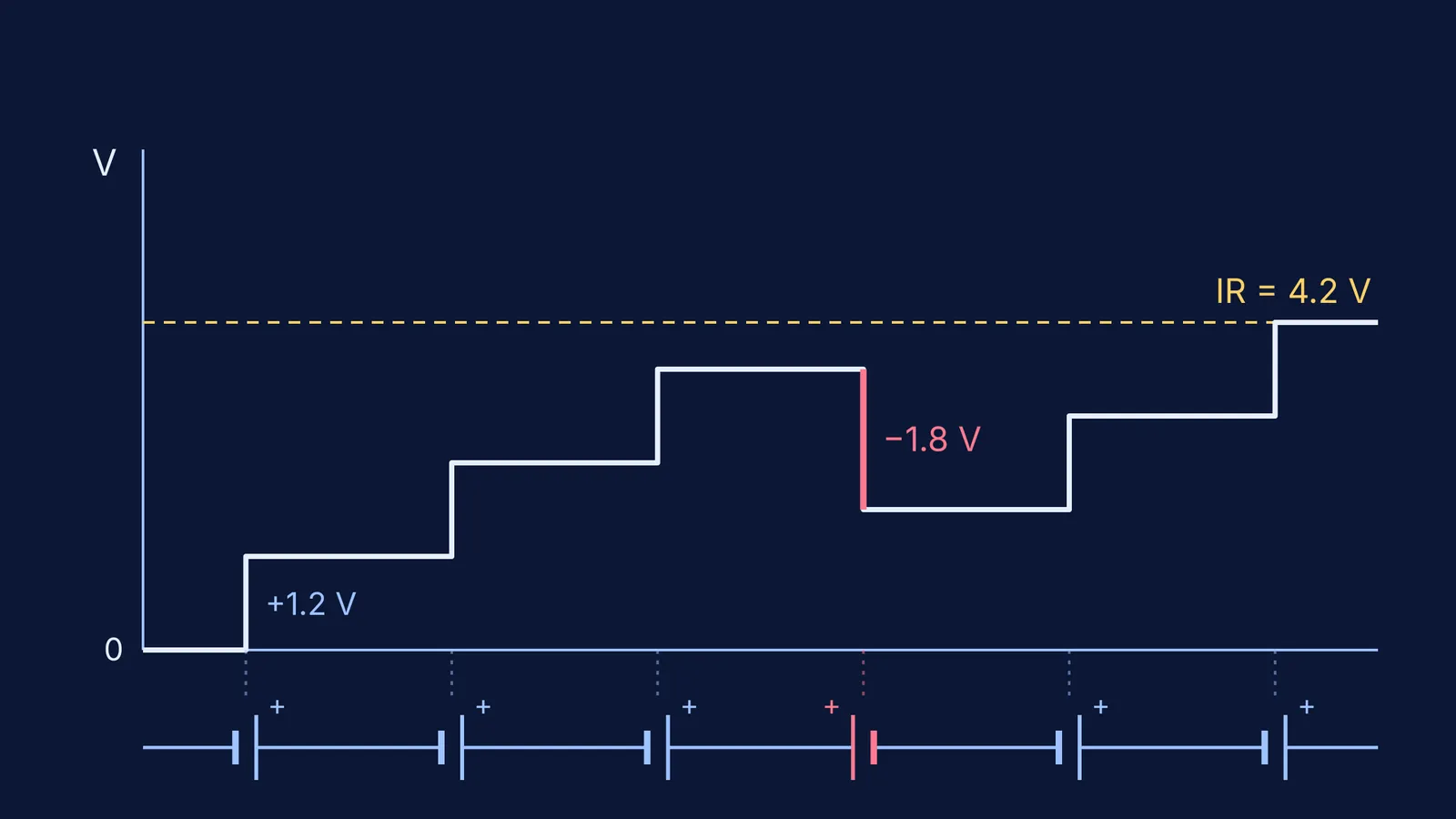
Each correctly placed cell: terminal voltage E − Ir = 1.5 − 0.3 = 1.2 V.
The reversed cell: the current is pushed through it from its positive terminal to its negative one, so by NCERT Eq. 3.60 its terminal voltage is E + Ir = 1.5 + 0.3 = 1.8 V, and it opposes the others.
Check with the loop: five cells at 1.2 V each give 6.0 V, minus 1.8 V for the reversed cell, leaves 4.2 V. That matches IR, so every sign is right. The diagram at the top of this page plots that staircase of potential along the chain.
Compare the pack built correctly: 9.0 V across a total of 10 Ω gives 0.9 A. One wrong cell cut the current by a third.
What are the common wrong answers?
7.5 V and 0.75 A. Subtracting E instead of 2E.
6 V and 0.67 A. Getting the emf right but also subtracting the reversed cell's resistance, so the total becomes 2.0 Ω instead of 3.0 Ω.
1.2 V across the reversed cell. Using E − Ir for a cell that is being driven backwards; it should be E + Ir.
If the E − Ir idea itself feels shaky, read our explainer on why a battery's terminal voltage drops with load. If you mix up which plate is which, see standard circuit symbols for a cell and a battery.
How do you find how many cells are reversed?
Exam questions often give you the open-circuit reading of a pack and ask how many cells are the wrong way round. With no current flowing, an ideal voltmeter reads the emf, so the number reversed is (nE − reading) / 2E.
For example, ten 1.5 V cells should give 15 V. If the pack reads 12 V, then (15 − 12) / 3 = 1 cell is reversed. A reading of 9 V would mean two.
If you keep losing marks on signs like these, the Fermi Problem Library has worked problems with a step-by-step solver that explains the reasoning rather than printing an answer, so you can see exactly where the minus sign enters. For the idea underneath, emf versus terminal voltage, the Fermi Concept Library gives each physics concept its own lesson.
Next time you see a reversed cell, write (n − 2)E for the emf and nr for the resistance before you touch anything else.


