On this page
Stain a thin slice of potato with iodine and the starch grains inside its cells turn bluish black. Those grains are food the cell has put away, not machinery that runs it. Exam questions can ask you to tell such non-living inclusions from organelles.
What are non-living inclusions in a cell?
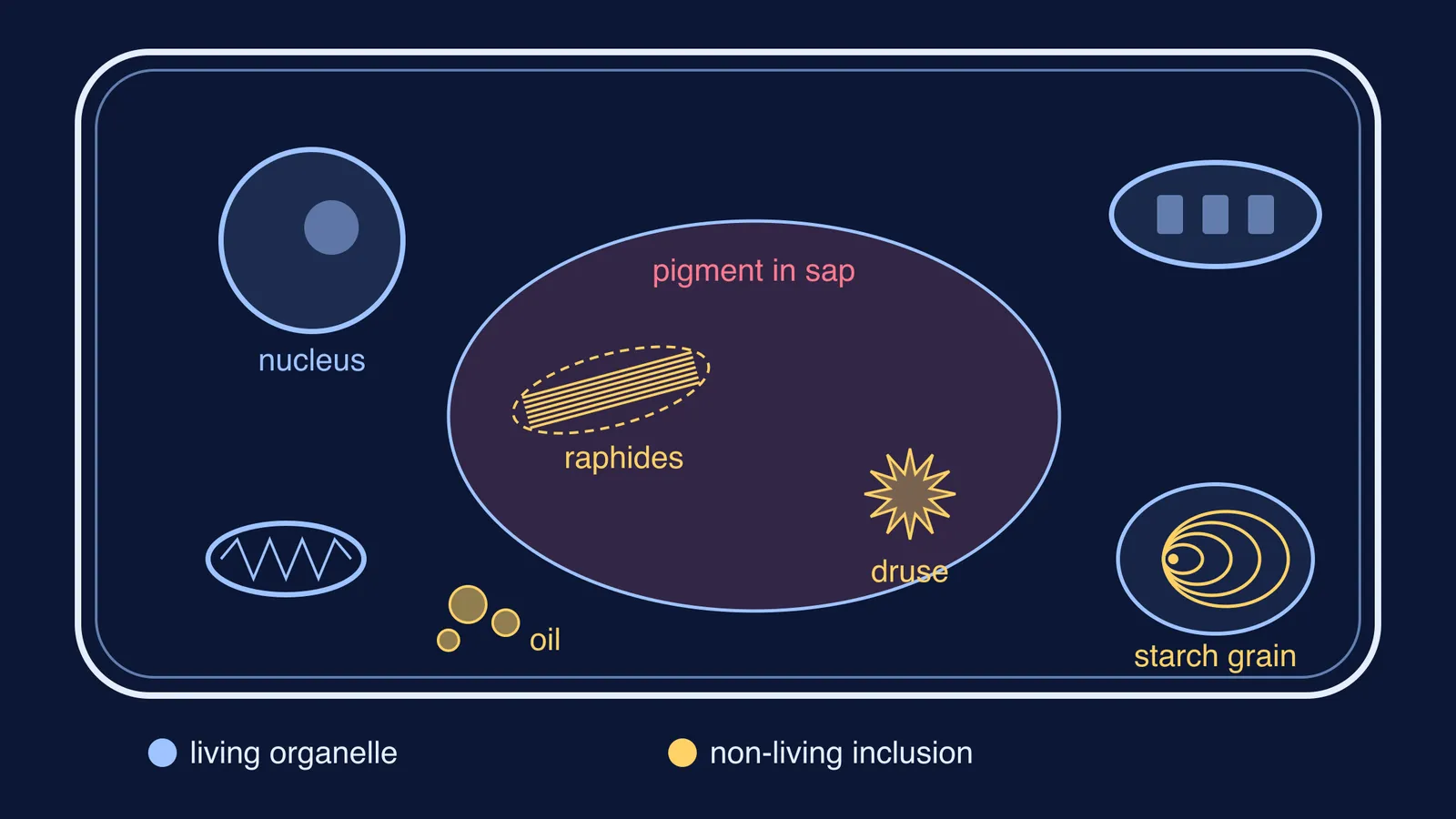
Non-living inclusions, also called ergastic substances, are the organic or inorganic substances that are metabolic by-products of the cell, as this college botany lecture on non-living inclusions defines them. The same lecture splits cell contents into two: living inclusions are the organelles, such as the nucleus, endoplasmic reticulum, chloroplasts and mitochondria; non-living inclusions are the products.
What are the three kinds of non-living inclusions?
The lecture groups them into three classes:
Reserve food: starch grains (carbohydrate), aleurone grains (protein), and fats and oils. Starch stains bluish black with iodine. Each grain has a portion called the hilum with layers around it; in potato the layers sit to one side, so the grains are called eccentric.
Secretory products: pigments, enzymes and nectar. Anthocyanin is a water-soluble pigment in the cell sap of vacuoles that gives blue, violet and pink colours.
Excretory products: tannins, gums, resins, essential oils, mucilage, latex, alkaloids and mineral crystals.
Mineral crystals are worth knowing in detail. The same lecture names calcium oxalate, calcium carbonate and silica crystals, and three forms come up often. Raphides are thin, needle-like crystals of calcium oxalate, sometimes in bundles, found for example in the rhizome of Colocasia (arbi). Druses are roughly spherical groups of calcium oxalate crystals. A cystolith is a grape-like cluster of calcium carbonate hanging from a stalk of cell wall, found in the banyan, Ficus benghalensis.
Non-living does not mean random. A review in the Annual Review of Plant Biology by Vincent Franceschi and Paul Nakata reported that calcium oxalate crystals occur in photosynthetic organisms from small algae to giant gymnosperms, form in shapes that stay constant within a species, and help regulate calcium and protect against herbivores (Franceschi and Nakata, 2005). Plants with many raphides are generally acrid and unpleasant to eat, and the needles seem to defend against animals that chew the leaves, as the Wikipedia entry on raphides notes.
How are inclusions different from living organelles?
Organelles do work. NCERT's Class 11 chapter Cell: The Unit of Life describes mitochondria as the sites of aerobic respiration, with their own DNA and ribosomes, and says they divide by fission. Most inclusions simply sit in store; a working part made or stored them.
The trap is that many inclusions sit inside organelles. The same NCERT chapter says leucoplasts store nutrients: amyloplasts store starch (potato is its example), elaioplasts store oils and fats, and aleuroplasts store proteins. The amyloplast is a living plastid; the starch grain inside it is the non-living inclusion. Chromoplasts hold carotenoid pigments that make plant parts yellow, orange or red, while anthocyanin dissolved in vacuole sap is an inclusion. Our guide to the types of plastids: chloroplast, chromoplast and leucoplast sorts these out.
The vacuole is where many inclusions collect. NCERT describes it as a membrane-bound space containing water, sap, excretory product and other materials not useful for the cell. In plant cells, vacuoles can occupy up to 90 per cent of the cell's volume, according to the same chapter.
Bacteria have their own version. NCERT says reserve material in prokaryotic cells is stored as inclusion bodies that are not bound by any membrane and lie free in the cytoplasm, such as phosphate granules, cyanophycean granules and glycogen granules. Our explainer on inclusion bodies in prokaryotic cells goes further.
Is it an organelle or an inclusion?
When a question names something inside a cell, ask these five questions:
Does it carry out a process, such as respiration? Then it is probably an organelle.
Is it stored food, a pigment, a crystal or a waste? Then it is an inclusion.
Is it the container or the contents? An amyloplast is the container; starch is the contents.
If it is an inclusion, which group is it: reserve food, secretory or excretory?
What is it made of? Write the chemical where you know it: calcium oxalate for raphides and druses, calcium carbonate for cystoliths.
Worked example: sort these ten: nucleus, starch grain, raphides, mitochondrion, aleurone grain, anthocyanin, chromoplast, oil droplet, cystolith, glycogen granule in a bacterium.
Living organelles: nucleus, mitochondrion, chromoplast.
Non-living, reserve food: starch grain, aleurone grain, oil droplet, glycogen granule (a prokaryotic inclusion body).
Non-living, secretory: anthocyanin.
Non-living, excretory: raphides (calcium oxalate), cystolith (calcium carbonate).
An easy slip is the chromoplast. It carries pigment, but it is itself a living plastid. Cover the answers, sort the list again tomorrow, and add two new items each time.
If the gap is the organelle itself rather than what it stores, the Fermi Concept Library has every concept in biology, each with its own lesson and its place in the map, so you can see where plastids and vacuoles fit. For practice, the Fermi Problem Library has worked problems with a step-by-step solver that explains the reasoning rather than printing an answer.