

On this page
Prokaryotes, such as bacteria and cyanobacteria, operate very differently from eukaryotic cells. They do not have the membrane-bound organelles—like chloroplasts, mitochondria, or a true nucleus—that plants and animals rely on to compartmentalise their tasks. When a bacterium needs to store food for tough times or alter its position in a lake, it cannot pack these materials into a neat, membrane-wrapped vacuole. Instead, it uses inclusion bodies.
What are inclusion bodies in prokaryotic cells?
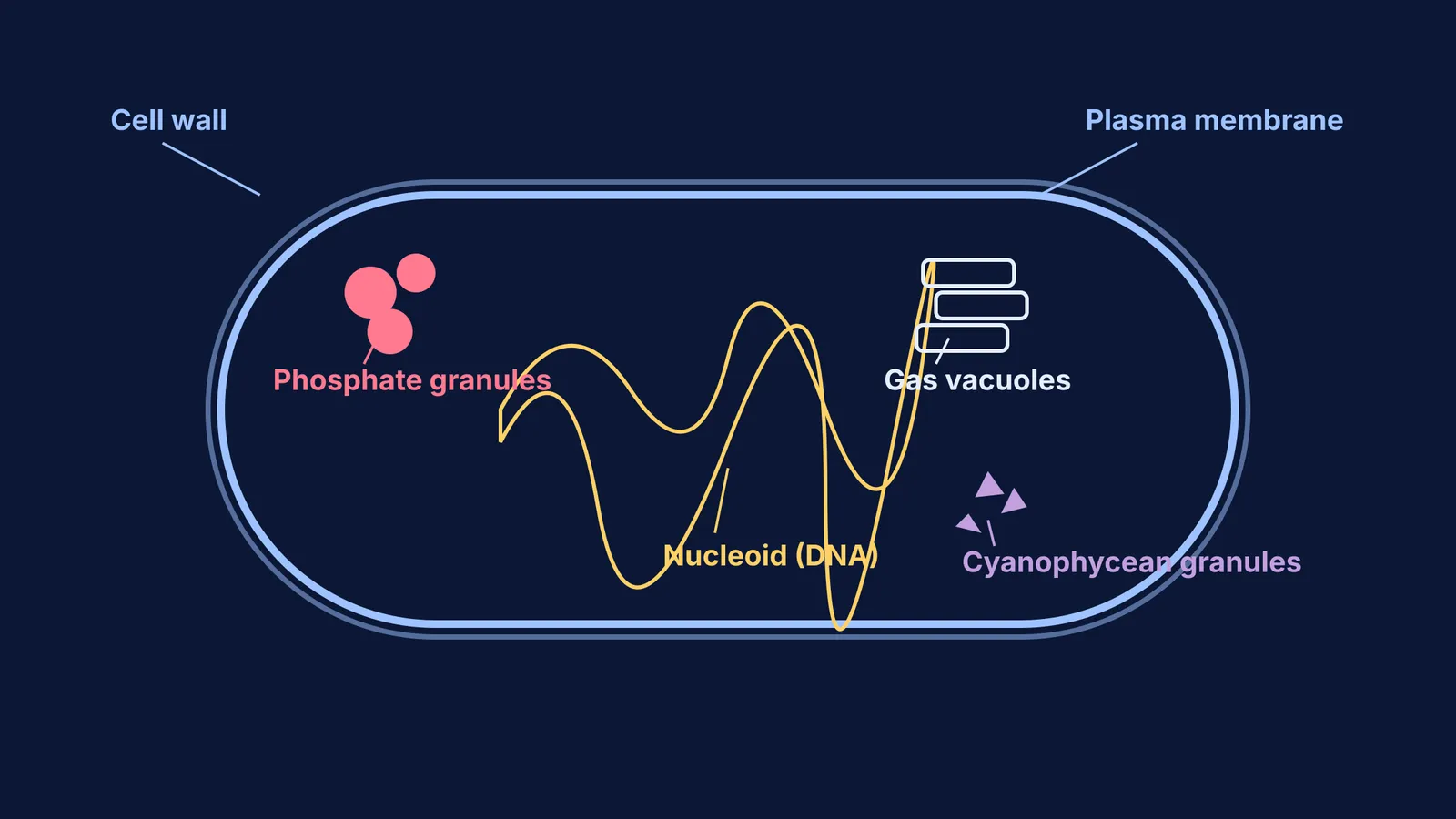
Inclusion bodies are non-living, cytoplasmic aggregates that serve as storage vessels for reserve materials in prokaryotes. Because bacteria lack an endomembrane system, these structures are not bound by any membrane; they lie free in the cytoplasm.
When nutrients are plentiful in their environment, the cell builds these granules up. When resources become scarce, the cell breaks them down to survive starvation.
What are examples of reserve material in inclusion bodies?
The reserves stored inside inclusion bodies depend on the bacterium and its environment. The most common examples tested in biology exams include:
Phosphate granules: Also known as volutin granules or polymetaphosphate granules, these store inorganic phosphate. Phosphate is a critical building block for making ATP (the cell's energy currency) and nucleic acids. The ability to store phosphate is heavily exploited in wastewater treatment, where specific bacteria are used to remove excess phosphorus from water by storing it as volutin. When stained with basic dyes like methylene blue, these granules exhibit a colour change, which is why they are sometimes called metachromatic granules.
Cyanophycean granules: Found heavily in cyanobacteria (blue-green algae), these bodies store nitrogenous reserve material. They are typically made of protein, often constructed from polymers of the amino acids arginine and aspartic acid.
Glycogen granules: Similar to the glycogen found in human liver cells, these granules store carbohydrates as glucose polymers, serving as a rapid energy reserve for the bacterium.
If you struggle to recall how these compare to eukaryotic storage, or if you get confused between these and RNA polymerases in eukaryotes, checking the Fermi Concept Library can help clarify the biological structures domain by domain.
How do gas vacuoles work?
While phosphate and glycogen granules store food, gas vacuoles have a purely mechanical job. Found in blue-green, purple, and green photosynthetic bacteria, gas vacuoles control buoyancy.
They are aggregates of hollow, rigid, protein-walled cylinders called gas vesicles. Because their protein walls are permeable to gases but impermeable to water, these vesicles fill with gas and reduce the overall density of the cell. Gas vesicles in different organisms vary in width, from 45 to over 200 nm, allowing them to withstand different critical collapse pressures based on water depth (10.1128/mr.58.1.94-144.1994). This allows aquatic photosynthetic bacteria to float up to the "photic zone"—the water layer near the surface where sunlight is strongest.
By adjusting their buoyancy, these bacteria can migrate vertically, sinking when light is too harsh and floating back up when they need more sun.
This buoyancy is not just a neat trick; it has massive ecological consequences. It is the primary driver behind the formation of large algal blooms in lakes and oceans. When nutrient levels are high, cyanobacteria produce vast numbers of gas vesicles to dominate the surface water, sometimes blocking sunlight from reaching other aquatic life below.
A study checklist for cell biology
To score well in cell biology questions—where examiners often test the differences between prokaryotic structures and viruses, viroids and lichens—use this mental checklist when evaluating a cell component:
Is it membrane-bound? If the answer is yes, it is not a prokaryotic inclusion body.
Does it store energy or materials? Phosphate (ATP and nucleic acids), glycogen (carbon), and cyanophycean granules (nitrogen) fit this description.
Does it change colour when stained? Volutin (phosphate) granules are famous for metachromasia—appearing reddish-purple under a blue stain, a fact often used to identify specific bacteria.
Does it provide buoyancy? Gas vacuoles are the only inclusion body dedicated to flotation in aquatic photosynthetic bacteria.
Understanding the logic behind these structures makes memorising their names much easier. If you want to test your recall on these specific topics, try a few practice questions in the Fermi Problem Library to see if you can reliably spot the membrane-less structures.


