On this page
Every detergent molecule has the same basic plan: a long hydrocarbon tail that avoids water and grabs grease, joined to a head that likes water. The Royal Society of Chemistry's teaching notes describe this as a hydrophilic head and a hydrophobic tail, and sort detergents into anionic, cationic, non-ionic and amphoteric types by what that head carries (RSC Education). Once you can see the head, the classification question answers itself.
What is an anionic detergent, and where is sodium lauryl sulphate used?
An anionic detergent is one whose water-loving head carries a negative charge (RSC Education).
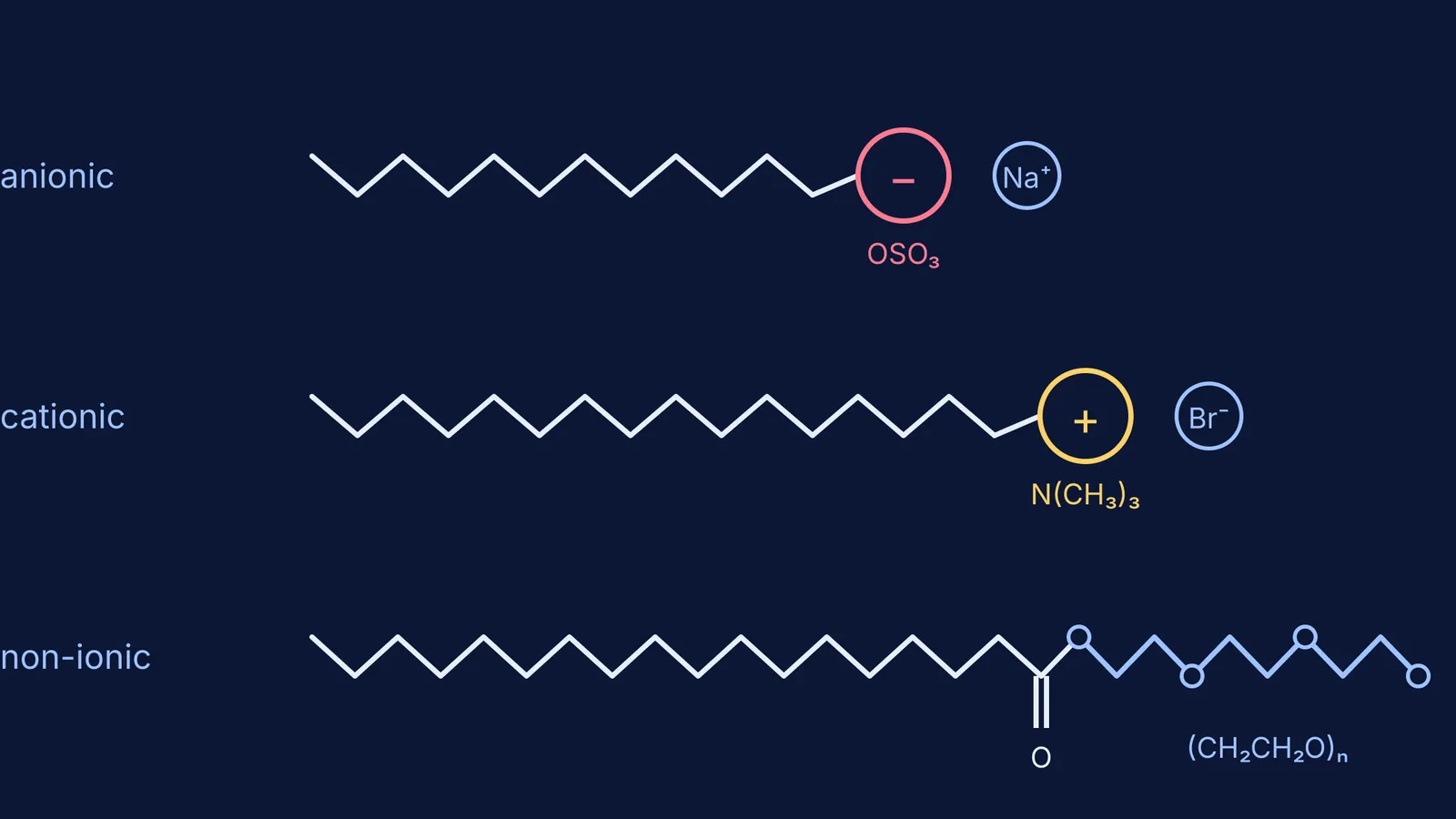
Sodium lauryl sulphate, also called sodium dodecyl sulphate (SDS), has the formula C12H25NaO4S, according to PubChem. That is a 12-carbon tail, CH3(CH2)11, joined to a sulphate head, –OSO3⁻, with Na⁺ as the counter-ion. In water the sodium ion separates and the long chain is left carrying the negative charge.
Where you meet it:
Toothpastes, shampoos and shaving foams, where it cleans and foams (PubChem use data, citing T3DB).
The biology lab, where it is used to separate proteins by electrophoresis; PubChem quotes the Merck Index for this use (PubChem).
Shampoos for oily hair: a review in the Indian Journal of Dermatology notes that lauryl sulphates work in both hard and soft water, give rich foam and rinse easily (D'Souza and Rathi, 2015).
That hard-water point matters. RSC's notes put it simply: soapless detergents do not form scum with hard water, which soap does (RSC Education).
What is a cationic detergent, and where is CTAB used?
A cationic detergent is one whose water-loving head carries a positive charge, such as a quaternary ammonium group (RSC Education).
Cetyltrimethylammonium bromide (CTAB) has the formula C19H42BrN and the systematic name hexadecyl(trimethyl)azanium bromide (PubChem). Count the carbons: 16 in the cetyl (hexadecyl) tail plus 3 methyl groups on the nitrogen makes 19. The head is a quaternary ammonium ion, –N⁺(CH3)3, and Br⁻ is the counter-ion. This time the long chain keeps the positive charge.
Where you meet CTAB and its cationic relatives:
Antiseptics: CTAB is one of the components of the topical antiseptic cetrimide (ChEBI, EMBL-EBI).
Fabric conditioners, which RSC names as the largest use of cationic detergents (RSC Education).
Hair conditioners, which contain cationic surfactants. Hair carries a negative charge, so the positively charged conditioner molecules are attracted to it and reduce static (D'Souza and Rathi, 2015).
What is a non-ionic detergent, and why is PEG stearate one?
A non-ionic detergent has a head with no charge at all; RSC describes these as neutral molecules (RSC Education).
The usual textbook example is polyethylene glycol stearate. It forms when the –COOH group of stearic acid, C17H35COOH, condenses with an –OH end of polyethylene glycol, giving an ester link. The tail is the stearate chain; the head is a string of –CH2CH2O– units whose oxygen atoms hydrogen-bond with water without carrying any charge.
Where you meet it:
Cosmetics: a safety review in Toxicological Research lists PEG stearates among the PEG fatty acid derivatives, and says PEGs and their derivatives are used as surfactants, cleansing agents and emulsifiers (Jang, Shin and Kim, 2015).
Mild shampoos: non-ionic detergents are among the mildest cleansers and can be combined with an ionic detergent as a secondary cleanser; polyoxyethylene sorbitol esters are one example (D'Souza and Rathi, 2015).
How do you tell anionic, cationic and non-ionic detergents apart?
Use three questions, in this order, on any structure you are given:
Find the long hydrocarbon chain. That is the tail; everything else is the head.
Look at the head. A negative group such as –SO3⁻ or –OSO3⁻ with Na⁺ alongside means anionic. A nitrogen with four groups and a positive charge, with Cl⁻ or Br⁻ alongside, means cationic.
No charge anywhere, but lots of oxygen (–CH2CH2O– repeats, an ester –COO– link)? Non-ionic.
The trap is the counter-ion. Na⁺ is positive, but sodium lauryl sulphate is anionic because the charge that matters is the one left on the long chain.
Can you classify these four compounds?
CH3(CH2)11OSO3⁻Na⁺: tail of 12 carbons, negative sulphate head. Anionic.
CH3(CH2)15N⁺(CH3)3Br⁻: tail of 16 carbons, positive quaternary nitrogen head. Cationic.
C17H35COO(CH2CH2O)nH: stearate tail, ester link, uncharged polyether head. Non-ionic.
C17H35COO⁻Na⁺: long tail, negative carboxylate head. Anionic too, but this is sodium stearate, an ordinary soap, not a synthetic detergent. Spotting soap versus detergent is a common follow-up question.
If the head groups themselves feel shaky (what a sulphate ester is, why a quaternary nitrogen stays charged), the Fermi Concept Library has a lesson on every chemistry concept, each placed in its map so you can see what it builds on. And when you want to practise reasoning through structure questions, the Fermi Problem Library has worked problems with a step-by-step solver that explains the reasoning rather than printing an answer.
Next time you pick up a shampoo bottle, try sorting its first three surfactants by their heads.