

On this page
Draw acetate, the ion left when acetic acid loses its proton, and you will probably write one C=O and one C–O⁻. Measurements say the two bonds are identical. Explaining that gap is a common question in Class 12 chemistry, JEE Main and NEET-UG.
Why are both C–O bonds in a carboxylate ion equal?
Because no single Lewis structure is the real ion. You can draw two structures for RCOO⁻ that differ only in where the π electrons and lone pairs sit. In one, the double bond goes to the top oxygen and the negative charge sits on the bottom one. In the other, they swap.
OpenStax Organic Chemistry stresses that acetate does not flip back and forth between these two forms. It is a resonance hybrid with a single, unchanging structure that has characteristics of both drawings.
The two forms are mirror images, so they contribute equally. The π bond is spread over both C–O links and the −1 charge is split between the two oxygens. Identical oxygens mean identical bonds.
How long are the C–O bonds in a carboxylate ion?
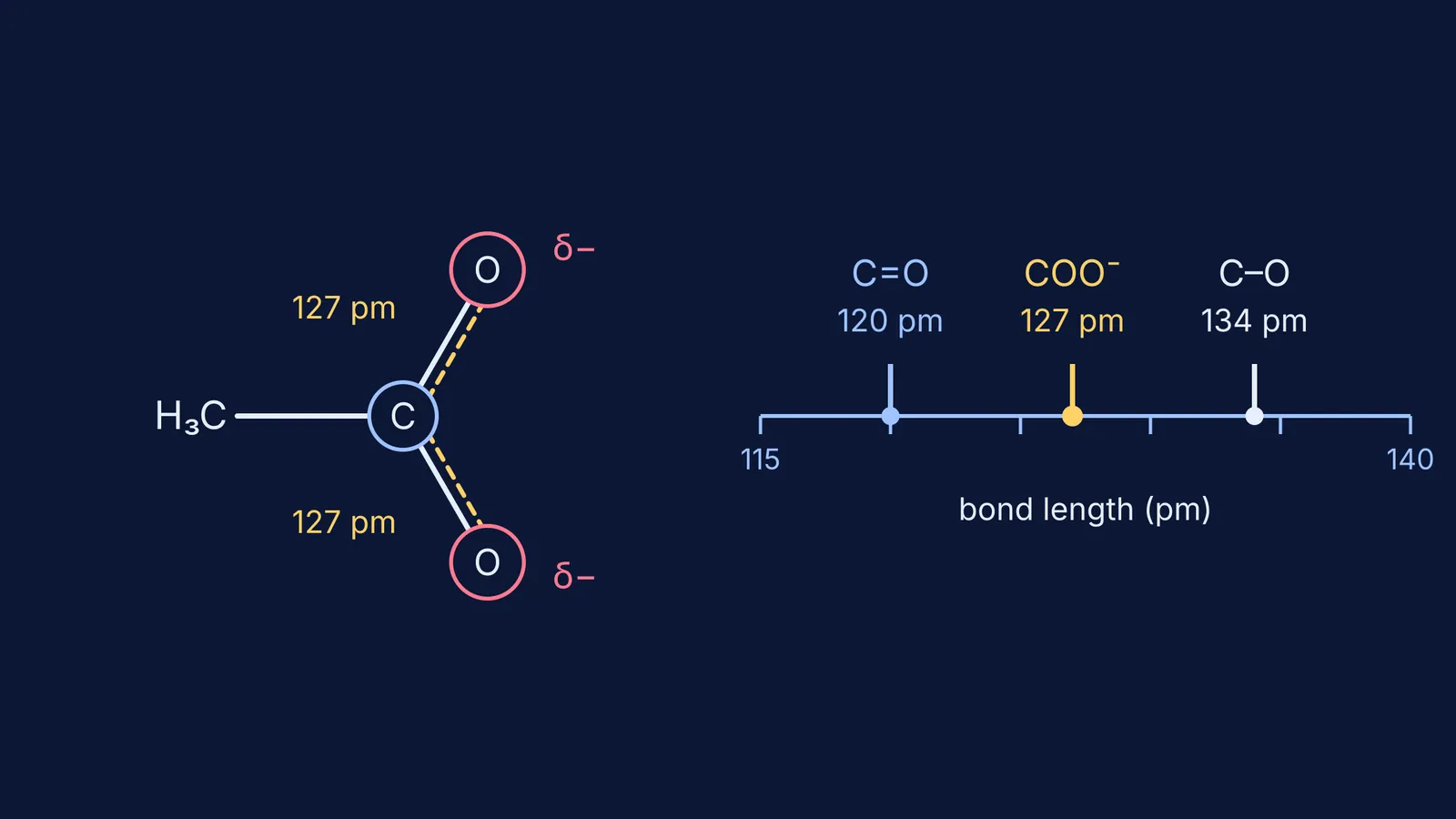
Both carbon–oxygen bonds in the acetate ion are 127 pm long, midway between a typical C–O single bond (135 pm) and a typical C=O double bond (120 pm), according to OpenStax Organic Chemistry, section 2.4.
The same textbook's chapter on carboxylic acids gives a cleaner side-by-side comparison. In formic acid, HCOOH, the C=O bond is 120 pm and the C–O bond is 134 pm. In sodium formate, HCOONa, both carbon–oxygen bonds are 127 pm.
In formic acid, the H on one oxygen pins the double bond to the other oxygen, so the two bonds differ. Remove the proton and the two oxygens become equivalent, so the bonds meet in the middle.
How do you find the bond order and charge on each oxygen?
Use this method whenever a question asks you to compare bonds in a resonance-stabilised ion.
Draw every valid resonance structure. For acetate, CH₃COO⁻, there are two.
Pick one oxygen. Count the bonds between C and that oxygen in each structure: 2 in the first, 1 in the second.
Average them: (2 + 1) ÷ 2 = 1.5. That is the C–O bond order.
Do the same for the charge on that oxygen: 0 in one structure, −1 in the other, so −½ on average. The other oxygen also gets −½.
Place the bond on a bond-order scale. Order 1.5 sits between a single bond (order 1) and a double bond (order 2), so its length falls between theirs, which matches the measured 127 pm.
The same steps work for the ions OpenStax Chemistry 2e uses as examples. It notes that experiments show both N–O bonds in the nitrite ion, NO₂⁻, are identical, and all three C–O bonds in the carbonate ion, CO₃²⁻, are exactly the same. For carbonate, three structures share one double bond, so each C–O bond order is (2 + 1 + 1) ÷ 3 = 4/3, and each oxygen carries −2/3. Ozone follows the same logic; see our post on ozone's resonance structure and why it is a strong oxidising agent.
If the step from bond order to bond length feels shaky, our explainer on how bond order relates to bond length works through C–C, C=C and N₂. For more practice, the Fermi Problem Library has worked problems with a step-by-step solver that explains the reasoning rather than printing an answer.
What mistakes do students make with this question?
Saying the ion switches between two structures. There is one real structure, the hybrid; the drawings are bookkeeping.
Quoting 120 pm and 134 pm for the carboxylate. Those are formic acid's bonds; the ion has two bonds of 127 pm.
Leaving the full −1 charge on one oxygen. Each oxygen carries −½.
Mixing up the acid and the ion. If an oxygen carries an H (the acid), the bonds differ; if not (the carboxylate), they are equal.
Moving atoms in resonance structures. Only π electrons and lone pairs move; if an atom moves, you have drawn a different compound.
Why does this make carboxylic acids more acidic than alcohols?
Equal bonds and acidity are evidence for the same idea. The OpenStax carboxylic acids chapter explains that a carboxylate ion has its negative charge delocalised over two equivalent oxygen atoms, while an alkoxide ion has its charge localised on a single oxygen. It gives acetic acid a pKa of 4.76 and says ethanol is a weaker acid than acetic acid by a factor of about 10¹¹.
A spread-out charge is a more stable charge, so the acid gives up its proton more readily. To see how groups attached to the COOH shift this further, read our post on the acidity order of formic, acetic and benzoic acid.
If resonance itself is the gap, the Fermi Concept Library gives every chemistry concept its own lesson and shows where it sits in the map, so you can go back one step before trying the next question.


