On this page
Proteins, carbohydrates, fats and DNA look nothing alike, but every one of them is built on a skeleton of carbon atoms. That follows from three properties of one atom, which tie together Class 11 and 12 biology and organic chemistry.
What makes carbon different from other elements?
Carbon has six electrons: two fill the inner shell and four sit in the outer shell, as the OpenStax Biology 2e chapter on carbon explains. To complete its octet, a carbon atom forms up to four covalent bonds.
Four is the useful number. One bond ends a molecule, two make a simple link, but four let a single atom join a chain on two sides and still carry two more groups. In methane, the four bonds point to the corners of a tetrahedron, so carbon compounds are three-dimensional shapes, not flat drawings.
OpenStax puts it this way: because carbon can bond to as many as four different atoms, it is ideal as the backbone of life's large molecules.
Why can carbon form long chains and rings?
Bond energy is the energy needed to break a particular covalent bond in one mole of gaseous molecules, and Table 7.2 of OpenStax Chemistry 2e lists the averages.
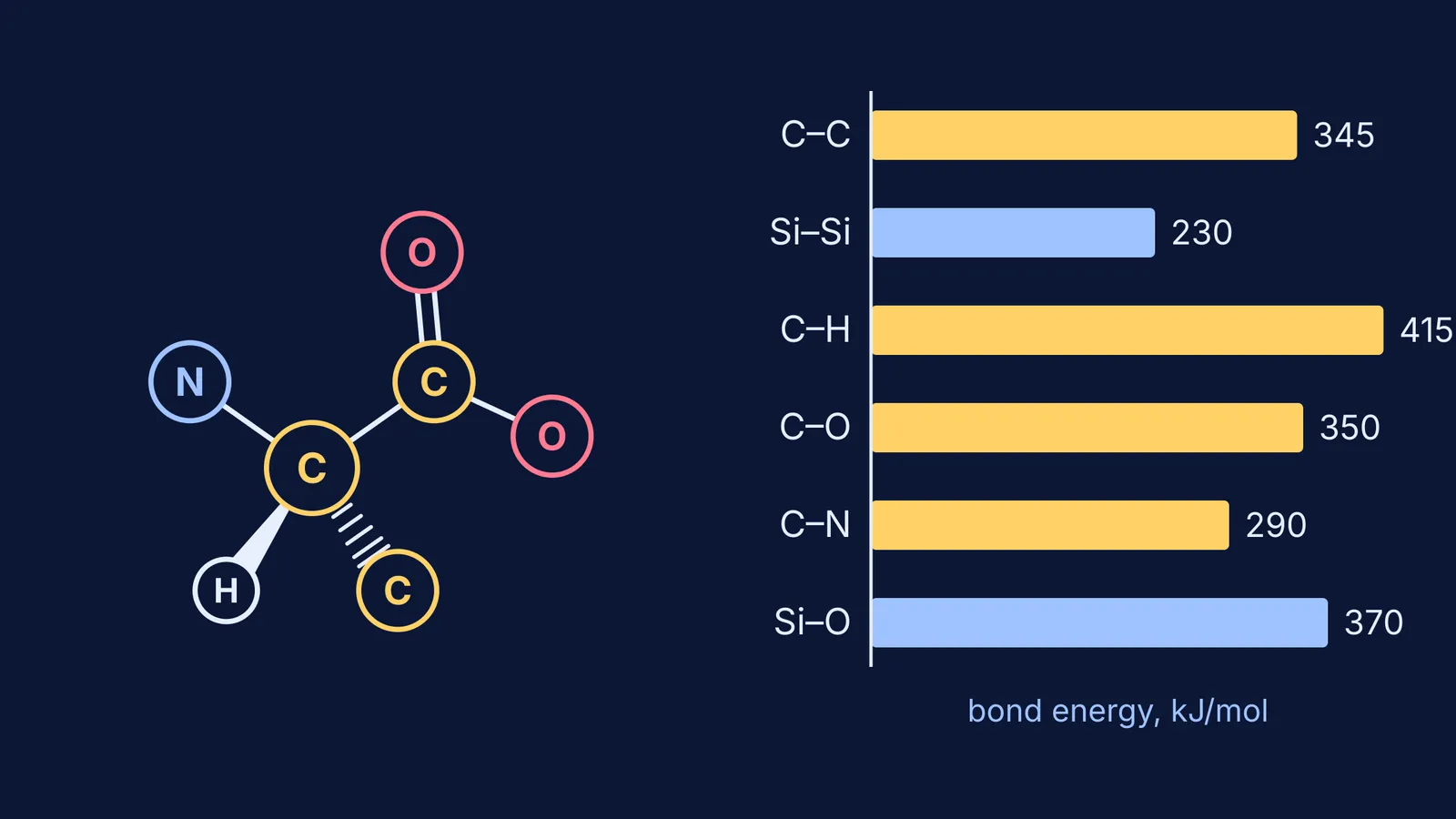
An average C–C single bond is 345 kJ/mol.
An average Si–Si single bond, silicon being carbon's neighbour in group 14, is only 230 kJ/mol.
Carbon also forms C=C (611 kJ/mol) and C≡C (837 kJ/mol) bonds, which add rigidity and flat sections to a skeleton.
Because carbon-carbon bonds are strong, carbon atoms can link into long chains and closed rings, and OpenStax Biology notes that the backbones of living molecules are chains, rings or combinations of both.
Chains also branch in many ways, so one formula can describe several different molecules, called isomers. Our walk-through of the five isomers of hexane, C6H14 shows how fast the options multiply with just six carbons.
Why does carbon bond so well with hydrogen, oxygen and nitrogen?
A skeleton alone does nothing. Biomolecules work because of the groups hanging off the carbons: –OH in sugars, –COOH and –NH2 in amino acids, C=O in many molecules. These functional groups give each molecule its chemical behaviour, as the OpenStax Biology 2e carbon chapter describes.
Carbon holds these partners firmly. In the same OpenStax Chemistry 2e table, C–H averages 415 kJ/mol, C–O 350 kJ/mol and C–N 290 kJ/mol.
Notice that C–O (350) and C–C (345) are almost equal: for carbon, a single bond to oxygen is barely stronger than a bond to another carbon. So a carbon chain can carry oxygen-containing groups along its length and keep its skeleton. Silicon behaves differently.
This matches what the body is made of. OpenStax Anatomy and Physiology 2e lists oxygen, carbon, hydrogen and nitrogen as the main elements of the human body.
Why isn't life based on silicon instead?
Silicon also has four outer electrons, and it is far more common: silicon makes up nearly one-fourth of the mass of the earth's crust, according to OpenStax Chemistry 2e.
The bond energies in OpenStax Table 7.2 help explain why abundance is not enough. Si–Si is weak (230 kJ/mol), while Si–O is much stronger (370 kJ/mol). In oxygen-rich surroundings, silicon ends up in Si–O–Si networks, the minerals of rocks and sand, rather than long Si–Si chains. The same OpenStax chapter adds that silicon does not readily form double or triple bonds, which carbon uses constantly.
Part of the reason is size: carbon is a small second-period atom, and our explainer on the anomalous behaviour of second-period elements covers why such atoms behave differently from heavier members of their groups.
How do you use this in an exam answer?
Take alanine, an amino acid, written CH3–CH(NH2)–COOH. Check it carbon by carbon.
The central carbon bonds to H, to N of –NH2, to the –COOH carbon and to the –CH3 carbon: four bonds, four different partners.
The –COOH carbon has a double bond to one O, a single bond to the other O, and a bond to the central carbon: 2 + 1 + 1 = 4.
The –CH3 carbon has three H atoms and one bond to the central carbon: 4.
For a short-answer question, write it in three lines: carbon is tetravalent; it shows catenation, forming chains and rings because C–C bonds are strong; and it bonds stably with H, O and N to form functional groups. Add the 345 versus 230 kJ/mol comparison from the OpenStax bond energy table if the question asks why not silicon. Then practise the same count on the molecules in our guide to essential and non-essential amino acids.
If tetravalency, hybridisation or catenation still feel shaky, the Fermi Concept Library has a lesson for each concept in chemistry and biology and shows where it sits on the map. To practise structure questions, the Fermi Problem Library has worked problems with a step-by-step solver that explains the reasoning rather than printing an answer.