

On this page
Fix two nails on a cork in a beaker, wire them to a 6-volt battery and a bulb, and pour in a glucose solution. The bulb stays dark. Swap in dilute hydrochloric acid and it glows. This is Activity 2.8 in NCERT's Class 10 chapter on acids, bases and salts, which notes that glucose and alcohol solutions do not conduct, and that the current in the acid is carried by ions.
A current needs charged particles that can move, and most carbon compounds have none.
What does a substance need to conduct electricity?
A current is a flow of charge, so something has to carry it. School chemistry has two kinds of carrier:
Free electrons that move through a solid, as in metals and graphite.
Mobile ions, as in a molten or dissolved ionic compound. NCERT's Carbon and its Compounds chapter reminds you that ionic compounds conduct in solution or in the molten state.
A substance with neither is a poor conductor, however many electrons its atoms contain.
Why do carbon compounds not conduct electricity?
Carbon has four valence electrons. The NCERT chapter explains why it does not simply become an ion: gaining four electrons would leave six protons holding ten electrons, and losing four would take a large amount of energy. So carbon shares electrons, forming covalent bonds.
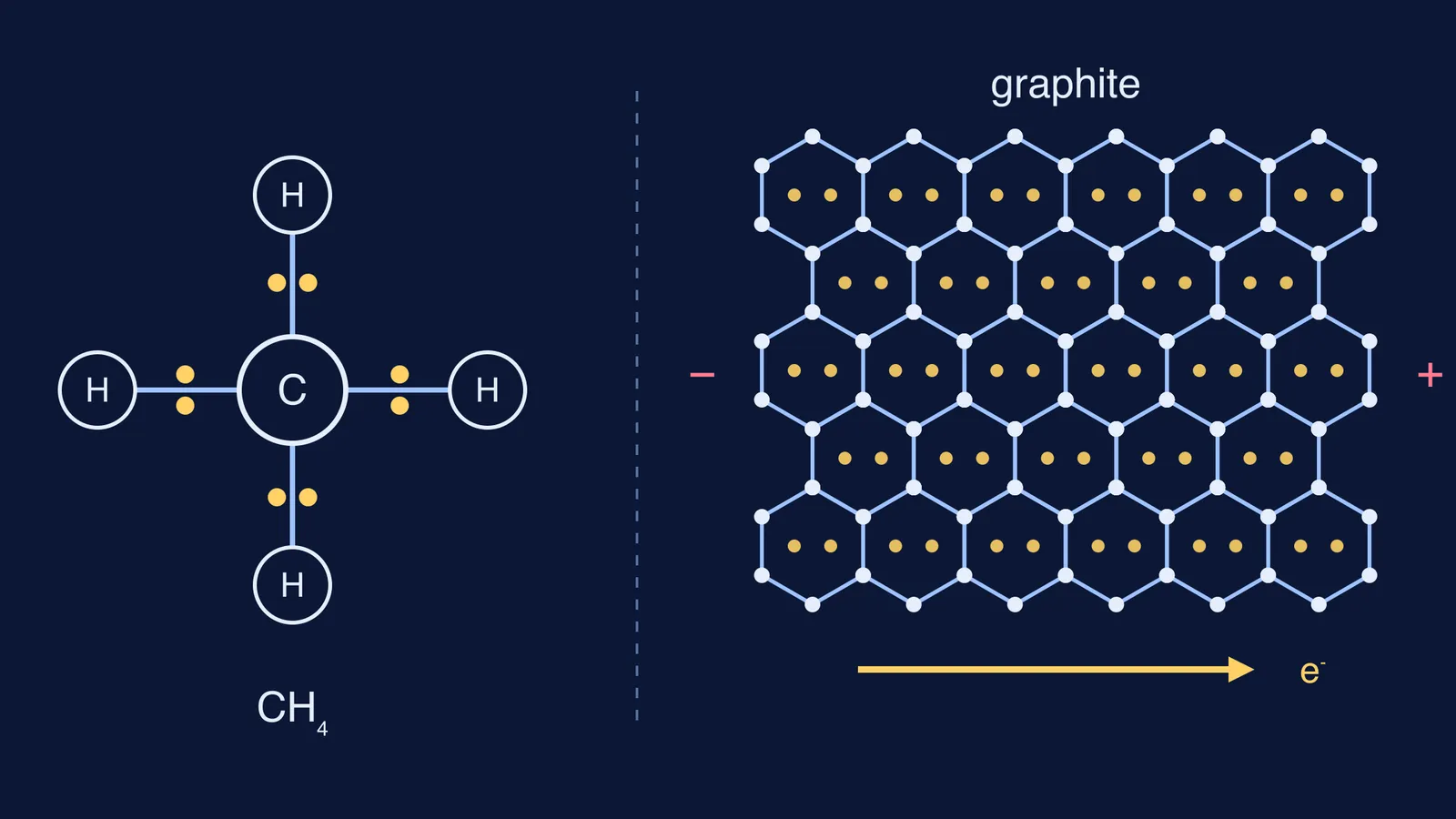
Sharing has two effects. Each bonding pair stays between the two atoms it joins, so there are no free electrons. No atom ends up charged, so there are no ions. NCERT puts it directly: “Since the electrons are shared between atoms and no charged particles are formed, such covalent compounds are generally poor conductors of electricity.”
The weak forces between covalent molecules give a second clue. In NCERT's Table 4.1, methane melts at 90 K and boils at 111 K, and ethanol melts at 156 K and boils at 351 K. NCERT links both the low melting points and the poor conduction to covalent bonding.
Why does graphite conduct electricity when diamond does not?
According to NCERT, each carbon in diamond is bonded to four others in a rigid three-dimensional structure, while in graphite each carbon is bonded to three others in the same plane, in hexagonal layers stacked one above the other. NCERT calls graphite “a very good conductor of electricity unlike other non-metals.”
The reason is the fourth electron. Chemguide explains that each carbon in graphite uses three electrons for bonds, and the spare electrons become delocalised over the whole sheet, so they “are free to move throughout the sheets.” In diamond, all the electrons “are held tightly between the atoms.” It adds that in theory electrons move only within a sheet, but real graphite is made of small crystals at different angles, so it conducts in all directions.
If diamond and graphite still blur with isotopes, read whether diamond is an isotope or an allotrope of carbon.
Do any carbon compounds conduct electricity?
A few do, and each fits the rule.
Acetic acid in water. NCERT's acids chapter lists CH₃COO⁻ among the ions acids form in water. Those ions are what glucose never produces.
Conductive polymers. The 2000 Nobel Prize in Chemistry went to Heeger, MacDiarmid and Shirakawa “for the discovery and development of conductive polymers.”
Carbon materials. For the wider family, read what Mildred Dresselhaus discovered about carbon materials.
How do you write this answer in a board exam?
Worked example: “Why are most carbon compounds poor conductors of electricity, while graphite conducts?”
Carbon has four valence electrons and cannot easily gain or lose four, so it forms covalent bonds by sharing electrons.
The shared electrons stay between the bonded atoms, and no ions form.
With no free electrons and no mobile ions, nothing carries charge, so most carbon compounds are poor conductors.
In graphite each carbon bonds to only three others; the fourth electron is delocalised across the layer and can move, so graphite conducts.
Check you have avoided these slips:
Saying carbon compounds “have no electrons”. They have plenty; none are free.
Saying graphite conducts through ions. It conducts through delocalised electrons.
Forgetting diamond. Every electron is held in a bond, so it does not conduct.
Assuming dissolving always helps. Glucose dissolves in water but forms no ions, so the bulb stays dark.
If this still feels shaky, the Fermi Concept Library covers every concept in chemistry, each with its own lesson and its place in the map, so you can go back to valence electrons. For more questions like this, the Fermi Problem Library has worked problems with a step-by-step solver that explains the reasoning rather than printing an answer.
To see where the shared electron pair came from, read how Heitler and London explained the covalent bond in 1927.


