

On this page
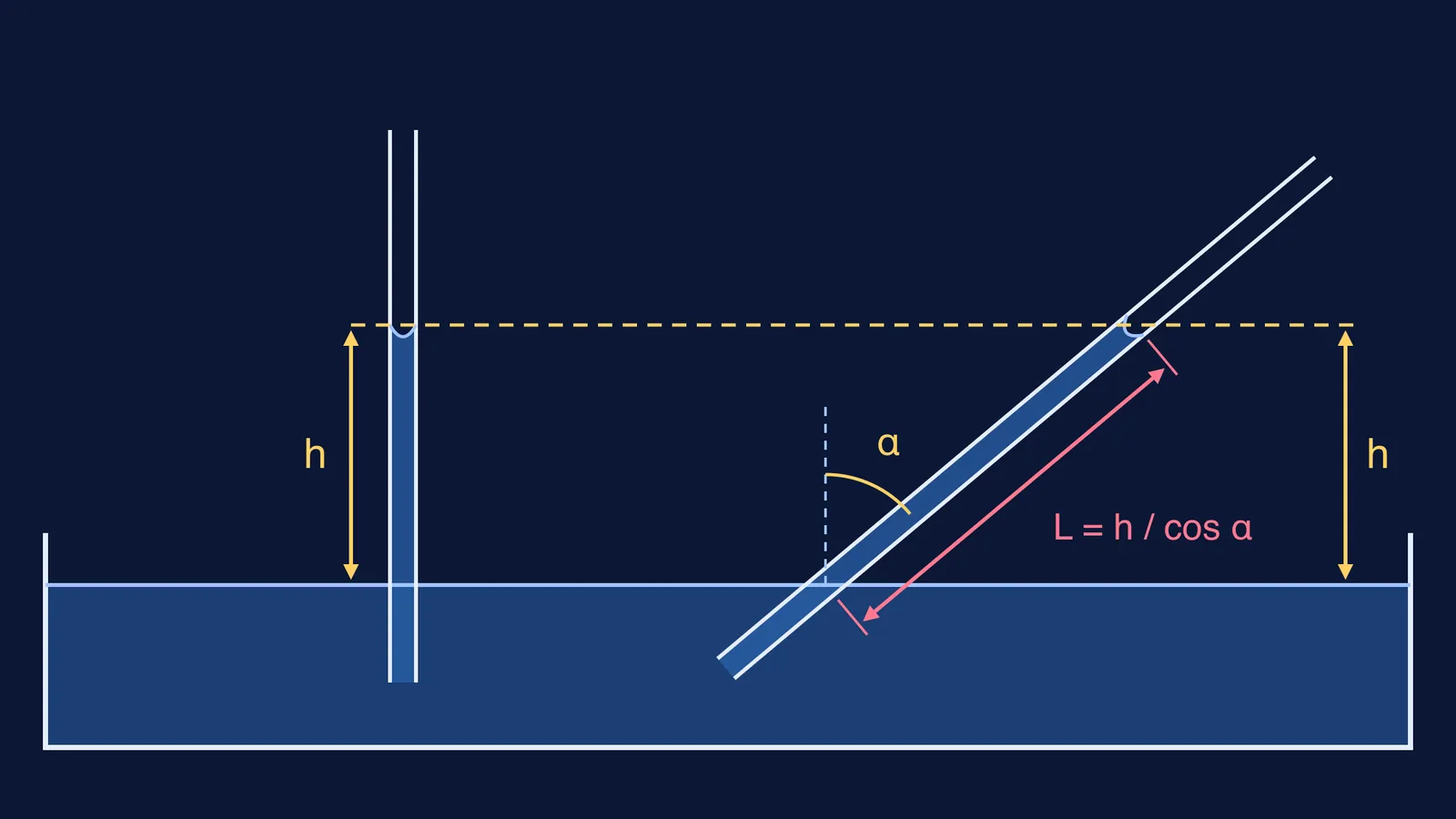
Tilt a capillary tube in a beaker of water and the water inside moves further up the glass. It is tempting to say the capillary rise has increased. It hasn't. The top of the column sits at exactly the same vertical height above the outside water as before; only the distance measured along the slanted tube has grown.
What is the capillary rise formula?
NCERT's Class 11 Physics chapter Mechanical Properties of Fluids (section 9.6.5) gives the capillary rise in a tube of radius a as h = 2S cos θ/(ρga), where S is the surface tension, θ the angle of contact, ρ the liquid's density and g the acceleration due to gravity.
The same NCERT section works out that water in a tube of radius 0.05 cm, with S = 0.073 N/m, rises 2.98 cm.
This relation is often called Jurin's law, after James Jurin, whose account of experiments on "the ascent and suspension of water in capillary tubes" appeared in the Philosophical Transactions of the Royal Society in 1718.
Look at what is missing from the formula: the length of the tube and the angle it makes. That is the first clue.
Does capillary rise change when the tube is tilted?
No. The vertical height h stays the same. You can see it two ways.
Start with pressure. Just under the curved meniscus, the pressure is lower than atmospheric by 2S cos θ/a (NCERT, equation 9.27). That depends only on the tube's radius and the contact angle, not on which way the tube points.
In a liquid at rest, pressure changes only with vertical depth, P = Pa + ρgh, and points at the same height have the same pressure (both in the same NCERT chapter). So the liquid below the meniscus must sit a vertical distance h above the outside surface, where hρg = 2S cos θ/a. Tilting the tube changes the path, not the vertical drop.
Forces give the same result. Surface tension pulls along the wall all round the contact line, giving a force 2πaS cos θ directed along the tube. A column of length L weighs ρπa²Lg, and only the part of that weight along the tube, ρπa²Lg cos α, opposes the pull. Setting them equal gives L cos α = 2S cos θ/(ρga) = h. Same answer, and it ignores the small volume of the meniscus, as the textbook result does.
How long is the liquid column in a tilted tube?
If α is the angle between the tube and the vertical, the length of liquid along the tube is L = h/cos α.
Take NCERT's water example, where h = 2.98 cm in a vertical tube (NCERT section 9.6.5):
α = 0° (vertical): L = 2.98 cm
α = 30°: L = 2.98/0.866 = 3.44 cm
α = 45°: L = 2.98/0.707 = 4.21 cm
α = 60°: L = 2.98/0.5 = 5.96 cm
In every row, L cos α comes back to 2.98 cm. As the tube approaches horizontal, cos α heads towards zero and the required length grows without limit, so a nearly horizontal tube simply fills along its length.
What happens if the tilted tube is too short?
This is the follow-up examiners like. Suppose the tube sticks out a length ℓ above the surface. Its top is only ℓ cos α above the water. If that is less than h, the liquid reaches the top and stops. It does not overflow into a fountain.
Instead, the meniscus at the top flattens. From hρg = 2S/R, where R is the meniscus's radius of curvature, a smaller available height means a larger R: the surface becomes less curved until the pressure balance holds again. The same reasoning explains why water fills a capillary tube in a freely falling lift, and a similar balance gives the rise between two parallel plates.
A four-step method for any tilted-tube question
Find h with h = 2S cos θ/(ρga), as if the tube were vertical.
Read the angle: from the vertical, or from the liquid surface?
Convert to the length along the tube: L = h/cos α (or h/sin of the angle with the surface).
Compare with the tube's vertical reach above the surface. If it is shorter than h, the liquid stops at the top and the meniscus flattens.
If you want to practise with a full solution laid out, the Fermi Problem Library has worked problems with a step-by-step solver that explains the reasoning rather than printing an answer. To see where surface tension, contact angle and excess pressure fit together, each has its own lesson in the Fermi Concept Library.
Before your practical exam, read how to find surface tension by capillary rise in the lab, and measure h vertically, even if your tube leans.


