

On this page
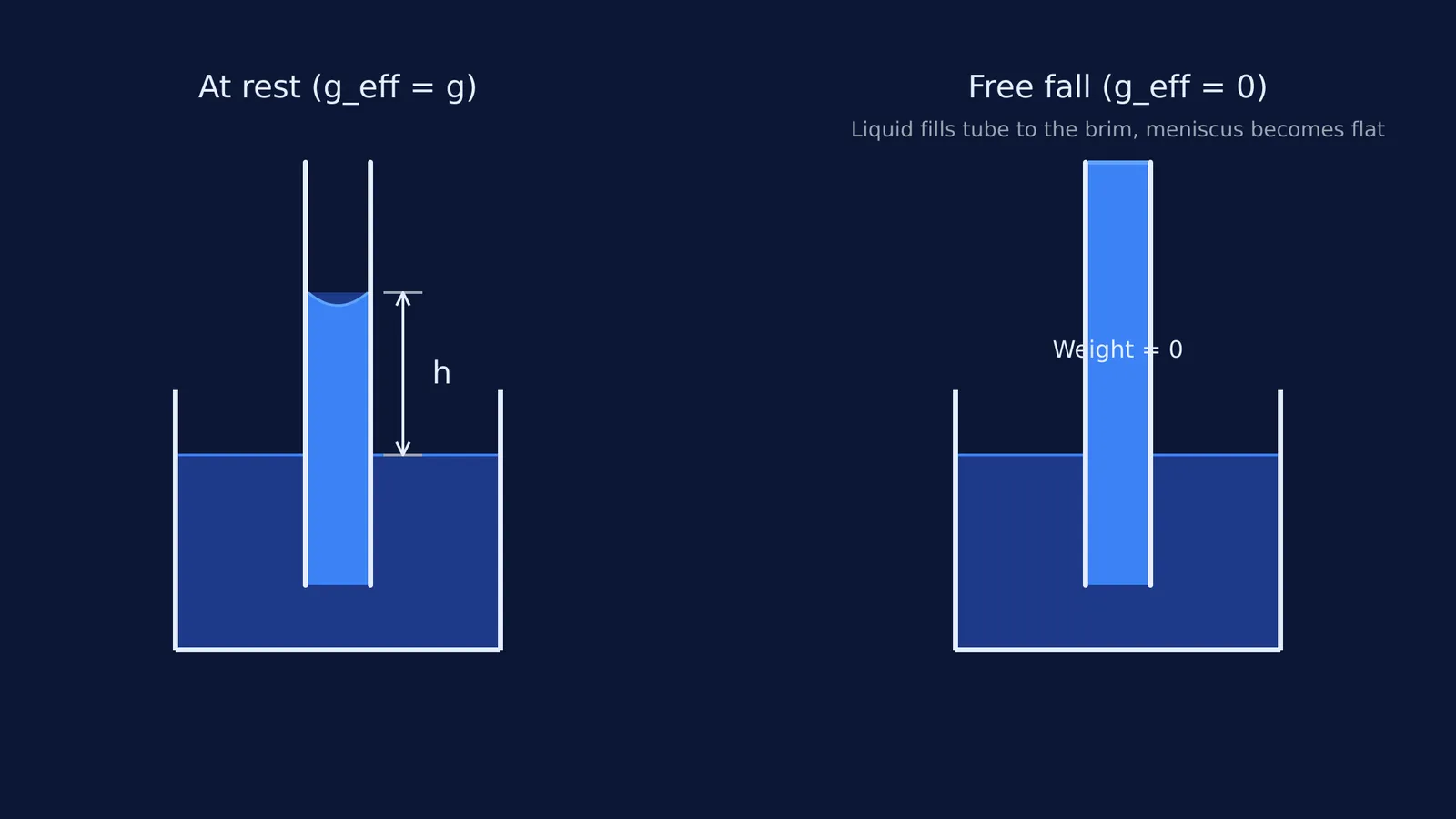
When you place a narrow glass tube in a beaker of water, the liquid climbs up the tube. This happens because the adhesive force between the water and the glass is stronger than the cohesive force between the water molecules. The upward pull of surface tension lifts the liquid until its weight balances the force.
But what happens if you carry that beaker into a lift and the cable snaps? Or if you run the experiment on the International Space Station?
How does an accelerating lift change capillary rise?
To find the capillary rise in any non-inertial frame, we must replace the standard acceleration due to gravity (g) with the effective gravity (g_eff). The standard formula for capillary rise, known as Jurin's law, is:
h = 2T cos θ / (ρ r g_eff)
where T is the surface tension, θ is the contact angle, ρ is the density of the liquid, and r is the radius of the tube. The denominator represents the weight of the liquid column. The height h is inversely proportional to g_eff.
When a lift accelerates upward with acceleration a, the floor pushes up against the fluid, making it feel heavier. The effective gravity is g_eff = g + a. The denominator increases, meaning the liquid column is shorter than it would be at rest. (For more on how accelerating frames change physical systems, see Simple pendulum in a lift or accelerating car: effective g).
When the lift accelerates downward, the liquid feels lighter. The effective gravity is g_eff = g - a. The denominator decreases, allowing surface tension to pull the liquid higher up the tube.
What happens to capillary rise in a freely falling lift?
If the lift is in free fall, its downward acceleration is equal to g. The effective gravity becomes zero:
g_eff = g - g = 0
If we put zero into the denominator of the formula, the theoretical height h tends to infinity.
So, what actually happens? Does the water fountain out of the top of the tube?
In a freely falling lift, the liquid climbs continuously until it reaches the very top of the tube, regardless of how long the tube is. Once it reaches the top edge, it does not overflow. Instead, the meniscus (the curved surface of the liquid) flattens out, changing its radius of curvature. Specifically, the contact angle θ changes. The upward force of surface tension drops until it precisely matches the now-zero weight of the column, anchoring the liquid at the brim. On Earth, a wetting liquid has a sharp, highly curved meniscus. In microgravity, the fluid boundary adjusts until the net capillary pressure vanishes, preventing any overflow.
Another way to think about this is energy. Capillary rise is a process that minimizes the total energy of the system—balancing the energy gained by wetting the glass with the gravitational potential energy required to lift the water column. In a freely falling lift, lifting the water column requires zero energy. The liquid will therefore wet as much glass as it possibly can. It climbs until it runs out of glass at the top of the tube.
How do space stations use capillary action?
In microgravity environments, such as on the International Space Station, fluids behave exactly as they do in free fall. Because there is no weight to counteract adhesive forces, liquids do not settle at the bottom of a tank. They creep along the walls and fill narrow gaps.
According to NASA's research on fluid dynamics, while capillary forces on Earth are limited to a few millimetres, in space they affect free surfaces that extend for meters. The Capillary Channel Flow experiment on the International Space Station studied how to use open channels, interior corners, and surface tension to guide fuel to tank outlets and manage recycled water. By carefully designing the geometry of the tanks, engineers can ensure a reliable flow of propellant to the engines without relying on heavy mechanical pumps. This eliminates complex moving parts, reducing the overall weight and failure risk of the spacecraft during long missions to the Moon or Mars.
If you need help building intuition for pseudo-forces or how physical laws shift across frames of reference, the Fermi Concept Library maps out the mechanics of accelerating frames with interactive lessons. Or, if you need to work through numericals on surface tension and capillary rise, the Fermi Problem Library provides a step-by-step solver that explains the reasoning rather than just printing an answer.


