On this page
A favourite capacitor question gives you two capacitors, each charged by its own battery, then joins the positive plate of one to the negative plate of the other. It asks for the charge left over, the voltage they settle at, and the energy that disappears. All three come from two rules you already know, applied in the right order.
What happens when you join two charged capacitors positive to negative?
Start from the definition. OpenStax University Physics defines capacitance as C = Q/V, and a charged capacitor carries +Q on one plate and −Q on the other.
When you join the two capacitors with two wires, each wire plus the two plates it touches becomes one isolated conductor. No charge can enter or leave it, so the charge on it is simply the sum of what the two plates carried before. Join + to −, and that sum is a subtraction: the charges partly cancel.
After the current stops, the two capacitors sit side by side between the same two wires. They are now in parallel, and OpenStax explains that parallel capacitors all have the same voltage across their plates and a combined capacitance C1 + C2. That shared voltage is the common potential.
How do you find the common potential, step by step?
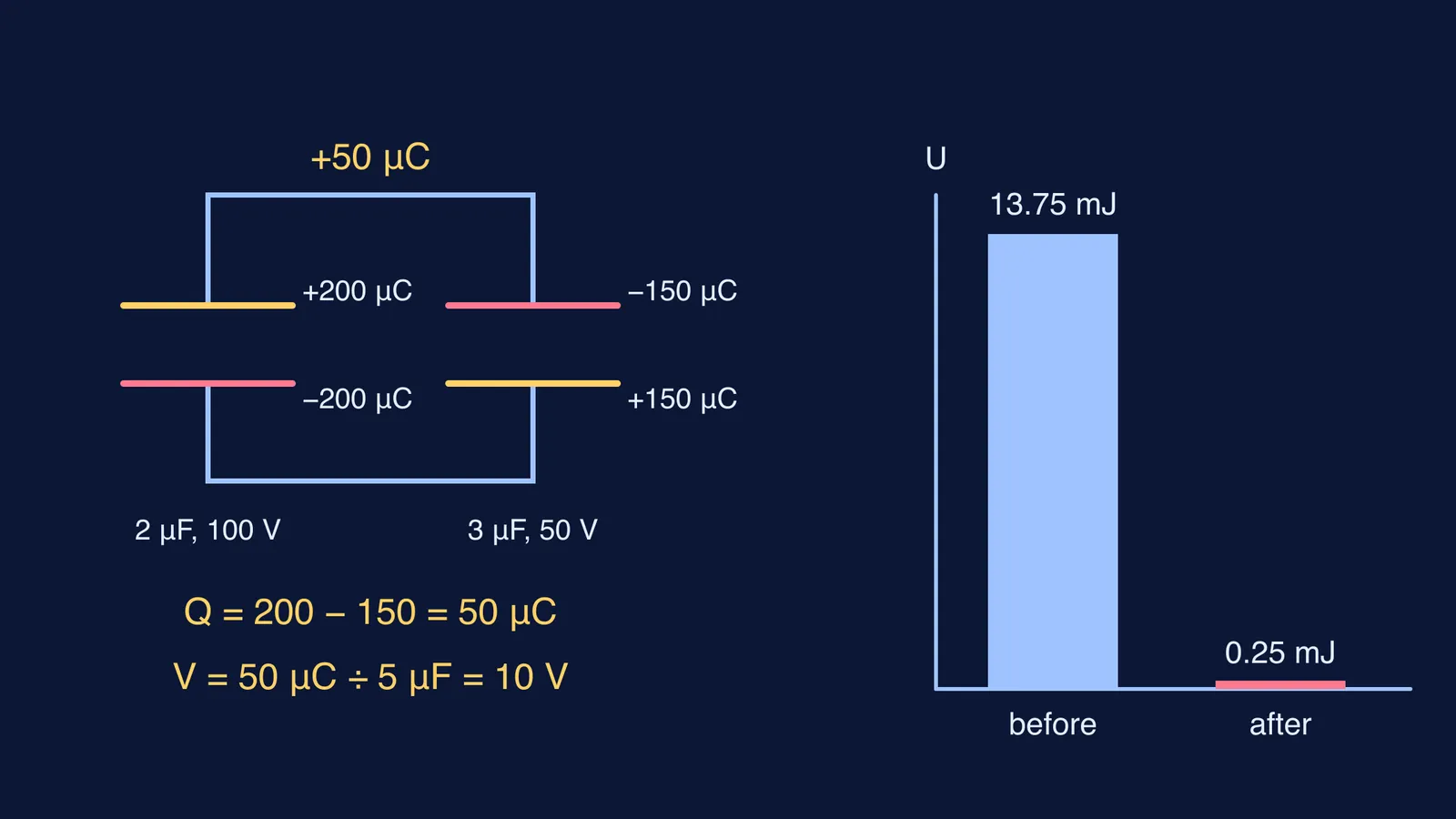
Here is a worked example with numbers you can check. Capacitor A is 2 μF charged to 100 V. Capacitor B is 3 μF charged to 50 V. A's positive plate is joined to B's negative plate, and A's negative plate to B's positive plate.
Charges before: Q_A = 2 μF × 100 V = 200 μC, and Q_B = 3 μF × 50 V = 150 μC.
Net charge on the wire joining A's + to B's −: +200 − 150 = +50 μC. The other wire carries −50 μC.
Combined capacitance: 2 + 3 = 5 μF.
Common potential: V = 50 μC ÷ 5 μF = 10 V, with A's original polarity.
Charges after: A holds 2 × 10 = 20 μC and B holds 3 × 10 = 30 μC.
Step 5 hides the surprise. B started with its top plate negative and ends with it positive at 10 V. The capacitor that held more charge sets the final polarity, and the one that held less charge flips, even though here it is the larger capacitor. The general formula is V = (C1V1 − C2V2)/(C1 + C2), and its sign tells you which polarity survives.
If the plates had been joined + to + instead, the charges would add: 350 μC on 5 μF gives 70 V. Writing a plus where the question needs a minus is an easy way to lose this question.
How much energy is lost, and where does it go?
OpenStax gives the energy stored in a capacitor as U = ½CV² = Q²/2C = ½QV. Use it before and after.
Before: A has ½ × 2 μF × (100 V)² = 10 mJ, and B has ½ × 3 μF × (50 V)² = 3.75 mJ, so 13.75 mJ in total.
After: ½ × 5 μF × (10 V)² = 0.25 mJ.
Lost: 13.75 − 0.25 = 13.5 mJ, about 98% of what was stored.
A shortcut gives the loss in one line: ΔU = ½ × C1C2/(C1 + C2) × (V1 + V2)². Here that is ½ × 1.2 μF × (150 V)² = 13.5 mJ, which matches. For a + to + joint, replace V1 + V2 with V1 − V2; in our example the loss drops to 1.5 mJ. Opposite polarity loses far more because the voltage difference that drives the charge across is V1 + V2, not V1 − V2.
Where does it go? The well-known two capacitor paradox works through the simplest case, a charged capacitor joined to an identical empty one: exactly half the energy is lost, as heat in the wire resistance, however small that resistance is, and as electromagnetic radiation when the wires have inductance. For the idealised case of wires with zero resistance, physicist Ashok K. Singal argues in a paper in Physics Education that the missing energy goes into the kinetic energy of the moving charges.
Which mistakes cost marks on this question?
Adding charges when the plates are joined opposite to each other.
Adding voltages (100 + 50) instead of working through charge.
Forgetting that one capacitor can end up with reversed polarity.
Using the series formula for the final capacitance: once the current stops, the two are in parallel.
Expecting energy to be conserved. Even a + to + joint loses some, unless both capacitors started at the same voltage.
If you want more practice, the Fermi Problem Library has worked problems with a step-by-step solver that explains the reasoning rather than printing an answer. If the idea of charge being conserved on a joined pair of plates still feels shaky, the Fermi Concept Library gives every concept in physics its own lesson.
Next time you see "positive plate connected to negative plate", write the subtraction first. Everything after it is arithmetic.