

On this page
In algebra, 3x = 3y gives x = y, so when a question hands you A ∩ B = A ∩ C, your pen wants to strike out A. For sets, that step is not allowed. The NCERT Class 11 Mathematics textbook makes the point twice in the Miscellaneous Exercise on Chapter 1, Sets: Question 8 asks you to show that A ∩ B = A ∩ C need not imply B = C, and Question 3 asks you to show that if A ∪ B = A ∪ C and A ∩ B = A ∩ C both hold, then B = C.
Does A ∩ B = A ∩ C imply B = C?
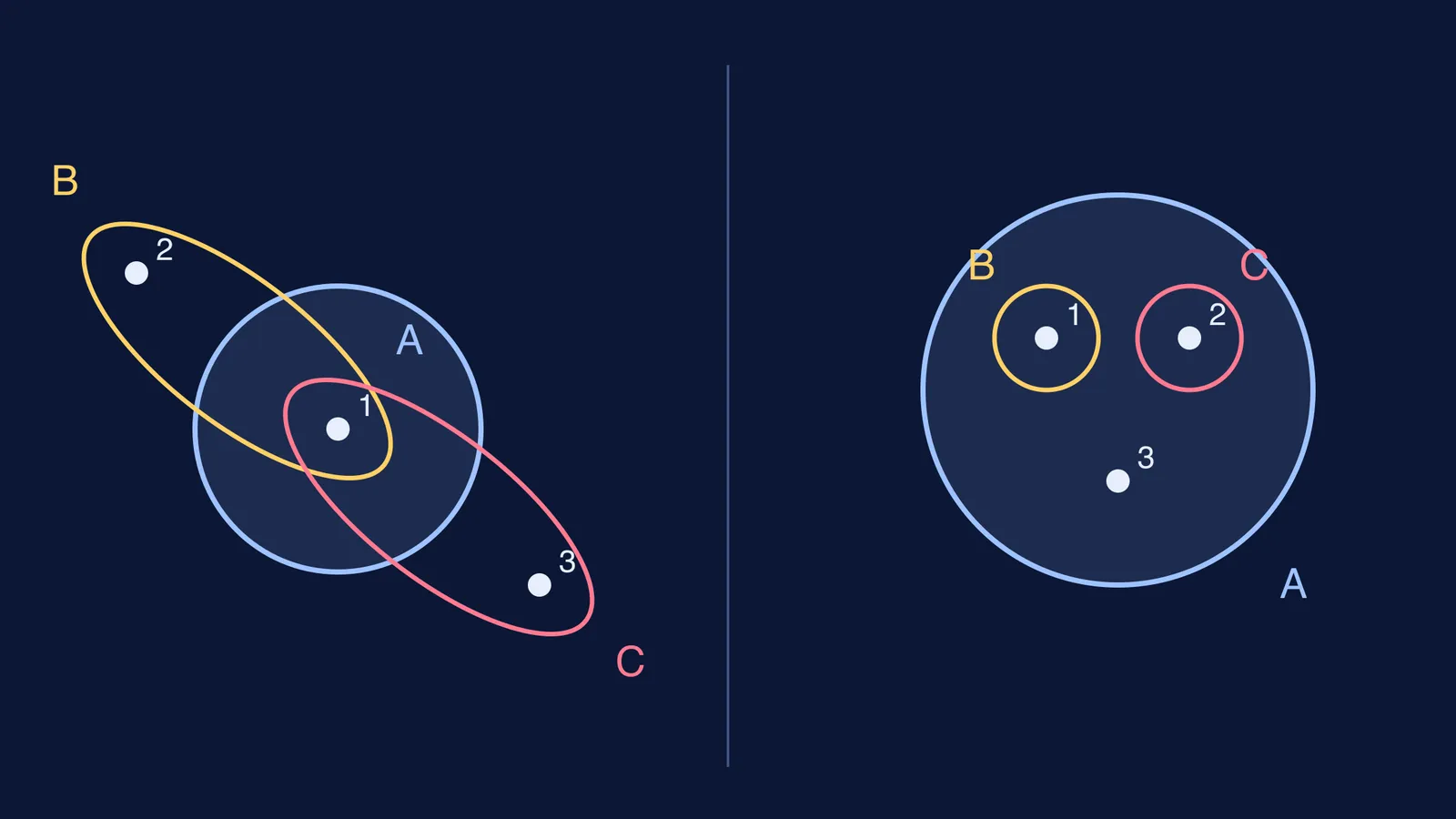
No. The intersection of two sets A and B is the set of elements common to both, as the NCERT Sets chapter defines it. So A ∩ B only reports the part of B that sits inside A. Whatever B contains outside A is invisible to it.
A counterexample:
A = {1}
B = {1, 2}
C = {1, 3}
A ∩ B = A ∩ C = {1}, but 2 is in B and not in C, so B ≠ C. The difference sits outside A, where intersection cannot look.
An even faster one: let A = ∅. Then A ∩ B = A ∩ C = ∅ for any B and C you like.
Does A ∪ B = A ∪ C imply B = C?
Also no, for the mirror-image reason. The union of A and B is the set of elements that are in A or in B. Anything B holds inside A gets absorbed, because A already supplies it.
A counterexample:
A = {1, 2, 3}
B = {1}
C = {2}
A ∪ B = A ∪ C = {1, 2, 3}, yet B ≠ C. This time the difference sits inside A, where union cannot look. The fast version: let A be the universal set U, and every union equals U.
Why do both conditions together force B = C?
Split B into two pieces: the part inside A and the part outside A. The intersection condition says the inside pieces of B and C match. The union condition says the outside pieces match, because an element outside A is in A ∪ B exactly when it is in B. Both halves match, so the whole sets match.
Written as an element-chasing proof, the same style NCERT uses in Example 25 of the chapter:
Take any x in B.
If x ∈ A, then x ∈ A ∩ B = A ∩ C, so x ∈ C.
If x ∉ A, then x ∈ A ∪ B = A ∪ C. Since x is not in A, x ∈ C.
Either way x ∈ C, so B ⊂ C. Swap the roles of B and C to get C ⊂ B. Hence B = C.
If you prefer the algebra of sets, here is a chain using absorption (Question 7 of the same exercise) and the distributive law (the hint to Question 9):
B = B ∩ (A ∪ B), by absorption
= B ∩ (A ∪ C), by the union condition
= (B ∩ A) ∪ (B ∩ C), by the distributive law
= (A ∩ C) ∪ (B ∩ C), by the intersection condition
= (A ∪ B) ∩ C, by the distributive law read backwards
= (A ∪ C) ∩ C, by the union condition
= C, by absorption
How do you test any cancellation claim about sets?
Use this four-step check on any "can I cancel this?" question:
Ask what the operation hides. Intersection with A hides everything outside A; union with A hides everything inside A.
Try the extreme sets first: A = ∅ and A = U. They break most false cancellations in seconds.
If the extremes don't break it, build the smallest counterexample, with one element in each region of the Venn diagram that the operation hides.
If nothing breaks it, prove it by element chasing, with one case per region.
The region-by-region thinking is the same one you use for checking De Morgan's laws with a Venn diagram, and it carries straight into probability once you start translating events like 'A but not B' into set notation. Vectors have their own version of the trap: a · b = a · c does not mean b = c either, because the dot product only sees the part of b along a.
To practise more set proofs, the Fermi Problem Library has worked problems with a step-by-step solver that explains the reasoning rather than printing an answer. If the definitions feel shaky, the Fermi Concept Library gives each mathematics concept its own lesson and its place in the map, so you can see what union and intersection build on.
Next time your pen reaches to cancel A, stop and ask: which half of B can this operation actually see?


