On this page
Buna-S, Buna-N and neoprene come up together because they make a neat test question. All three are synthetic rubbers, and each has a 1,3-diene among its monomers, but only one of them is made from a single monomer. If you can write the monomers and count them, you can classify each one in under a minute.
What are the monomers of Buna-S, Buna-N and neoprene?
Here are the three, with the IUPAC names from PubChem.
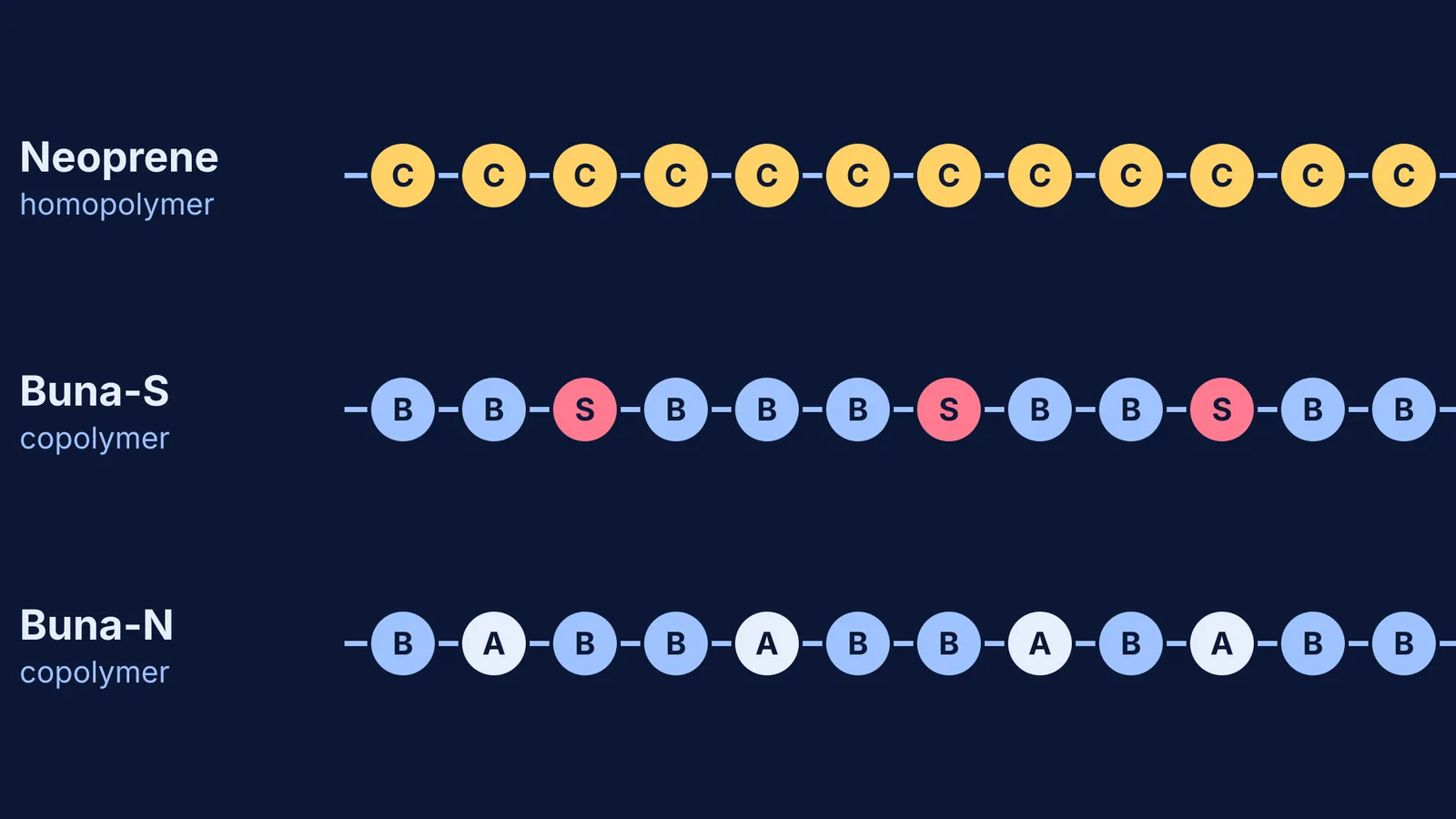
Neoprene (polychloroprene): one monomer, chloroprene, which is 2-chlorobuta-1,3-diene, C4H5Cl, written CH2=CCl–CH=CH2.
Buna-S (styrene-butadiene rubber, SBR): two monomers, buta-1,3-diene, C4H6, and styrene, C8H8.
Buna-N (nitrile rubber, NBR): two monomers, buta-1,3-diene and acrylonitrile, which is prop-2-enenitrile, C3H3N, written CH2=CH–CN.
Neoprene is made by polymerising chloroprene, and commercially this is done by free-radical emulsion polymerisation. Buna-S is derived from two monomers, styrene and butadiene. Buna-N is derived from acrylonitrile and butadiene.
Is neoprene a homopolymer or a copolymer?
Neoprene is a homopolymer. A copolymer is "a polymer derived from more than one species of monomer", the IUPAC definition. A homopolymer is the opposite case: one kind of monomer, repeated.
So the classification is:
Neoprene: one monomer (chloroprene), so a homopolymer.
Buna-S: two monomers (1,3-butadiene and styrene), so a copolymer.
Buna-N: two monomers (1,3-butadiene and acrylonitrile), so a copolymer.
The same Wikipedia article on copolymers lists styrene-butadiene and nitrile rubber among its examples of commercial copolymers.
How do you remember which monomer goes with which rubber?
Read the names. In Buna-S, Bu stands for butadiene, Na for sodium (natrium) and S for styrene. Use the same pattern for Buna-N: Bu for butadiene, and N for nitrile, the –CN group in acrylonitrile. Neoprene has no "Buna" in its name, and that fits: butadiene is not one of its monomers.
For neoprene, compare chloroprene with isoprene. Isoprene is 2-methylbuta-1,3-diene, and chloroprene is 2-chlorobuta-1,3-diene. Same four-carbon diene, with Cl at carbon 2 where isoprene has CH3. "Chloro-prene" tells you exactly what changed.
A worked example: classify it in three steps
Try this on any polymer a question gives you.
Write the monomer or monomers by name.
Count how many different species there are. Ignore how many atoms of each element they contain.
One species: homopolymer. Two or more: copolymer.
Now the trap versions you may see in an MCQ:
"Neoprene contains chlorine, so it is a copolymer." Wrong. The chlorine sits inside the single monomer, chloroprene. One species, so homopolymer.
"Buna-N and Buna-S are homopolymers of butadiene." Wrong. Each has a second monomer (acrylonitrile or styrene), so both are copolymers.
"Buna-S and Buna-N share a monomer." Right. Both contain 1,3-butadiene.
If step 1 is where you get stuck, the gap is the monomer structures, not the classification. The Fermi Concept Library gives every chemistry concept its own lesson and shows where it sits in the map, so you can revise dienes and addition polymers before coming back to this.
Where are these rubbers used, and why does the second monomer matter?
The second monomer changes the properties. For Buna-S, a higher styrene content makes the rubber harder and less rubbery. It was developed in Germany by Walter Bock in 1929.
Buna-N has good resistance to mineral oils, vegetable oils and petrol, which is why it turns up in oil seals, hoses, O-rings and disposable non-latex gloves. The same article says most applications that need both solvent resistance and low-temperature flexibility call for an acrylonitrile content of 33%. Nitrile rubber was developed in 1931 at BASF and Bayer.
Neoprene was invented by DuPont scientists on 17 April 1930. Foamed neoprene is used in wetsuits and drysuits, and the same source lists laptop sleeves and orthopaedic braces among its uses.
Are polymers still in the NCERT and exam syllabus?
Check before you spend hours here. In its list of rationalised content for Class XII (May 2022), NCERT dropped Unit 15, Polymers, from Chemistry Part II as a full chapter. Exam syllabi are set separately and change year to year, so read the current syllabus on the official NTA page for JEE Main or NEET-UG, or your board's syllabus, rather than an old coaching module or question bank.
If it is on your list, practise it the way it will be tested: a mixed set where neoprene, Buna-S, Buna-N and other polymers sit side by side. The Fermi Problem Library has worked problems with a step-by-step solver that explains the reasoning rather than printing an answer, which helps when you got the classification right but cannot say why.