

On this page
Bromomethane has one carbon. Propanone (acetone) has three: PubChem lists it as C₃H₆O, IUPAC name propan-2-one. So this conversion is about building carbon–carbon bonds, and the trick is that bromomethane supplies all three carbons itself, if you send it down two roads and then join them.
How do you convert bromomethane to propanone?
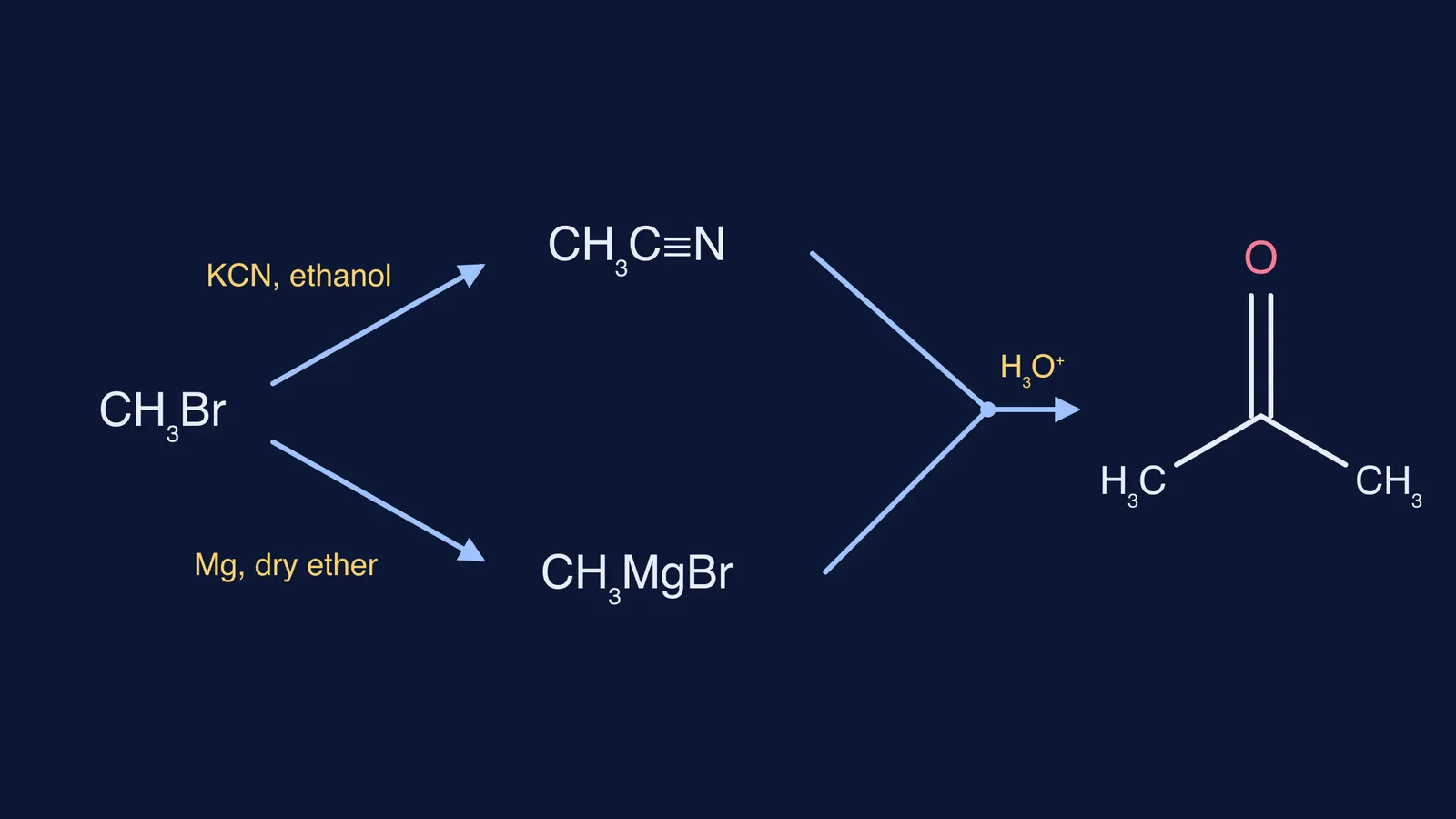
Here is the full sequence. Steps 1 and 2 are done separately, on two portions of bromomethane.
Make acetonitrile. CH₃Br + KCN → CH₃C≡N + KBr. Chemguide describes the conditions: a halogenoalkane heated under reflux with sodium or potassium cyanide in ethanol has its halogen replaced by a –CN group. This adds the second carbon.
Make the Grignard reagent. CH₃Br + Mg → CH₃MgBr, in dry ether. Chemguide notes the halogenoalkane is added to magnesium in ethoxyethane, and everything must be perfectly dry because Grignard reagents react with water.
Combine, then hydrolyse. CH₃MgBr + CH₃C≡N → (CH₃)₂C=N–MgBr, then H₃O⁺ → (CH₃)₂C=O + NH₃ + Mg(OH)Br. The methyl group of the Grignard reagent becomes the third carbon.
Count the carbons: one from the nitrile's methyl, one from the C≡N carbon, one from the Grignard. The nitrile carbon is the one that ends up as the C=O carbon.
Why does the Grignard reagent stop at the ketone?
This is worth knowing, because a Grignard reagent does not always stop after one addition. With a nitrile, LibreTexts explains, the Grignard reagent adds to the electrophilic nitrile carbon to form an intermediate imine anion, and the negative charge of that anion prevents any further nucleophilic addition/20%3A_Carboxylic_Acids_and_Nitriles/20.07%3A_Chemistry_of_Nitriles). The ketone only appears after you add aqueous acid, when the imine salt is hydrolysed to a ketone/Nitriles/Reactivity_of_Nitriles/Conversion_to_ketones_using_Grignard_reagents) and the nitrogen leaves as ammonia. By then no Grignard reagent is left to attack it.
What mistakes lose marks in this conversion?
The carbon skeleton is the easy part; the conditions are where it is easy to slip. Check your answer against this list before you move on.
Water in step 1. Chemguide warns that if water is present you tend to get substitution by –OH instead of –CN. Write "KCN, ethanol" or "alc. KCN", not "aq. KCN", or you have made methanol.
Water in step 2. Grignard reagents react with water to produce alkanes. Here that alkane is methane, and your methyl group is gone. Write "dry ether".
Acid added too early. H₃O⁺ belongs after the addition, as a separate step. Writing "CH₃MgBr, H₃O⁺" over one arrow without numbering them suggests they go in together.
Wrong cyanide. Cyanide is an ambident nucleophile, so an isonitrile can form as a side product; the same article notes that free cyanide ions from an alkali-metal salt tend to give the nitrile. Use KCN for the nitrile.
Forgetting the intermediate. If the question asks for the mechanism or for compounds A, B and C, show the imine salt (CH₃)₂C=N–MgBr.
Is there another route to propanone?
Yes: CH₃MgBr with ethanal gives propan-2-ol, which you can oxidise to propanone. But that needs ethanal, so it does not start from bromomethane alone. When the question gives only bromomethane and inorganic reagents, write the nitrile route. Our post on methods of preparing aldehydes and ketones in Class 12 puts the nitrile method next to the others so you can compare them.
The safety figure comes from the NIOSH RTECS entry for potassium cyanide.
How should you practise conversions like this?
Don't memorise each conversion separately. Ask three questions every time:
How many carbons does the product have compared with the start? Here, one becomes three.
Which reactions make C–C bonds? Cyanide substitution and Grignard addition come first.
What group must the last step create? A ketone C=O here, which the nitrile delivers.
The same Grignard logic works on carbon dioxide, as in bromobenzene to benzoic acid. And once you have propanone, you can go further, as in converting propanone to propene in two steps.
If you get the skeleton right but keep losing marks on conditions, the Fermi Problem Library has worked problems with a step-by-step solver that explains the reasoning rather than printing an answer. If the gap is earlier, say why a nitrile carbon is electrophilic at all, the Fermi Concept Library gives each chemistry concept its own lesson.
Try it now: write the same three steps to make butanone from bromoethane and bromomethane, and check whether it matters which one becomes the nitrile.


