On this page
If you have studied boron in Class 11 chemistry, you have probably met the line "boron nitride is called inorganic graphite". The better question is why two materials that look almost identical at the atomic scale behave so differently. Graphite conducts electricity; hexagonal boron nitride (h-BN) does not. One bond explains it.
Why is boron nitride called inorganic graphite?
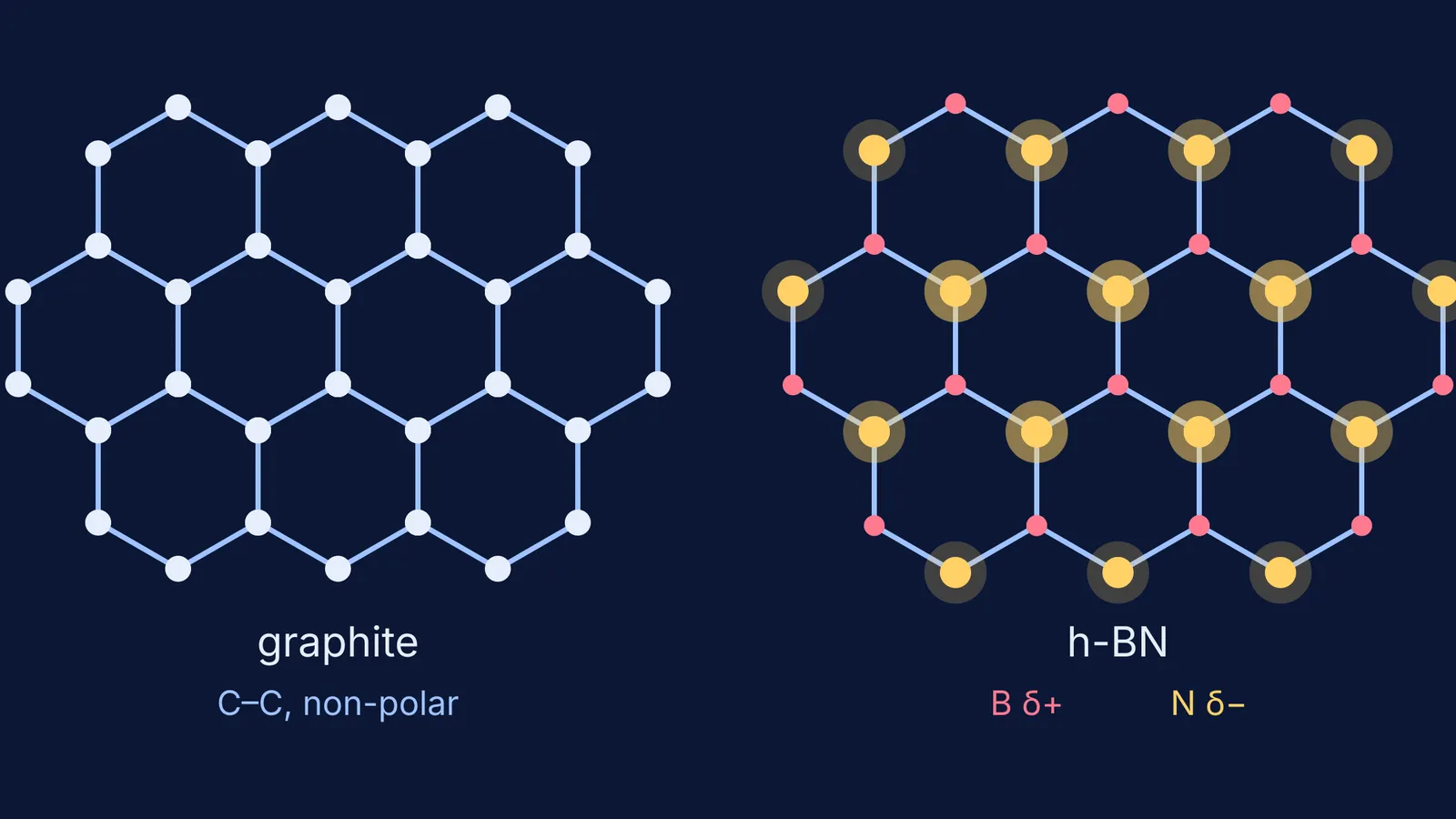
Hexagonal boron nitride is a layered solid in which each layer is a flat honeycomb of alternating boron and nitrogen atoms. Chemist Oded Hod describes an h-BN layer as a graphene sheet with each bonded pair of carbons replaced by a boron–nitrogen pair, and notes the two are isoelectronic (Hod, Journal of Chemical Theory and Computation, 2012). Its nicknames include "white graphite" (Wikipedia: Boron nitride).
Isoelectronic means the electron count matches: boron's 3 valence electrons plus nitrogen's 5 make 8, the same as two carbons with 4 each.
How similar are the structures of h-BN and graphite?
Here are the measured numbers side by side:
In-plane lattice constant: 2.46 Å for graphite (Chung, Journal of Materials Science, 2002) and 2.50 Å for h-BN (Constantinescu, Kuc and Heine, Physical Review Letters, 2013).
Bond length: 1.42 Å for C–C in graphite (Chung); about 1.44 Å for B–N, worked out as the 2.50 Å lattice constant divided by √3.
Distance between layers: 3.35 Å in graphite (Chung) and 3.33 Å in h-BN (Constantinescu and colleagues, citing experiment).
Between layers: weak van der Waals forces in both, so the layers slide; both are used as lubricants.
So far, they look like twins. The difference is inside the bond.
Why does graphite conduct electricity but boron nitride does not?
In graphite, each carbon has one electron left in a p orbital after forming its three bonds. These electrons join into a π system spread across the whole layer, making graphite a semimetal (Hod, 2012). It conducts well within the layers and poorly perpendicular to them (Chung, 2002).
In h-BN the electron count is the same, but the atoms are not. On the Pauling scale, nitrogen's electronegativity is 3.04 and boron's is 2.04 (PubChem periodic table data), a difference of 1.00. In a C–C bond the difference is zero. So the B–N bond is polar: boron carries a partial positive charge (δ+) and nitrogen a partial negative charge (δ−).
Hod writes that, because of this electronegativity difference, the π electrons "tend to localize around the nitrogen atomic centers thus forming an insulating material" (Hod, 2012). Electrons held near one atom cannot easily carry a current across the sheet.
The band gap is the energy an electron needs to reach a state where it can move freely. Using optical spectroscopy, Cassabois, Valvin and Gil measured an indirect band gap of 5.955 eV in h-BN (Nature Photonics, 2016). Graphite, a semimetal, has no such gap. The reduced delocalisation also shows in h-BN's lack of colour (Wikipedia: Boron nitride).
Do the layers stack the same way?
No. In graphite, layers stack in an AB pattern: each layer is shifted so that half its carbon atoms sit over the hexagon centres of the next layer (Hod, 2012). In h-BN, the layers stack AA′: the hexagons sit directly above each other, with boron over nitrogen (Constantinescu, Kuc and Heine, 2013). Hod links this to the charges: a δ+ boron in one layer sits on top of a δ− nitrogen in the next.
You might expect that attraction to pull h-BN layers closer than graphite's. Hod's calculations found the electrostatic contribution from the partial charges is vanishingly small and the dispersion forces are very similar, so the spacing comes out practically the same.
How do you answer a comparison question in an exam?
A typical question: "Compare the structure and electrical conductivity of hexagonal boron nitride with graphite." A five-point answer to adapt for JEE Main, JEE Advanced or board exams:
Both are layered solids of flat hexagonal sheets held by weak van der Waals forces, so both are soft and slippery.
B–N is isoelectronic with C–C (3 + 5 = 4 + 4 valence electrons), so the structures match.
B–N bonds are polar because nitrogen is more electronegative than boron; C–C bonds are non-polar.
Graphite's π electrons are delocalised over each layer, so it conducts along the layers. In h-BN they are localised on nitrogen, so it insulates.
Stacking differs: AB in graphite, AA′ in h-BN with boron above nitrogen.
Three mix-ups to avoid:
Saying h-BN has no π electrons. They are localised, not missing.
Calling B–N ionic. It is a polar covalent bond with partial charges.
Saying graphite conducts equally in all directions. It conducts along the layers, poorly across them.
If a step felt shaky, such as hybridisation or why electronegativity decides where electrons go, the Fermi Concept Library has a lesson for each idea and its place in the map of chemistry. To practise comparison questions, the Fermi Problem Library has worked problems with a step-by-step solver that explains the reasoning rather than printing an answer.
Next time "inorganic graphite" turns up in a question, start with the bond, and the rest of the answer follows.