

On this page
If your Class 11 practical asks for the boiling point of a liquid organic compound, you will probably use the capillary method: a drop or two of liquid in a fusion tube, a thin capillary sealed at one end and dipped in upside down, and a thermometer tied alongside. It is quick, and easy to get wrong.
How does the capillary method find a boiling point?
The boiling point of a liquid is the temperature at which its vapour pressure becomes equal to the atmospheric pressure, as Experiment 3.3 of the NCERT Class 11 Chemistry Laboratory Manual defines it. The same manual calls the boiling point at 1.013 bar the normal boiling point.
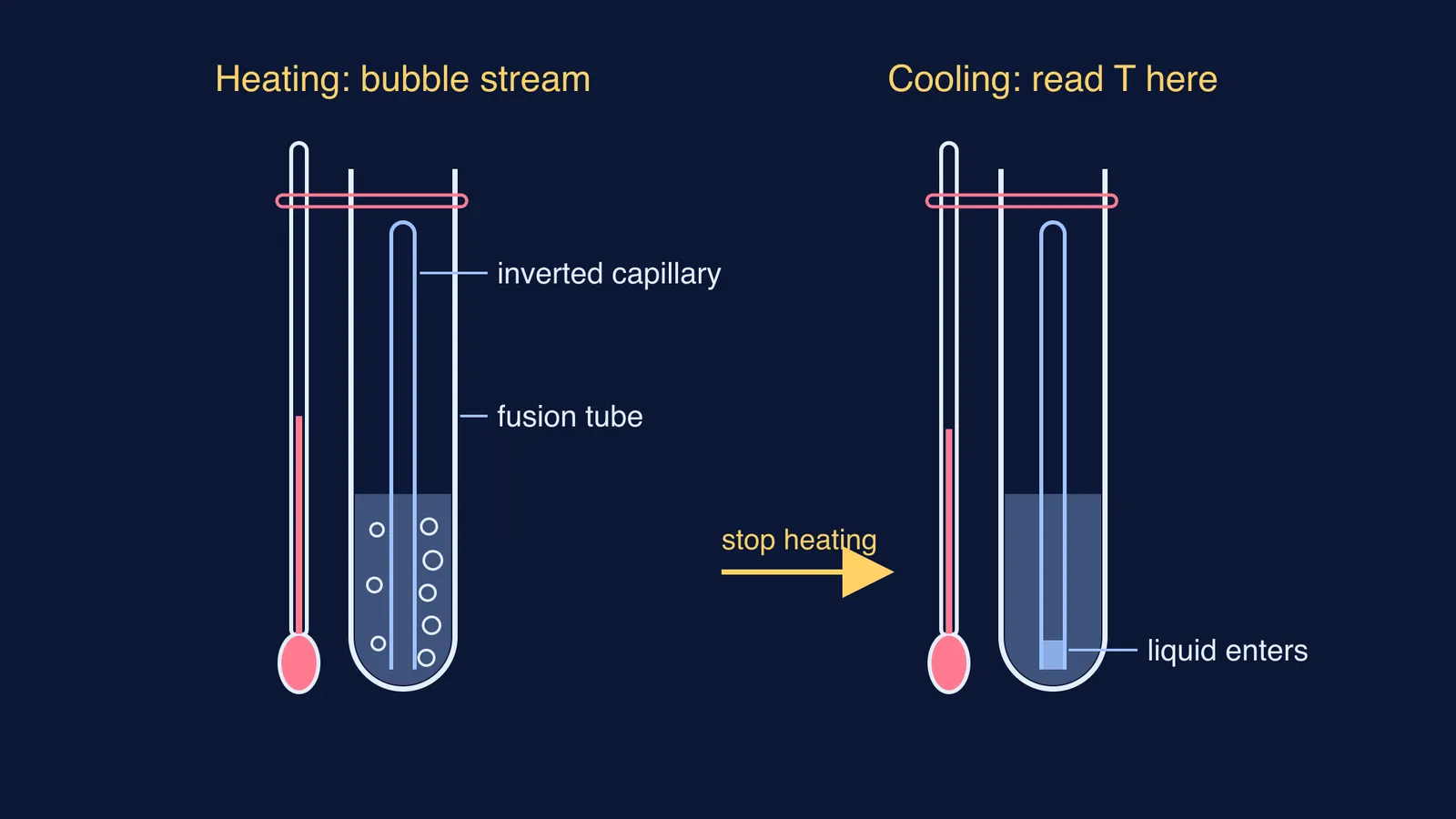
The inverted capillary is the indicator. Its trapped air expands and escapes as bubbles, and vapour takes its place. As the setup cools, the pressure inside the capillary, now due only to the compound's vapour, falls to match the air pressure outside, the bubbles slow, and liquid is drawn up into the capillary. Chemistry LibreTexts/06:_Miscellaneous_Techniques/6.02:_Boiling_Point/6.2B:_Step-by-Step_Procedures_for_Boiling_Point_Determination) says the boiling point should be recorded as the temperature when liquid just begins to enter the capillary tube.
A. Siwoloboff described boiling point determination for small amounts of liquid in an 1886 paper in Berichte der Deutschen Chemischen Gesellschaft, which is why the capillary technique is also called the Siwoloboff method.
How do you set up the fusion tube and inverted capillary?
The NCERT manual gives this sequence:
Fill the Thiele tube with liquid paraffin so that it crosses the bent portion.
Put 1-2 drops of the liquid in the fusion (ignition) tube and tie it to the thermometer with a rubber band, with the bottom of the tube level with the thermometer bulb.
Seal one end of a capillary about 8 cm long by heating it in the flame.
Place the capillary with its open end down, dipping into the liquid.
Heat the side arm of the Thiele tube gently with a low flame.
The manual also says the bath liquid should boil 50-60 °C higher than the liquid you are testing. LibreTexts adds that the rubber band should sit above the oil level, allowing for the oil expanding as it heats.
When exactly should you read the temperature?
You will meet two versions. The NCERT manual asks you to note the temperature at which bubbles start coming briskly and continuously. The LibreTexts procedure/06:_Miscellaneous_Techniques/6.02:_Boiling_Point/6.2B:_Step-by-Step_Procedures_for_Boiling_Point_Determination) heats until the stream is so fast that individual bubbles can barely be told apart, then lets the bath cool and reads the temperature as the bubbles slow and liquid just starts to enter.
The cooling reading matches the definition itself: vapour pressure inside equal to pressure outside. The heating reading tends to depend more on how fast you heat.
Worked example: ethanol on a school bench
The NIST Chemistry WebBook lists ethanol's normal boiling point as 351.5 ± 0.2 K, about 78.4 °C. The bench readings below are illustrative, not real data.
55 °C: a few slow bubbles. This is trapped air expanding, not boiling. Do not record it.
81 °C: a fast, steady stream. Take the flame away.
77.5 °C: the stream slows, stops, and liquid just starts up the capillary. Record this.
Say the lab barometer reads 740 mmHg, 20 mmHg below standard. LibreTexts/06:_Miscellaneous_Techniques/6.02:_Boiling_Point/6.2A:_Overview_of_Boiling_Point) gives a rule of thumb: within 10% of one atmosphere, a 10 mmHg drop lowers the boiling point by about 0.3-0.5 °C. So you expect 0.6-1.0 °C less, roughly 77.4-77.8 °C. The cooling reading fits; the 81 °C stream would have put you about 3 °C high.
The same page notes that each halving of pressure lowers the boiling point by about 10 °C, which helps with NCERT's discussion question about a liquid that boils at 100 °C in Delhi and what happens at a hill station.
What are the most common errors in this experiment?
Recording the first bubbles, which are air, not vapour.
Heating so hard that the whole sample boils away before you can read anything.
Thermometer bulb not level with the bottom of the fusion tube.
Capillary not properly sealed, so no air pocket forms.
Reading after the capillary has filled, instead of the moment liquid just begins to enter.
Ignoring the day's pressure when comparing with a book value.
Misreading the scale; see reading a thermometer and measuring cylinder correctly.
The solid version of this practical uses the same Thiele tube; see finding the melting point of an organic compound. To predict which liquid should boil higher, see how to order boiling points of organic compounds.
If vapour pressure still feels shaky, the Fermi Concept Library has a lesson on each chemistry concept and shows where it sits in the map. If you keep slipping on the method in chemistry numericals, the Fermi Problem Library has worked problems with a step-by-step solver that explains the reasoning rather than printing an answer.
Next time you are at the bench, keep the flame low, watch the capillary as it cools, and write down the moment the liquid moves.


