On this page
When you read about environmental conservation in a biology textbook, it often sounds like a modern, state-led initiative. But one of the most effective conservation movements in history began more than 500 years ago in the arid Thar Desert. The Bishnoi community of Rajasthan has made the protection of trees and wildlife—particularly the Khejri tree and the blackbuck—a central part of their identity.
The community's dedication is so absolute that it inspired the modern Chipko movement and led the Government of India to establish the Amrita Devi Bishnoi Wildlife Protection Award for exceptional courage in protecting wildlife.
What are the 29 principles of the Bishnoi community?
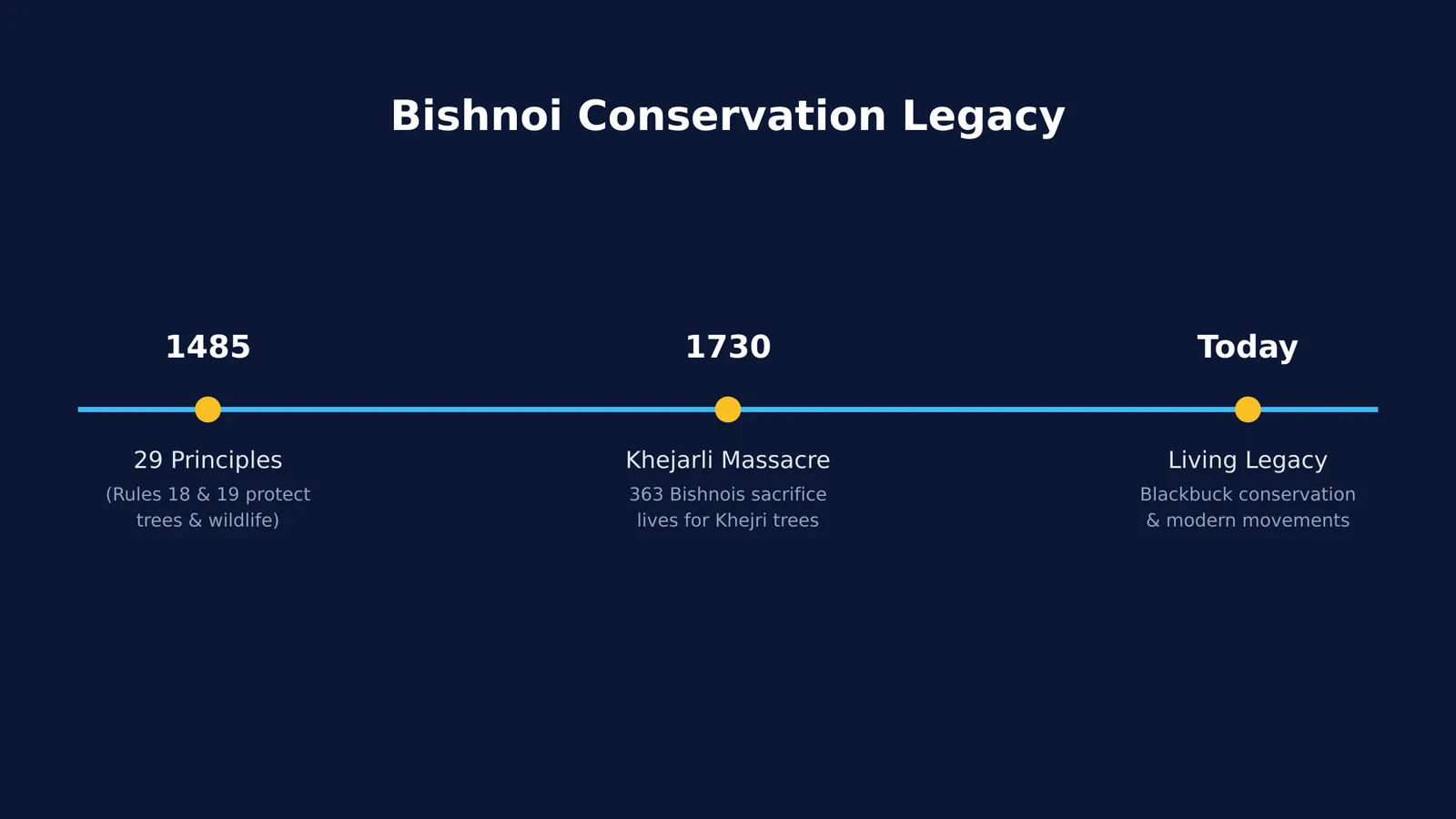
The Bishnoi faith was founded in 1485 by Guru Jambheshwar at Samrathal Dhora, following a period of severe drought. The name of the community itself comes from the Rajasthani words for twenty (*bis*) and nine (*noi*), representing the 29 principles laid down by the Guru to help his followers survive the harsh desert conditions without destroying their environment.
While the principles cover personal hygiene, social behaviour, and spiritual practice, the community is most famous for its strict environmental mandates:
Rule 18 requires compassion toward all living beings.
Rule 19 explicitly forbids the cutting of green trees.
Because these rules are framed as a religious duty, protecting the ecosystem is woven into daily life. This is why Bishnoi villages remain green oases despite being in a harsh desert environment.
What happened at the Khejarli massacre of 1730?
The most defining moment of the Bishnoi conservation legacy occurred in September 1730 in Khejarli, a village near Jodhpur. Maharaja Abhai Singh needed wood to fuel lime kilns for a new palace and sent soldiers to cut down the village's sacred Khejri trees.
A local woman, Amrita Devi, stood between the soldiers and the trees. She famously stated that saving a tree was worth giving up one's head. She hugged a tree to shield it and was killed by the soldiers. Her three daughters followed her example, and the news quickly spread to surrounding villages.
In total, 363 Bishnois sacrificed their lives that day, each hugging a tree until they were struck down. When Maharaja Abhai Singh learned of the immense scale of the massacre, he was horrified by the bloodshed. He personally apologised to the community and issued an enduring royal decree banning tree felling and animal hunting in all Bishnoi-dominated areas.
How does the Bishnoi community protect the blackbuck today?
The Bishnois consider the protection of the blackbuck, an antelope, to be a fundamental religious duty. Today, they provide water and grain for the animals, and Bishnoi women have even been documented nursing orphaned fawns as part of their own families.
Their protection extends to fierce legal and physical defence. The community's persistence was crucial in pursuing poachers in high-profile legal cases, proving their willingness to stand by their beliefs for decades. It is common to see herds of blackbuck roaming fearlessly through Bishnoi villages, knowing they are safe from hunting.
Wildlife researchers closely monitor these regions to see how community stewardship impacts species recovery. When you are reading about conservation and need help with exam questions, the Fermi Problem Library has worked problems with a step-by-step solver that explains the reasoning rather than printing an answer.
For more on species preservation, you can read about Why did the dodo, quagga, thylacine and Steller's sea cow go extinct? and see India's share of world biodiversity percentage explained.
How can students apply community-led principles?
You do not need centuries of history to start protecting your local environment. If you want to build a conservation project for a school assignment or college application, use the Bishnoi framework as a model:
Focus on one local species: Rather than trying to save the entire planet, identify one native tree or animal in your district that needs protection.
Set a clear, absolute rule: The 29 principles work because they leave no room for ambiguity. Create a simple, non-negotiable rule for your project group, like zero single-use plastics at school events.
Defend it collectively: Individual action is easily ignored. Build a small group of students who will hold each other accountable and publicly advocate for your chosen cause.