

On this page
A parallelogram has four angles, and a bisector cuts each one exactly in half. Draw all four bisectors and they cross at four points that always form a rectangle, unless the parallelogram is a rhombus.
Why do the angle bisectors of a parallelogram form a rectangle?
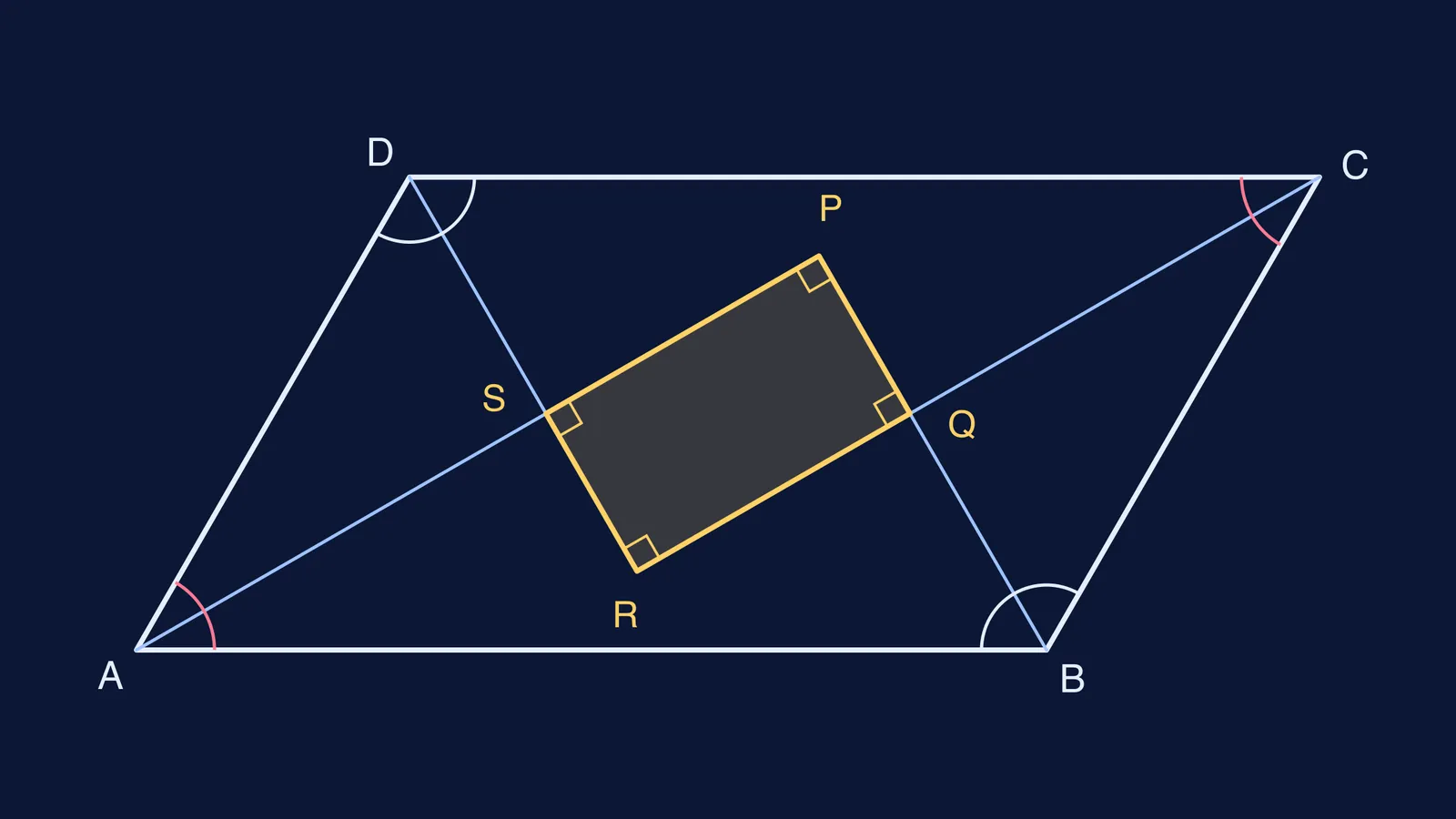
Take parallelogram ABCD with AB ∥ DC and AD ∥ BC. Let the bisectors of ∠A and ∠B meet at P, of ∠B and ∠C at Q, of ∠C and ∠D at R, and of ∠D and ∠A at S. You want to show that PQRS is a rectangle.
AD ∥ BC and AB is a transversal, so ∠A + ∠B = 180°, because they are co-interior angles (Euclid's Elements, Book I, Proposition 29).
AP and BP are bisectors, so ∠PAB + ∠PBA = ½∠A + ½∠B = ½ × 180° = 90°.
The three angles of triangle APB add up to 180° (Euclid's Elements, Book I, Proposition 32), so ∠APB = 180° − 90° = 90°.
The same argument with the other pairs of parallel sides gives ∠BQC = ∠CRD = ∠DSA = 90°.
S lies on line AP and Q lies on line BP, so ∠SPQ is either ∠APB itself or the angle vertically opposite it. Either way, ∠SPQ = 90°. The same holds at Q, R and S.
A quadrilateral with four right angles is a rectangle, so PQRS is a rectangle.
Where does the 180° for co-interior angles come from?
Co-interior angles are the two angles on the same side of a transversal, between two parallel lines. Euclid's Book I, Proposition 29 says that a straight line falling on parallel straight lines makes “the sum of the interior angles on the same side equal to two right angles” (Euclid, Book I, Proposition 29, D. E. Joyce's edition). Two right angles make 180°.
In a parallelogram, each side is a transversal across a pair of parallel sides: AB crosses AD and BC, so ∠A and ∠B are co-interior, and the same holds at every corner.
The same halving move explains why the bisectors of a linear pair meet at 90°.
Worked example: does it hold with real numbers?
Take AB = 10 cm, AD = 6 cm and ∠A = 60°. This is the parallelogram in the diagram above.
∠B = 180° − 60° = 120°.
In triangle APB, ∠PAB = 30° and ∠PBA = 60°, so ∠APB = 90°.
In triangle BQC, ∠QBC = 60° and ∠QCB = 30°, so ∠BQC = 90°.
With trigonometry: BP = 10 sin 30° = 5 cm and BQ = 6 cos 60° = 3 cm, so PQ = 2 cm.
AP = 10 cos 30° ≈ 8.66 cm and AS = 6 cos 30° ≈ 5.20 cm, so SP = 4 cos 30° = √12 ≈ 3.46 cm.
So PQRS is a rectangle measuring 2 cm by about 3.46 cm. Its diagonal is √(4 + 12) = 4 cm, which is exactly AB − AD.
What if the parallelogram is a rhombus or a rectangle?
Rhombus (all sides equal): the diagonals of a rhombus bisect its angles, so all four bisectors lie along the two diagonals and pass through one point. The rectangle shrinks to that single point.
Rectangle that is not a square: every bisector makes 45° with the sides, so PQRS has equal sides and is a square.
How do you write this proof for full marks?
Marks come from the reasons, so justify every step:
Draw and label the figure, with P, Q, R and S.
Write Given and To prove, one line each.
For ∠APB, give each step its reason in brackets: (co-interior angles, AD ∥ BC), (AP bisects ∠A), (angle sum of a triangle).
Write “Similarly, ∠BQC = ∠CRD = ∠DSA = 90°” instead of repeating the argument three times.
Finish with the conclusion: PQRS has four right angles, so it is a rectangle.
Common slips to avoid:
Writing ∠A = ∠B. Neighbouring angles of a parallelogram add up to 180°; only opposite angles are equal.
Using the 180° fact without naming the parallel lines and the transversal.
For longer problems, see how to do angle chasing in geometry. For why a quadrilateral's angles total 360°, read why the angle sum of a polygon is (n − 2) × 180°.
If you get stuck on a variant, such as finding the sides of the rectangle, the Fermi Problem Library has worked problems with a step-by-step solver that explains the reasoning rather than printing an answer. If the angle facts about parallel lines feel shaky, the Fermi Concept Library gives each concept its own lesson.
Next time you see bisectors in a parallelogram, find the pair of angles that add up to 180° first; the 90° follows.


