

On this page
In Class 12 board exams, JEE Main, and NEET-UG, converting benzyl chloride to 2-phenylethanamine is a classic trap. Many students reach instinctively for ammonia, overlooking that direct substitution cannot add the missing carbon.
Why does direct ammonolysis fail to give 2-phenylethanamine?
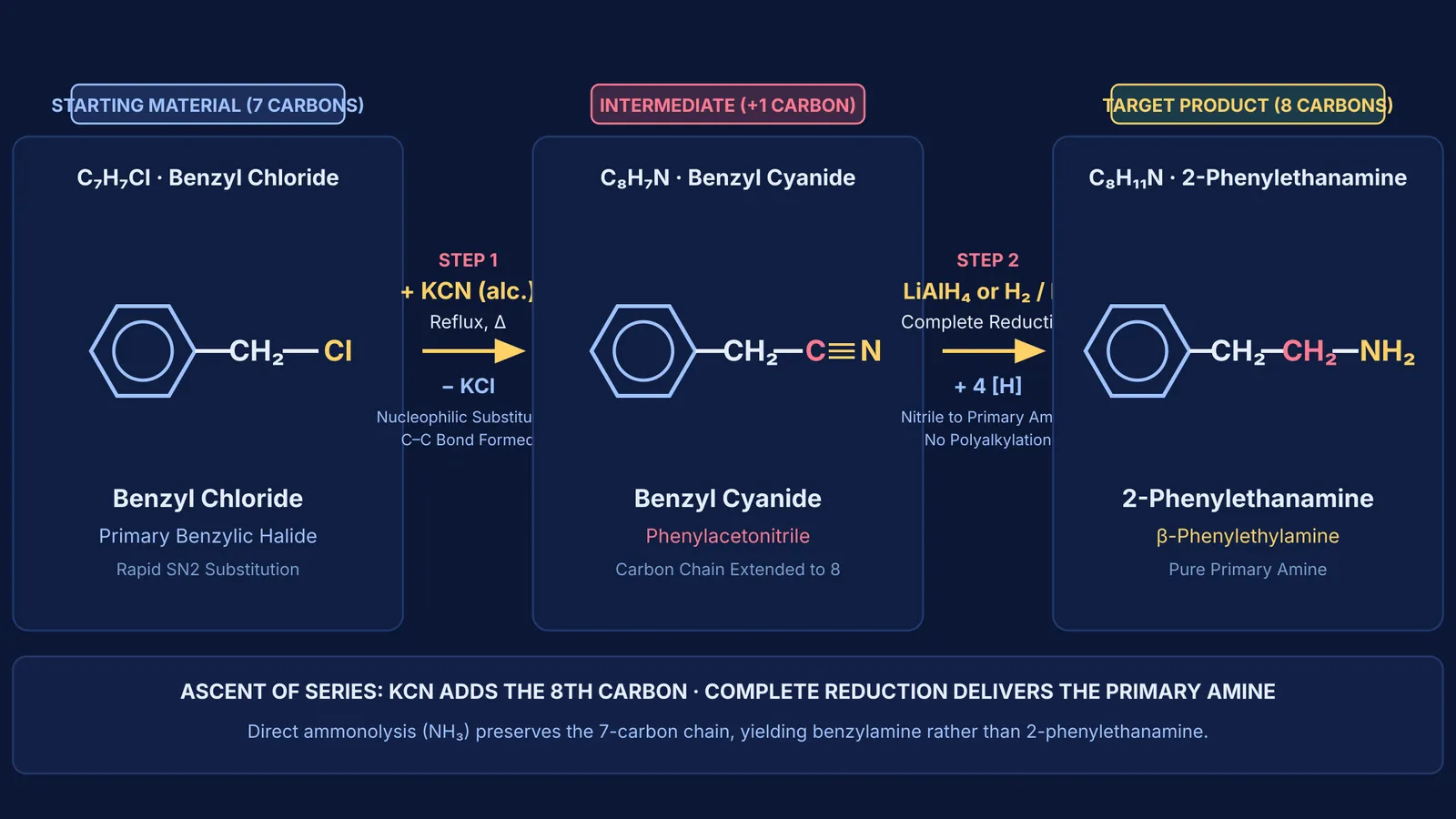
Direct ammonolysis fails because of carbon accounting. The starting reactant, benzyl chloride, contains seven carbons: six in the aromatic ring and one in the benzylic position (C7H7Cl). The target product, 2-phenylethanamine, contains eight carbons (C8H11N), with an ethylamine side chain attached to the ring.
Treating benzyl chloride with excess ammonia displaces chlorine to form benzylamine (C6H5CH2NH2), which retains only seven carbons. It also yields mixed secondary and tertiary amines, as discussed in choosing the right method to prepare a primary amine. To produce 2-phenylethanamine, you must step up the series by adding one carbon before creating the amine group.
How does ethanolic potassium cyanide add the extra carbon?
The standard way to insert a single carbon atom is nucleophilic displacement using cyanide. Refluxing benzyl chloride with ethanolic potassium cyanide (KCN) yields phenylacetonitrile, commonly called benzyl cyanide:
C6H5CH2Cl + KCN (alc.) → C6H5CH2CN + KCl
Benzylic halides undergo rapid nucleophilic substitution because the adjacent aromatic ring stabilizes the transition state. In a classic synthesis published by Roger Adams and A. F. Thal in Organic Syntheses, reacting benzyl chloride with alkali cyanide in aqueous ethanol gives an 80% to 82% yield of pure benzyl cyanide.
The reagent choice matters. Cyanide is an ambident nucleophile that can bond through carbon or nitrogen. Ionic potassium cyanide dissociates into free cyanide ions in solution; attack occurs through carbon because the resulting carbon-carbon bond is stronger than a carbon-nitrogen bond. If you use covalent silver cyanide (AgCN), attack occurs via nitrogen, yielding benzyl isocyanide (C6H5CH2NC) instead. This carbon-addition strategy is explored further in stepping up an organic series by adding one carbon.
Which reducing agents convert benzyl cyanide to the amine?
With the eighth carbon in place, reducing the nitrile (−C≡N) yields the primary amine (−CH2NH2):
C6H5CH2CN + 4 [H] → C6H5CH2CH2NH2
The NCERT Class 12 Chemistry Amines chapter and NCERT Haloalkanes chapter highlight two standard routes for complete reduction:
Lithium aluminium hydride (LiAlH4): In dry ether followed by water, LiAlH4 smoothly reduces nitriles to primary amines. Robert F. Nystrom and Weldon G. Brown demonstrated in the Journal of the American Chemical Society that LiAlH4 provides clean reductions without polyalkylation.
Catalytic hydrogenation: Hydrogen gas over Raney nickel (H2 / Ni) or palladium under pressure cleanly reduces nitriles to primary amines.
Sodium in ethanol (Na / C2H5OH): Known as the Mendius reaction, this classic reduction also generates the primary amine.
Avoid partial reducing agents like DIBAL-H or SnCl2 with HCl (Stephen reduction). These stop at the imine and hydrolyse to phenylacetaldehyde, as explained in our guide on reactions of nitriles to make acids, amines, and ketones.
What is the step-by-step diagnostic checklist for organic conversions?
When you face multi-step conversion questions under exam pressure, work through this four-step diagnostic sequence before picking any reagents:
Count carbons first: If the product has one more carbon than the starting halide, use cyanide substitution, not direct ammonolysis.
Verify halide reactivity: Benzylic halides undergo rapid substitution with KCN; aryl halides like chlorobenzene do not.
Choose ionic KCN: Use ethanolic KCN to obtain the nitrile via C-attack rather than AgCN, which gives an isocyanide.
Select complete reduction: Use LiAlH4 or H2 / Ni to reduce the nitrile fully to the primary amine.
How can you practice multi-step conversions?
When practicing organic conversions, understanding the underlying mechanism helps you choose reagents without guesswork. The Fermi Problem Library has worked problems with a step-by-step solver that explains the reasoning rather than printing an answer. For deeper review of functional group transformations, explore the Fermi Concept Library, which covers every concept in chemistry with its own lesson and its place in the map. If you get stuck mapping a reaction chain, Fermi's AI tutor works out what you already know and builds a plan for the session, guiding your problem-solving step by step.


