

On this page
Acetyl chloride "reacts violently with water", according to the US NOAA CAMEO Chemicals entry for acetyl chloride. Benzoyl chloride is slower. The CAMEO entry for benzoyl chloride still lists it as water-reactive, but records an Argonne National Laboratory finding that it was "quite unreactive in water". The difference comes from what the benzene ring does to the carbonyl carbon, and the same idea explains a reaction in your syllabus: benzoylation in aqueous sodium hydroxide.
Why is benzoyl chloride less reactive than acetyl chloride?
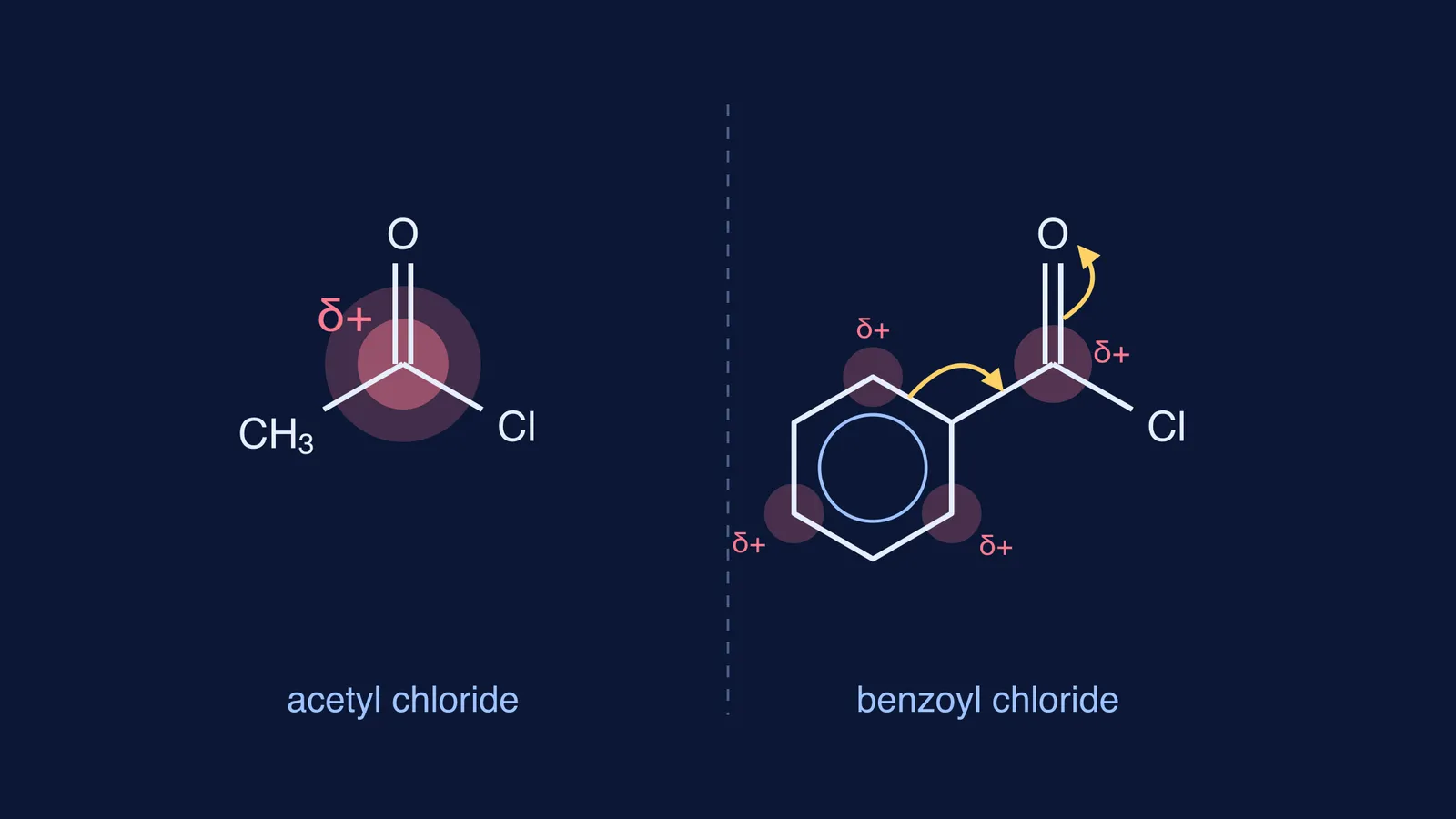
In the textbook mechanism, both compounds react the same way. A nucleophile (water, an alcohol or an amine) attacks the carbonyl carbon, the C=O opens into a tetrahedral intermediate, and then chloride leaves. The larger the partial positive charge (δ+) on that carbon, the faster the first step goes.
In benzoyl chloride the C=O group is attached directly to the ring and lies in its plane, so the ring's π electrons are conjugated with the C=O π bond. Draw the resonance structure where a ring π pair moves towards the carbonyl. You get a C=C between the ring and the carbonyl carbon, a negative charge on oxygen, and positive charge on the ortho and para carbons of the ring. The carbonyl carbon no longer carries the positive charge alone, so it is a weaker target. Conjugation also stabilises the starting molecule, and attack breaks that conjugation, so the energy climb is steeper.
NCERT's Class 12 chapter uses this argument for aldehydes: "the polarity of the carbonyl group is reduced in benzaldehyde due to resonance", which is why benzaldehyde is less reactive than propanal (NCERT, Aldehydes, Ketones and Carboxylic Acids). We walk through that case in why benzaldehyde is less reactive than propanal. In acetyl chloride the methyl group has only a weak +I effect and no resonance, so the δ+ stays concentrated on the carbonyl carbon.
What do rate studies show about acetyl chloride?
Bentley and colleagues compared rates in two solvent mixtures with similar ionising power but different nucleophilicity. Acetyl chloride's solvolyses were over 20-fold more sensitive to nucleophilic attack than benzoyl chloride's (Bentley, Llewellyn and McAlister, Journal of Organic Chemistry, 1996). The same paper proposes that acetyl chloride may react by a direct SN2-type displacement rather than through a tetrahedral intermediate. A later paper by Bentley and Harris notes that "conjugative effects are significant" in planar benzoyl chlorides (International Journal of Molecular Sciences, 2011).
Why can benzoyl chloride be used in aqueous NaOH?
NCERT's Amines chapter says acylation of amines "is carried out in the presence of a base stronger than the amine, like pyridine, which removes HCl", and calls the reaction with benzoyl chloride benzoylation (NCERT, Amines). The Schotten-Baumann method uses aqueous sodium hydroxide instead of pyridine. Eugen Baumann described it for benzoic esters in 1886 (Berichte, 1886).
It works because of a competition for the carbonyl carbon. Benzoyl chloride hydrolyses slowly enough that the amine, a far better nucleophile than water, wins most of the time. The 1996 Bentley paper reports that, with m-nitroaniline in methanol, benzoyl chloride is 40-fold more sensitive to the added amine, whereas acetyl chloride behaves like p-methoxybenzoyl chloride (Journal of Organic Chemistry). Meanwhile NaOH neutralises the HCl, so the amine stays free instead of turning into an unreactive ammonium salt.
In one Organic Syntheses procedure, 2.0 moles of piperidine and 2.6 moles of NaOH in 800 cc of water were treated with 2 moles of benzoyl chloride at 35-40 °C, giving 87-91 per cent benzoyl piperidine. Acetyl chloride, which reacts violently with water, would lose more of itself to hydrolysis; NCERT's own example acetylates aniline with acetic anhydride and pyridine instead. The full mechanism is in our post on the Schotten-Baumann benzoylation of amines.
Can you rank these by reactivity?
Rank each set, fastest first, for attack by a nucleophile.
CH3COCl, C6H5COCl
C6H5COCl, p-CH3O-C6H4COCl, p-O2N-C6H4COCl
CH3CONH2, CH3COCl, CH3COOC2H5, (CH3CO)2O
C6H5CHO, CH3CH2CHO
C6H5COCl, C6H5CH2COCl
Answers:
CH3COCl > C6H5COCl: ring conjugation lowers the δ+.
p-O2N > H > p-CH3O. Nitro withdraws electrons; methoxy donates more by resonance. Use this order for direct attack only: electron donors also weaken the C-Cl bond and favour an ionisation route in strongly ionising solvents (Bentley and Harris, 2011).
Acid chloride > anhydride > ester > amide. The better the leaving group and the weaker the lone-pair donation to C=O, the faster the reaction. See why acid chlorides are more reactive than amides.
Propanal > benzaldehyde, for the same resonance reason (NCERT Example 8.3).
C6H5CH2COCl > C6H5COCl. The CH2 group cuts the ring off from the carbonyl.
If you got a ranking wrong and can't see why, the Fermi Problem Library has worked problems with a step-by-step solver that explains the reasoning rather than printing an answer. If the gap is resonance itself, the Fermi Concept Library gives each chemistry concept its own lesson and its place in the map.
Redo set 2 tomorrow without notes, writing a one-line reason for each answer.


