

On this page
Acid chlorides, anhydrides, esters and amides look alike on paper. Each is a carbonyl group joined to a different atom. Yet an acid chloride reacts with water, while an amide only hydrolyses when you heat it in aqueous acid or base. Once you see the two reasons behind this, you don't have to memorise the reactivity order, and questions asking which reagent converts one derivative into another become much easier.
What is the reactivity order of acid derivatives?
All four react by nucleophilic acyl substitution: a nucleophile adds to the carbonyl carbon, and then the group attached to that carbon leaves. The OpenStax Organic Chemistry textbook gives the order as acid chlorides > acid anhydrides > thioesters > esters > amides. Carboxylic acids sit roughly alongside esters, according to LibreTexts.
Two factors set this order: how easily the group leaves, and how strongly the attached atom pushes electrons back into the carbonyl.
Why are acid chlorides more reactive than amides?
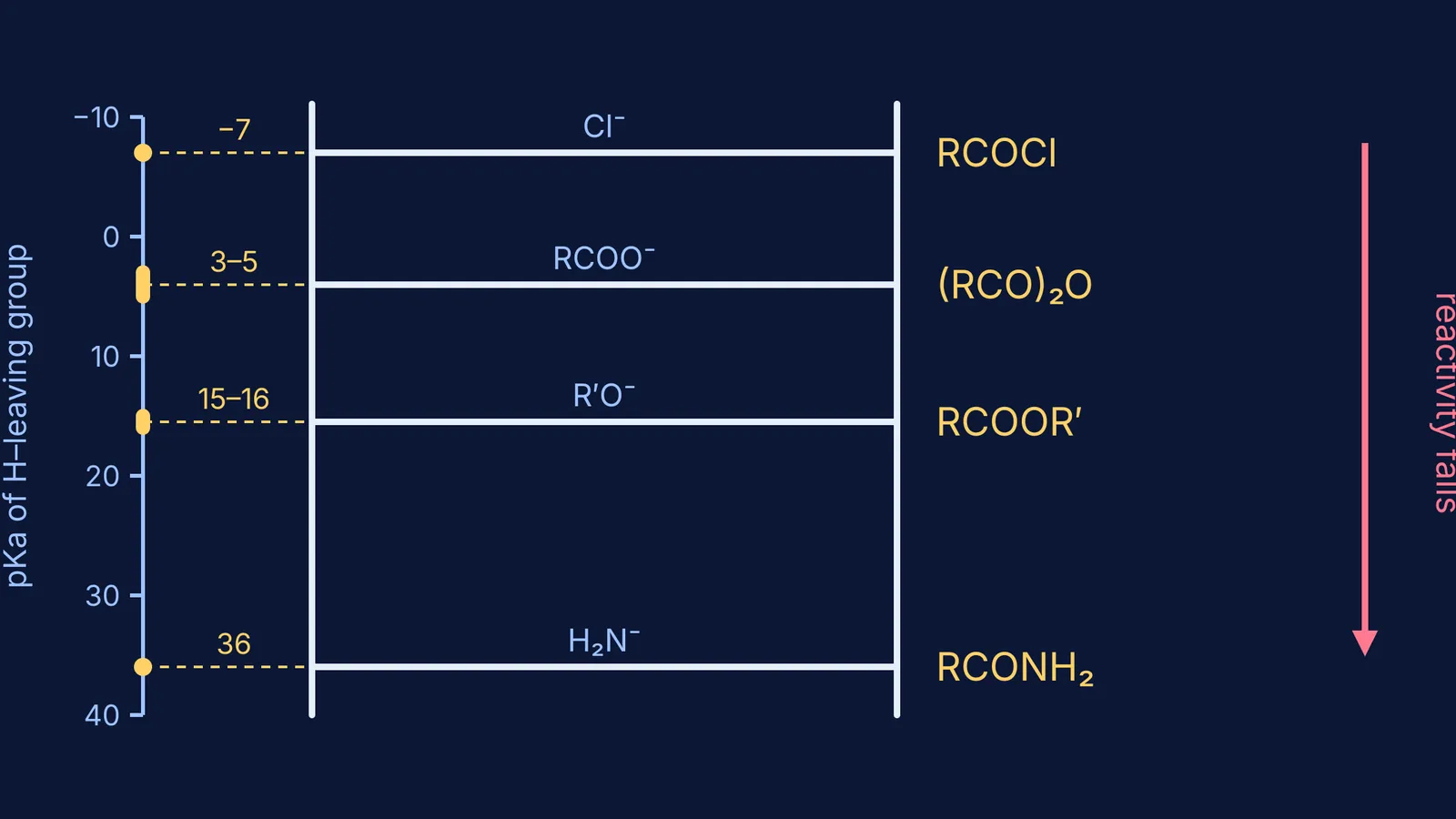
The first reason is leaving-group ability. A good leaving group is a weak base, which means its conjugate acid is strong. LibreTexts lists/21%3A_Carboxylic_Acid_Derivatives-_Nucleophilic_Acyl_Substitution_Reactions/21.02%3A_Nucleophilic_Acyl_Substitution_Reactions) the pKa of each leaving group's conjugate acid:
Acid chloride: Cl⁻ leaves; HCl has a pKa of about −7.
Anhydride: a carboxylate leaves; carboxylic acids have pKa 3 to 5.
Ester: an alkoxide leaves; alcohols have pKa 15 to 16.
Amide: NH₂⁻ leaves; ammonia has a pKa of about 36.
That is a gap of about 43 pKa units between HCl and ammonia, and each pKa unit is a factor of ten. Chloride carries a negative charge away easily. NH₂⁻ is an extremely strong base and is a very poor leaving group.
The second reason is resonance donation. The atom bonded to the carbonyl can share a lone pair with it. OpenStax explains that amino and methoxyl groups donate electrons to acyl groups by resonance, while the electronegative chlorine atom withdraws electrons from the carbonyl carbon. Greater electron donation by the attached atom means a lower partial positive charge on the carbonyl carbon, and so lower electrophilicity (LibreTexts/20%3A_Carboxylic_Acid_Derivatives/20.1%3A_Relative__Reactivities_Structures_and__Spectra__of_Carboxylic_Acid__Derivatives)).
You can see this in IR spectra. According to OpenStax, saturated acid chlorides absorb near 1810 cm⁻¹, esters near 1735 cm⁻¹ and amides near 1690 cm⁻¹, because resonance from nitrogen lengthens the C=O bond. A computational study of formamide by Wiberg and Breneman (1992) concluded that stabilisation of the lone pair on nitrogen is the most important factor in determining the structures and energies of amides, though it found the charge shift on rotation was mainly between carbon and nitrogen, with the oxygen little affected. That lone-pair interaction is linked to amides being planar and having a relatively high barrier to rotation about the C–N bond.
Which interconversions work, and which don't?
You can go down the ladder in one step, but you cannot go up. OpenStax states that acid chlorides can be converted directly into anhydrides, thioesters, esters and amides, but amides can't be converted directly into any of them.
What works (all from OpenStax, chapters 21.4, 21.6 and 21.7):
Acid chloride + alcohol gives an ester; pyridine or NaOH is added to react with the HCl formed.
Acid chloride + ammonia or an amine gives an amide; you use two equivalents, because one reacts and the other takes up the HCl.
Ester + ammonia or an amine gives an amide. This works, but it is not often used because starting from the acid chloride is usually easier.
Water converts these derivatives into the carboxylic acid. For an amide, this needs heating in aqueous acid or base.
What fails: amide + alcohol does not give an ester, and an ester does not turn directly into an acid chloride.
Worked example: from an amide back up to an ester
Suppose a question asks you to make ethyl ethanoate from ethanamide (CH₃CONH₂).
Check the direction. An amide is lower on the ladder than an ester, so you can't do it in one step.
Go down to the acid. Heat with aqueous acid to get ethanoic acid and ammonium ion.
Climb using a reagent. Thionyl chloride (SOCl₂) turns the acid into ethanoyl chloride by first replacing the –OH with a much better leaving group (OpenStax 21.3).
Go down to the target. Ethanol with pyridine gives ethyl ethanoate.
The pattern to remember: to go up the ladder, first go down to the acid, then use SOCl₂.
If you know the ladder but keep picking the wrong route in multi-step questions, the Fermi Problem Library has worked problems with a step-by-step solver that explains the reasoning rather than printing an answer. If the gap is earlier, in resonance or leaving groups themselves, the Fermi Concept Library gives each concept its own lesson and its place in the map.
Try it now: cover this page and rank acetic anhydride, methyl acetate and acetamide, giving one reason for each step.


