

On this page
Benzil is two benzoyl groups joined back to back: Ph-CO-CO-Ph. Warm it with potassium hydroxide and you do not get a simple addition product. One phenyl group jumps from one carbon to the other, and the skeleton changes. That jump is the whole reaction, and once you see it, you can predict the product for most 1,2-diketones an exam gives you.
What is the benzilic acid rearrangement?
The benzilic acid rearrangement is the base-induced 1,2-rearrangement of a 1,2-diketone into an alpha-hydroxy carboxylic acid, and benzil with KOH giving benzilic acid is the textbook case (Wikipedia summary of the reaction).
It has a place in history too: Justus von Liebig first carried it out in 1838, and it is the first reported example of a rearrangement reaction (same source). For a detailed older review of the reaction and its relatives, see Selman and Eastham's 1960 article in Quarterly Reviews of the Chemical Society (doi:10.1039/qr9601400221).
What happens when benzil reacts with KOH?
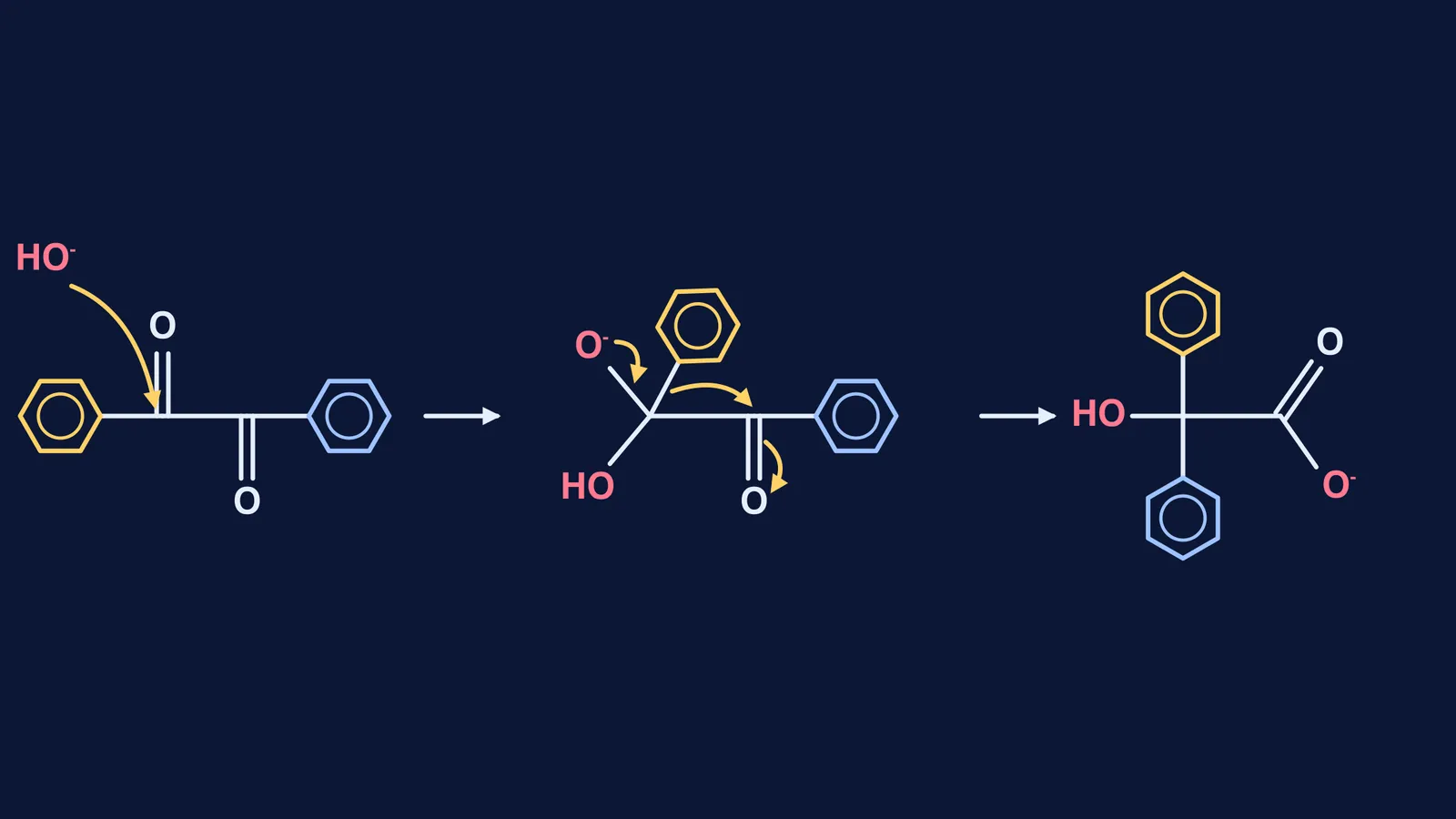
Follow the three panels in the diagram above, left to right.
Hydroxide adds to one carbonyl. OH- attacks one C=O carbon. That carbon becomes tetrahedral and carries an O- and an OH.
The phenyl shifts. The O- pushes its electrons back down to re-form C=O. To make room, the phenyl on that same carbon moves, with its bonding pair, to the neighbouring carbonyl carbon. The C=O there opens up to an alkoxide.
Proton transfer. You now have a carboxylic acid next to a strongly basic alkoxide. The acid hands its proton over, giving the carboxylate: potassium benzilate, Ph2C(OH)COO- K+.
Acid work-up. Adding dilute acid protonates the carboxylate and benzilic acid, Ph2C(OH)COOH, comes out.
Why does the phenyl group move?
Once hydroxide has added, the alkoxide can re-form its C=O only if something leaves that carbon. The phenyl does, attacking the neighbouring carbonyl carbon in a single concerted step, a sequence that resembles a nucleophilic acyl substitution (Wikipedia).
That migration is the rate-determining step, and the reaction is second order overall: first order in the diketone and first order in base (same source). The rate law fits the mechanism: one diketone and one hydroxide meet in the step before the slow shift.
Which group moves also follows a pattern. Aryl groups migrate more readily than alkyl groups, and aryl groups carrying electron-withdrawing substituents migrate fastest (same source).
How do you predict the product for any 1,2-diketone?
Use this four-step check on any question:
Confirm the two C=O groups are on neighbouring carbons. No 1,2-diketone, no benzilic rearrangement.
Look for hydrogens on the carbons next to the carbonyls. The reaction works best without them, because enolisable protons let aldol condensation compete (source).
Pick the nucleophile. Hydroxide gives the alpha-hydroxy acid salt. An alkoxide gives an alpha-hydroxy ester instead, and an amide anion gives an alpha-hydroxy amide (the benzilic ester rearrangement, same source). The alkoxide should not be easily oxidised, or a Meerwein-Ponndorf-Verley reduction competes as a side reaction.
Draw the shift: one carbon becomes C(=O)O-, the other gets both R groups plus OH.
Worked example. Benzil with potassium tert-butoxide. Step 1: yes, a 1,2-diketone. Step 2: no alpha hydrogens, since both neighbours are phenyl rings. Step 3: an alkoxide, so expect an ester; tert-butoxide has no hydrogen on its oxygen-bearing carbon, so it is not easily oxidised. Step 4: tert-butoxide adds to one carbonyl, a phenyl shifts, and the product is tert-butyl benzilate, Ph2C(OH)COOC(CH3)3.
Cyclic twist. If the two carbonyls sit inside a ring, the shifting group is a ring bond, so the ring loses a carbon: on cyclic diketones the reaction is formally a ring contraction (source). The COOH ends up outside the smaller ring, on the carbon that also carries the OH. Number the ring atoms before and after so you do not keep the old ring size by habit.
How is it different from pinacol and Cannizzaro?
Pinacol and benzilic rearrangements both involve a 1,2-shift, and Cannizzaro also starts with hydroxide adding to a carbonyl, which is why the three get mixed up in exams. In the pinacol-pinacolone rearrangement, acid creates a carbocation and a group moves towards that positive carbon. In the benzilic case there is no carbocation: base adds first, and the group moves to a carbonyl carbon. In the crossed Cannizzaro reaction, a hydride, not a phenyl, is passed on, and it goes to a second aldehyde molecule rather than to a neighbouring carbon. If you keep a list of named reactions, these tips for clearing named organic reaction doubts help you group them by what moves and why.
If you get the product right but stumble on the arrows, practise a few mechanisms where every step has to be justified. The Fermi Problem Library has worked problems with a step-by-step solver that explains the reasoning rather than printing an answer. And if the gap is the idea of a nucleophile adding to C=O, the lesson on it in the Fermi Concept Library is the place to start.
Next time you see a 1,2-diketone and a base, run the four-step check before you draw a single arrow.


