

On this page
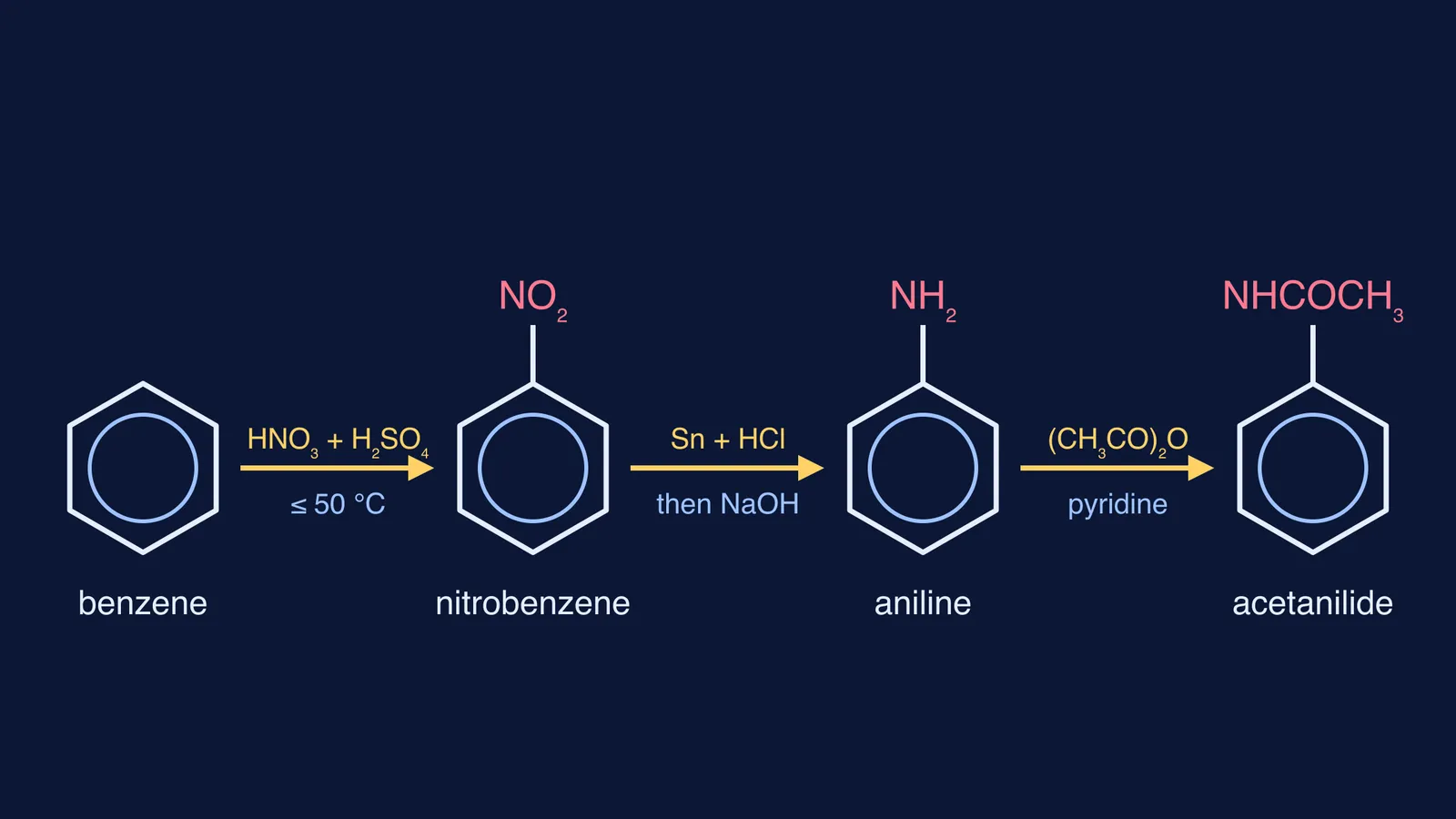
If your textbook asks you to convert benzene into acetanilide, it wants three reactions in a fixed order: put a nitro group on the ring, turn that nitro group into an amino group, then cap the amino group with an acetyl group. Each step has one condition examiners like to check.
What are the three steps from benzene to acetanilide?
Nitration: benzene with concentrated HNO₃ and concentrated H₂SO₄, at or below 50 °C, gives nitrobenzene (C₆H₅NO₂) (chemguide).
Reduction: nitrobenzene with Sn and concentrated HCl, heated, then NaOH, gives aniline (C₆H₅NH₂).
Acetylation: aniline with acetic anhydride, (CH₃CO)₂O, gives acetanilide (C₆H₅NHCOCH₃) and acetic acid.
The order cannot change. Benzene has no nitrogen, so there is nothing to acetylate until step 1 brings the nitrogen in and step 2 makes it an amine.
How do you nitrate benzene, and why keep it below 50 °C?
Benzene is treated with a mixture of concentrated nitric acid and concentrated sulphuric acid at a temperature not exceeding 50 °C, according to chemguide's page on the nitration of benzene. The same page gives the reason for the limit: at higher temperatures there is a greater chance of more than one nitro group going onto the ring, and you want only one.
The sulphuric acid is not a spectator. It acts as a catalyst, and it reacts with the nitric acid to form the electrophile, the nitronium ion NO₂⁺, which then attacks the ring (chemguide, nitration mechanism). Our explainer walks through how mixed acid makes the nitronium ion.
Why does Sn/HCl give aniline only after you add NaOH?
NCERT's Class 12 Amines chapter lists reduction of nitro compounds as the first way to prepare amines, showing nitrobenzene going to aniline with Sn and HCl, Fe and HCl, or H₂ over Pd in ethanol.
In the lab, nitrobenzene is reduced with tin and concentrated hydrochloric acid, heated under reflux in a boiling water bath for about half an hour (chemguide, preparing phenylamine). Because the mixture is strongly acidic, what forms first is not aniline but the phenylammonium ion, C₆H₅NH₃⁺. Adding sodium hydroxide removes the extra proton and releases free aniline, which is then separated by steam distillation, solvent extraction and a final distillation.
That NaOH step is easy to leave out, so write it. The medium also decides the product: in neutral or alkaline conditions nitrobenzene gives different compounds, covered in our post on reducing nitrobenzene in neutral and alkaline media.
How do you acetylate aniline with acetic anhydride?
Acylation is the replacement of a hydrogen of the –NH₂ group by an acyl group, giving an amide, as the NCERT Amines chapter defines it. The chapter adds that acylation is carried out in the presence of a base stronger than the amine, such as pyridine, which removes the acid formed and shifts the equilibrium to the right.
The NCERT Class 12 chemistry lab manual gives the practical version: 5 mL aniline with an acetylating mixture of 5 mL acetic anhydride and 5 mL glacial acetic acid, refluxed gently for 10-15 minutes, then poured slowly into 150-200 mL of ice-cold water with stirring. The solid is filtered, washed with cold water and recrystallised from hot water containing a few drops of methanol or ethanol. The manual also warns that a strongly coloured aniline sample should be distilled first, because impure aniline lowers the yield; our post on why aniline turns brown on standing explains where that colour comes from.
Acetanilide melts at 114.3 °C, the CRC Handbook value listed by PubChem, so a sharp melting point near that figure is your purity check.
How should you write this conversion in an exam?
A model answer for your notes, with the nitration conditions from chemguide and the acetylation from the NCERT Amines chapter:
C₆H₆ + HNO₃ (conc. H₂SO₄, at or below 50 °C) → C₆H₅NO₂ + H₂O
C₆H₅NO₂ (Sn and conc. HCl, heat; then NaOH) → C₆H₅NH₂
C₆H₅NH₂ + (CH₃CO)₂O (pyridine) → C₆H₅NHCOCH₃ + CH₃COOH
Before you move on, check your answer against this list:
Both acids marked concentrated, and the temperature written for nitration.
The NaOH step written after Sn/HCl.
Acetic anhydride written as (CH₃CO)₂O, with acetic acid as the by-product.
Every intermediate named: nitrobenzene, aniline, acetanilide.
Why does acetanilide matter? It is how you tame aniline. The same chapter shows that direct nitration of aniline gives 51% para, 47% meta and 2% ortho nitroaniline, because aniline is protonated in the strong acid to the meta-directing anilinium ion. Acetylating first makes the para product the major one, and the acetyl group is removed afterwards by hydrolysis.
To practise multi-step conversions like this one, the Fermi Problem Library has worked problems with a step-by-step solver that explains the reasoning rather than printing an answer. If an idea such as electrophilic substitution still feels shaky, the Fermi Concept Library gives each concept its own lesson, so you can fill the gap before the next conversion.


