

On this page
Why does aniline turn brown on storage?
Pure aniline (aminobenzene, C₆H₅NH₂) is a colourless, oily liquid with a boiling point of 184 °C and a melting point of -6 °C, as documented in the PubChem compound record. Yet in chemistry laboratories across India, students opening a reagent bottle of aniline almost always encounter an amber, reddish-brown, or nearly black liquid.
This colour change is one of the classic observations in Class 12 chemistry and the NCERT syllabus on amines: pure arylamines are naturally colourless but develop colour on standing due to atmospheric oxidation (also known as autoxidation). As documented in Wikipedia's aniline summary, exposure to air and light causes gradual darkening to yellow, red, and brown through the formation of oxidized impurities. Unlike benzene, which resists oxidation by molecular oxygen under ambient conditions, aniline's amino group (-NH₂) acts as a powerful electron-donating group. Through the +R resonance effect, the unshared lone pair of electrons on nitrogen delocalises into the benzene ring, increasing electron density across the ortho and para positions and drastically lowering the molecule's oxidation potential.
What chemical products cause the brown colour?
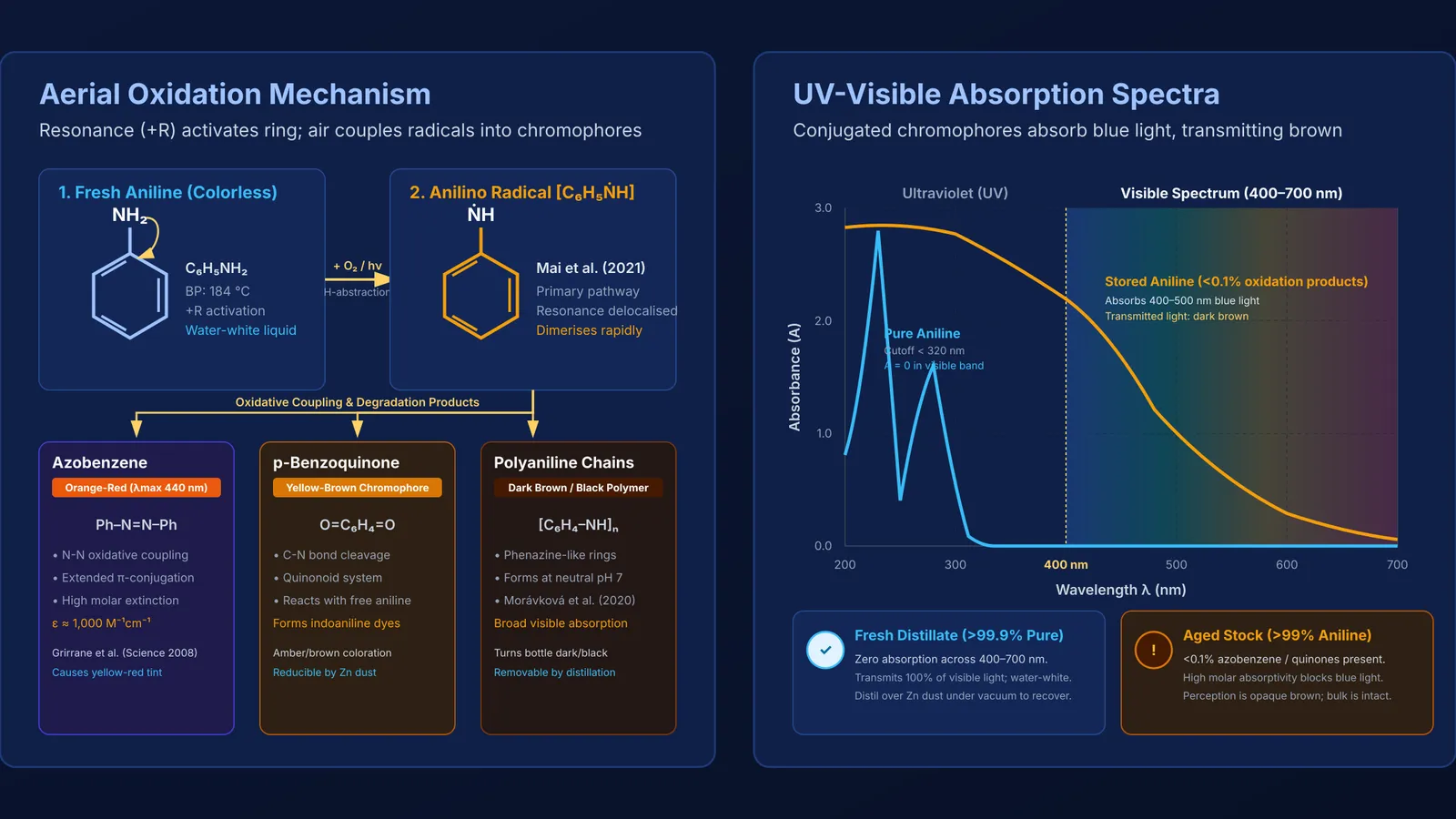
Atmospheric oxidation is a free-radical chain process promoted by ambient light and dissolved oxygen. A 2021 kinetic study published in *Environmental Science & Technology* by Mai et al. (2021) established that the dominant initial pathway of aniline degradation is hydrogen abstraction from the -NH₂ group, generating resonance-stabilised anilino radicals (C₆H₅ṄH).
Once these radicals form, they undergo multiple competing coupling and oxidation reactions:
Azobenzene formation: Oxidative coupling of nitrogen centers generates hydrazobenzene, which readily oxidises to azobenzene (C₆H₅-N=N-C₆H₅), an intensely orange-red compound. In *Science*, Grirrane, Corma, and García (2008) demonstrated that catalytic aerobic oxidation of anilines couples them directly into symmetric aromatic azo compounds with yields exceeding 98%, illustrating how readily anilino radicals dimerise into azo chromophores.
Quinonoid derivatives: Ring oxidation cleaves the C-N bond or oxidises the ring into p-benzoquinone (1,4-benzoquinone), which appears bright yellow to brown. p-Benzoquinone reacts with unreacted aniline to form coloured indoaniline dyes.
Polyaniline and phenazine oligomers: In a 2020 study in *Applied Sciences*, Morávková, Šeděnková, and Bober (2020) demonstrated that aniline oxidation under neutral conditions (pH 7) generates both linear para-linked chains and cyclic, phenazine-like polycyclic oligomers. Even at neutral pH, these oligomers polymerise into dark green, brown, and black polyaniline structures.
Why does a tiny amount of oxidation cause such deep colour?
A common misconception among students preparing for competitive exams is that brown aniline must be mostly decomposed. In reality, a bottle that appears dark brown or black may be more than 99% pure aniline by mass.
The dramatic visual darkening is an optical effect governed by chromophore formation and molar absorptivity. According to optical data catalogued in the PubChem azobenzene summary, pure aniline absorbs light exclusively in the ultraviolet region, with primary electronic transition peaks around 230 nm and 280 nm. Because its absorbance is zero across the visible spectrum (400 to 700 nm), pure aniline transmits all visible wavelengths and appears clear.
However, products like azobenzene, p-benzoquinone, and polyaniline oligomers possess extended networks of conjugated alternating single and double bonds. This extensive delocalisation narrows the HOMO-LUMO energy gap, shifting their electronic absorption bands directly into the visible region (400 to 520 nm). Because these chromophores absorb blue and violet light with high molar extinction coefficients, the complementary transmitted light appears yellow, red, or dark brown. An oxidation impurity fraction of less than 0.1% is sufficient to turn the entire liquid opaque.
To trace how resonance and electron-donating groups govern chemical reactivity, the Fermi Concept Library covers every concept in physics, chemistry, biology, mathematics and computing, each with its own lesson and its place in the map.
How do you store and purify aniline in the lab?
Because aerial oxidation requires oxygen and is accelerated by light photons, preventing discoloration requires strict storage protocols. According to chemical safety profiles compiled in the PubChem compound record, industrial and analytical grades are stored in airtight amber glass bottles under an inert nitrogen blanket to exclude air.
In undergraduate laboratories, students often need colourless aniline for preparing acetanilide in the lab or examining protecting the amine via acetylation. When a laboratory stock has turned dark, it is restored using targeted distillation techniques.
Laboratory protocol: storing and redistilling aniline
To recover water-white, colourless aniline from an oxidised brown sample:
Add sacrificial zinc dust: Transfer the coloured aniline to a round-bottom distillation flask and add 1% to 2% zinc dust by weight. Metallic zinc acts as a mild reducing agent, converting coloured quinones and azo impurities back into colourless reduced species while scavenging residual oxygen.
Distil under reduced pressure: Although aniline boils at 184 °C at atmospheric pressure, heating it near 180 °C in an open system accelerates thermal oxidation. Distilling under vacuum (e.g. 15 to 20 mmHg) lowers the boiling temperature to 70–80 °C, yielding a pristine, colourless distillate.
Alternative steam distillation: If vacuum distillation equipment is unavailable, steam distillation separates pure aniline from non-volatile polymeric tars and oxidation residues, as also used after reducing nitrobenzene to aniline.
Store protected from light: Collect the distillate directly into an amber bottle flushed with dry nitrogen, seal the cap tightly, and store it in a cool, dark cabinet.
When working through multi-step synthesis questions where oxidation sensitivity affects reagent choice, the Fermi Problem Library offers worked problems with a step-by-step solver that explains the reasoning rather than printing an answer.


