

On this page
If you bump a compass, its needle swings back and forth before finally settling North. This back-and-forth swing is simple harmonic motion (SHM), and its time period depends on the strength of the magnet and the magnetic field around it.
Carl Friedrich Gauss first used this principle in 1832 to measure the absolute strength of Earth's magnetic field. Today, calculating the time period of a bar magnet oscillating in a uniform magnetic field is a standard problem in Class 12 physics.
What is the restoring torque on a magnet?
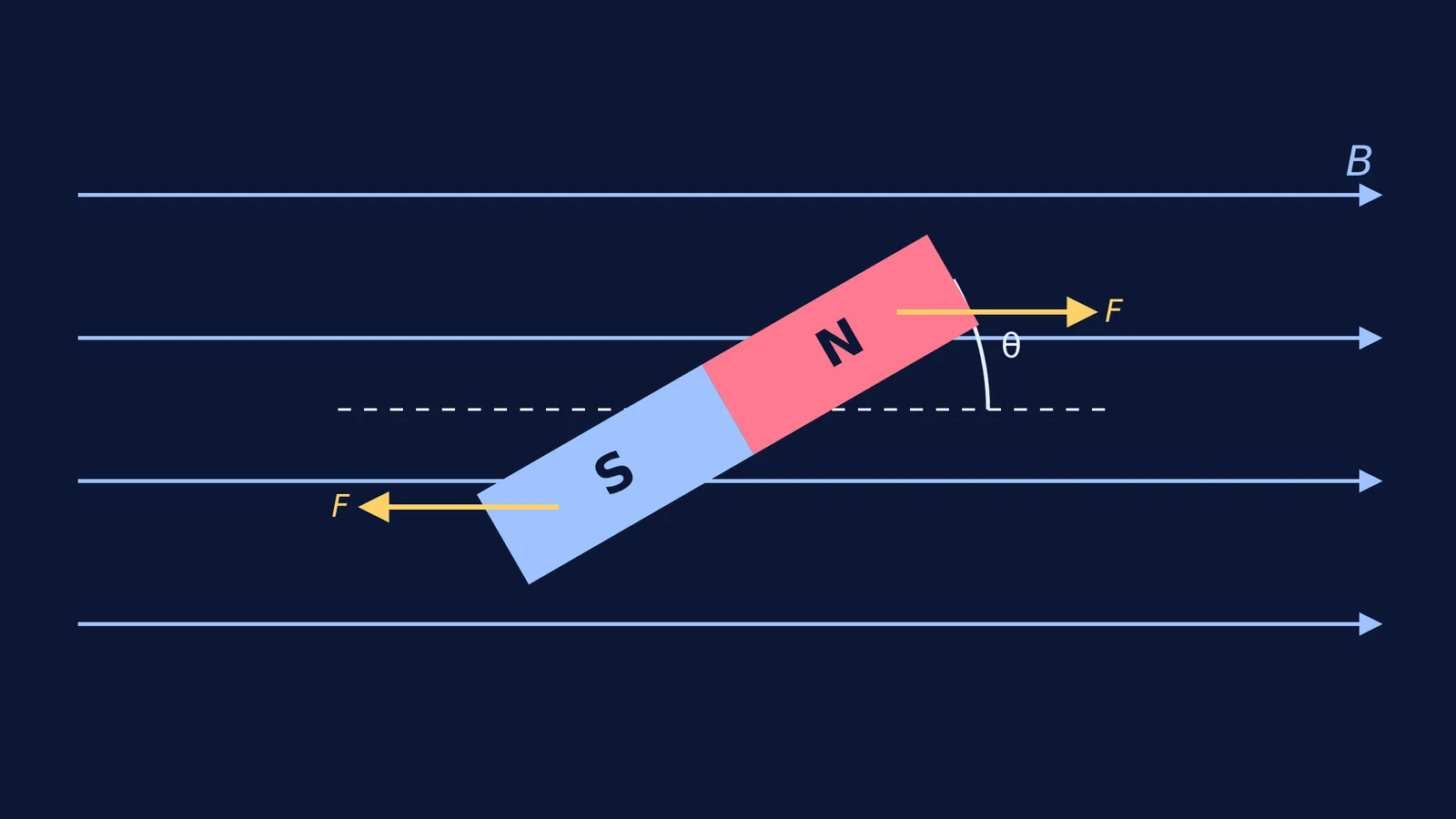
When a bar magnet rests in a uniform magnetic field B, it naturally aligns with the field. If you rotate it by a small angle θ, the magnetic field pulls on the magnet's north and south poles in opposite directions. This creates a restoring torque τ.
The torque depends on the magnetic field B, the magnetic dipole moment m, and the angle θ. Its magnitude is: τ = mB sin θ
In simple harmonic motion, a negative sign is added to show that the torque opposes the displacement and pulls the magnet back toward the centre.
For small angles (usually less than 10 degrees), we can use the small-angle approximation sin θ ≈ θ (in radians). This simplifies the restoring torque to: τ ≈ -mBθ
How do you derive the time period formula?
To find the time period, we use Newton's second law for rotation, τ = Iα, where I is the magnet's moment of inertia and α is its angular acceleration.
Substitute the restoring torque into this equation: Iα = -mBθ
α = -(mB/I)θ
This is the standard equation for simple harmonic motion (α = -ω²θ), with angular frequency ω = √(mB/I).
Since the time period is T = 2π/ω, we get the final formula: T = 2π√(I/mB)
This formula tells us two things. First, a heavier or longer magnet (larger I) swings more slowly. Second, a stronger magnet (larger m) or a stronger magnetic field (larger B) snaps the magnet back faster, reducing the time period.
What happens when you cut the magnet?
Exam questions frequently test this formula by asking what happens if you cut the oscillating bar magnet in half.
Cutting parallel to its length: If you slice the magnet lengthwise into two identical strips, the mass is halved, so its moment of inertia I becomes half the original value. Its magnetic moment m also halves. Since both I and m decrease by the same factor, the ratio I/m does not change. The time period T remains exactly the same.
Cutting perpendicular to its length: If you break the magnet into two shorter halves, the mass halves, but its length also halves. Since I depends on the square of the length (mL²/12), the new moment of inertia becomes 1/8 of the original. The magnetic moment m simply halves (since length halves but pole strength stays the same). Plugging these into the formula, the new time period becomes T/2. The shorter magnet will oscillate twice as fast.
If you want to review the principles of SHM or magnetic moments before tackling problems, the Fermi Concept Library has a lesson for every concept. When you are ready to test yourself on Gauss's method or the magnet-cutting tricks, the Fermi Problem Library features a step-by-step solver that explains the reasoning rather than printing an answer.
Read more:


