

On this page
Ask someone to picture air and they often picture a crowd. The numbers say otherwise. Here is the calculation step by step, so you can redo it in an exam.
What is the average distance between gas molecules at STP?
The number you need is the Loschmidt constant: the number of molecules in one cubic metre of an ideal gas at 273.15 K and 101.325 kPa. NIST lists it as exactly 2.686 780 111... × 10^25 per cubic metre in the 2022 CODATA values (NIST, Loschmidt constant).
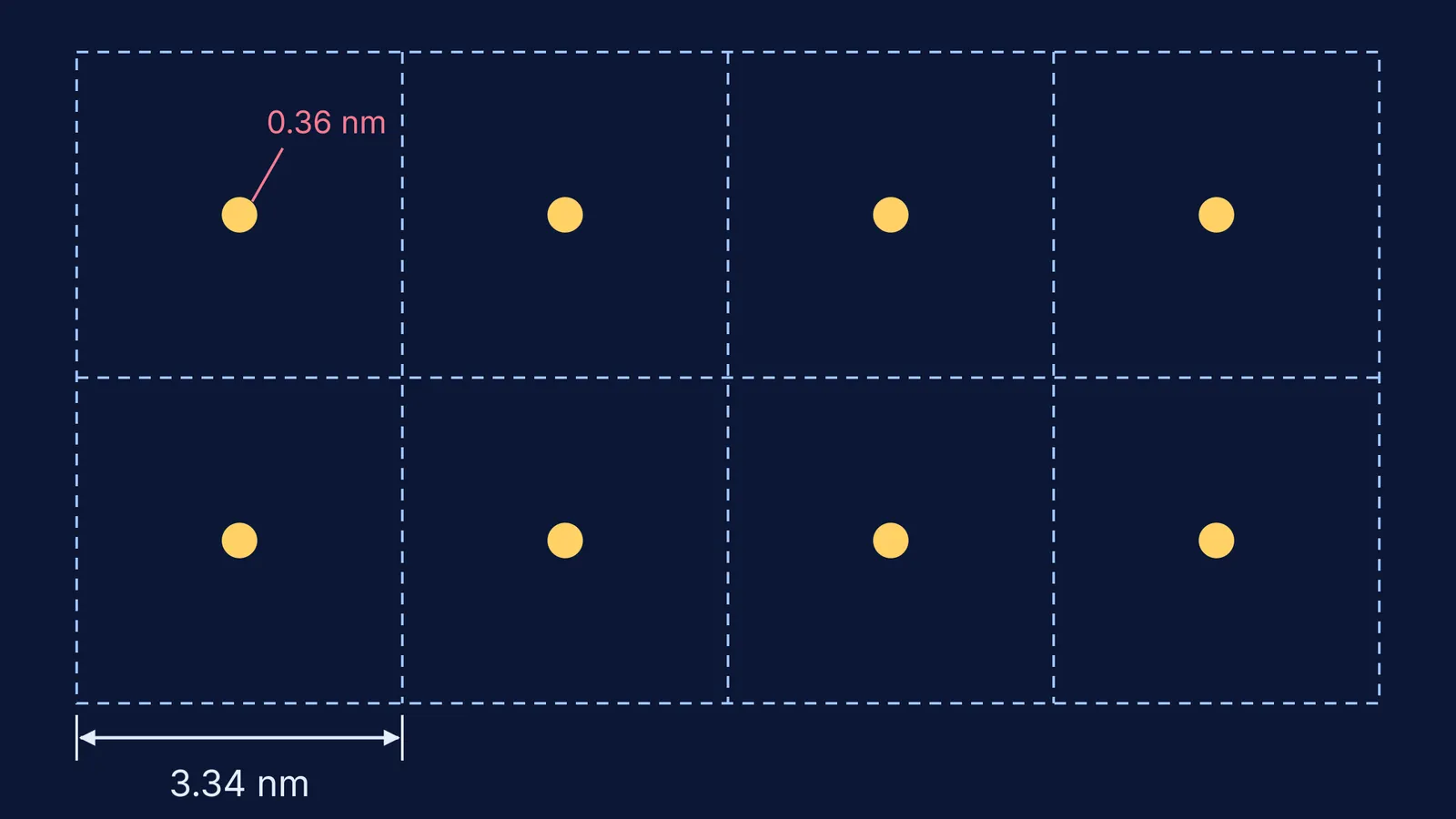
Share the space out evenly and each molecule gets 1/n of a cubic metre. Picture that share as a small cube. The side of the cube is the typical spacing:
Volume per molecule: 1 ÷ (2.687 × 10^25) = 3.72 × 10^-26 m³, about 37 nm³.
Side of the cube: the cube root of 37.2 nm³ is about 3.34 nm.
So the average distance between gas molecules at STP is about 3.3 nm, or 33 Å.
If your book uses the newer standard pressure of 100 kPa, NIST gives 2.651 645 804... × 10^25 per cubic metre (NIST, 100 kPa value), and the spacing becomes 3.35 nm. Which convention you use barely changes the answer.
You can also get there without the constant. NCERT's Class 11 kinetic theory chapter gives Avogadro's number as 6.02 × 10^23 and says that is the number of molecules in 22.4 litres of any gas at STP (NCERT Physics Part II, Chapter 12). Divide: 6.02 × 10^23 ÷ 0.0224 m³ = 2.69 × 10^25 per cubic metre, the same number.
How big is a gas molecule compared with that gap?
Kinetic diameter is a measure of how likely a gas molecule is to collide with another, so it is the size that matters here. Commonly quoted values are 364 pm for nitrogen and 346 pm for oxygen (kinetic diameter table). NCERT's exercise 12.1 uses a round 3 Å for oxygen (NCERT Chapter 12).
Now compare: 3.34 nm ÷ 0.364 nm ≈ 9, and 3.34 nm ÷ 0.3 nm ≈ 11. The spacing is about ten times a molecule's size. NCERT's "Points to ponder" makes a related point: at ordinary pressures and temperatures, the intermolecular distance in a gas is "only 10 times or so the interatomic distance in solids and liquids". The same chapter puts atoms in solids about 2 Å apart.
What fraction of a gas is empty space?
Ten times in length becomes a thousand times in volume. Treat NCERT's 3 Å oxygen molecule (NCERT Chapter 12) as a sphere: its volume is (π/6)d³ ≈ 0.0141 nm³. Multiply by 2.687 × 10^25 molecules per cubic metre (NIST) and the molecules themselves fill about 3.8 × 10^-4 of the space, roughly 0.04%. That is the estimate NCERT exercise 12.1 asks for, and it is why gas can be squeezed into a cylinder, as our post on why gases compress into LPG and CNG cylinders explains.
The same numbers give the mean free path, which NCERT writes as l = 1/(√2 n π d²). With d = 0.3 nm, l ≈ 93 nm, about 28 times the spacing. A molecule passes many neighbours before it hits one, because a collision needs two centres to come within one diameter of each other.
Is 3.3 nm the distance to the nearest molecule?
Not quite. The cube-root answer is a typical spacing, not the distance to your nearest neighbour, because gas molecules sit at random rather than on a grid. For an ideal gas, the mean nearest-neighbour distance is Γ(4/3) ≈ 0.893 times the Wigner-Seitz radius, the radius of a sphere holding one molecule's share of volume (mean inter-particle distance). The result goes back to Paul Hertz in 1909 (Mathematische Annalen). At STP that sphere has a radius of 2.07 nm, so the nearest molecule is on average about 1.85 nm away.
In textbook problems, the cube root of 1/n is the usual method; NCERT's Example 12.3 scales spacing the same way, as V^(1/3). All three numbers land in the same place: a few nanometres, or several molecular diameters.
A 60-second method you can reuse
Find n = P/(k_B T), or use 2.69 × 10^25 per cubic metre at STP (NIST).
Take 1/n for the volume per molecule.
Take the cube root for the spacing.
Divide by the molecular diameter (about 0.3 nm) for the ratio.
Cube the ratio to see how much of the gas is empty.
Since n follows P/T, spacing goes as (T/P)^(1/3). Double the pressure and the spacing shrinks only by the cube root of 2, about 1.26 times. Our post on the Boltzmann constant and the gas constant shows where k_B comes from, and counting the air molecules in a room uses the same n at the scale of a room.
If number density still feels shaky, the Fermi Concept Library gives each concept its own lesson and shows where it sits in the map. To practise the whole chain with new numbers, the Fermi Problem Library has worked problems with a step-by-step solver that explains the reasoning rather than printing an answer.


