

On this page
Auto-tune is software that nudges a singer's voice onto the right note. AutoTune was released on 19 September 1997 by Antares Audio Technologies and was developed by Andy Hildebrand, a PhD research engineer who specialised in stochastic estimation theory and digital signal processing (AutoTune, Wikipedia). The same page notes that Cher's 1998 single "Believe" was the first commercial recording to use it as a deliberate, robotic-sounding effect.
It does three jobs you can follow with school physics and logarithms: measure the pitch, pick the target note, shift the voice.
What is pitch, in physics terms?
Pitch is how your brain hears frequency: how many times a sound wave repeats each second, measured in hertz (Hz). A sung note is not one clean sine wave. It is a mix of many sine waves stacked together, the way adding sine waves can build a square wave, but the whole mix still repeats at one rate, called the fundamental frequency. That repeat rate is the note you hear, and inside your ear the cochlea sorts frequencies by place.
How does auto-tune detect the pitch of a voice?
It looks for the delay at which the signal best matches a copy of itself. This is called autocorrelation. Hildebrand's patent, US 5,973,252, granted in October 1999, says the pitch detection works by processing sampled sounds "according to auto-correlation function techniques".
Slide a copy of the waveform along the original. When the slide equals exactly one period, the peaks line up and the match is strongest. An A at 440 Hz repeats every 1/440 of a second, about 2.27 milliseconds, so its best match sits at a delay of 2.27 ms. Pitch is then 1 divided by that delay.
Plain autocorrelation still makes mistakes. The YIN method, published by Alain de Cheveigné and Hideki Kawahara in 2002, adds a number of modifications to autocorrelation that combine to prevent errors, and its authors report error rates about three times lower than the best competing methods, tested on a database of recorded speech (YIN, Journal of the Acoustical Society of America).
What are the frequencies of musical notes?
Western music today mostly uses equal temperament, which splits the octave into 12 equal semitones, each a frequency ratio of the 12th root of 2, about 1.05946 (Equal temperament). The reference note A4 is 440 Hz, a standard taken up by the International Organization for Standardization in 1955 and formalised in 1975 as ISO 16 (A440 pitch standard)).
That gives one formula for every piano key: f = 440 × 2^((n − 49)/12) Hz, where n is the key number and key 49 is A4 (Piano key frequencies). Middle C comes out at 261.63 Hz, A♯4 at 466.16 Hz and B4 at 493.88 Hz. Run it backwards and you get the number auto-tune needs: semitones away from A4 = 12 × log₂(f/440).
Worked example: where does a 450 Hz note go?
Say the detector measures your note at 450 Hz. Using the formula from the piano key table:
Semitones from A4: 12 × log₂(450/440) = 0.39.
Round to the nearest whole semitone: 0, so the target is A4 at 440 Hz.
Shift factor: 440/450 = 0.978, so the voice is lowered by about 2.2%.
Now try 455 Hz:
Semitones from A4: 12 × log₂(455/440) = 0.58.
Round: 1, so the target is A♯4 at 466.16 Hz.
Shift factor: 466.16/455 = 1.025, so the voice is raised by about 2.5%.
Five hertz decided which note you got. The halfway mark is 0.5 semitones: drift past it and auto-tune pulls you onto the neighbouring note instead. The patent describes this choice as taking "the period of a note from a musical scale that is closest to the input period", and the shift itself as resampling "at a new sample rate proportional to the desired change in pitch" (US 5,973,252).
Try it yourself: open a free tuner app that shows frequency in hertz, hum a note, read the frequency, and run the three steps above, then compare with the note the app names.
Why does auto-tune sometimes sound robotic?
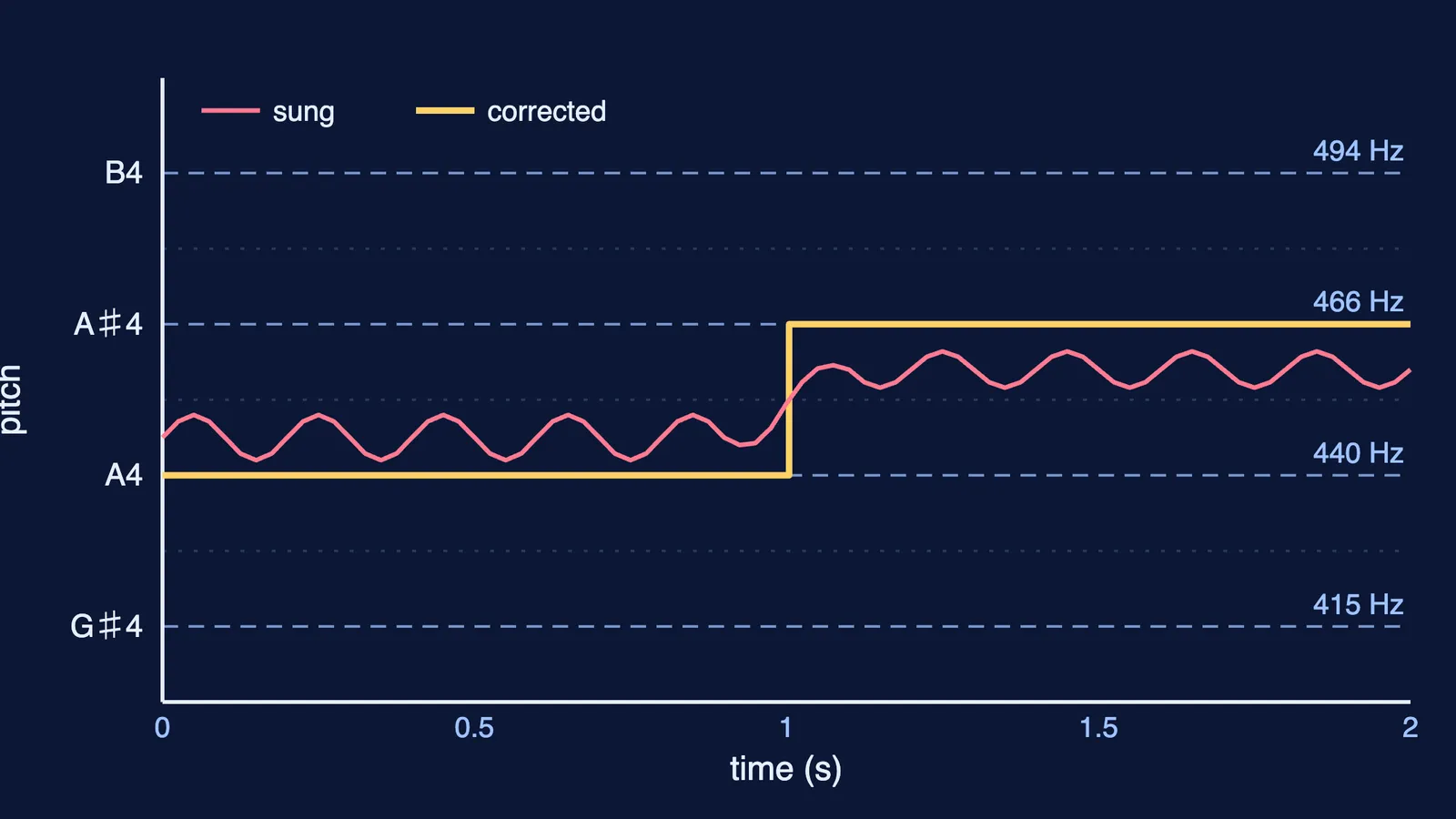
Because of how fast it snaps. The Antares AutoTune user guide says its Retune Speed control sets how rapidly correction is applied; at 0 milliseconds the pitch jumps instantly from note to note and vibrato is completely suppressed, which it calls best for the iconic effect, while 50 to 100 ms sounds more natural (AutoTune User Guide, Antares). The diagram above shows the instant version: the wobbly sung line becomes flat steps.
If the logarithm step is where you get stuck, Fermi's AI tutor works through problems like this alongside you, checking understanding as it goes. For ideas that are easier to see than to read, the Fermi Simulation Lab has interactive simulations.
Next, see what happens to the same voice after recording in how MP3 compression decides what to throw away.


